
Komatsu PC128UU-1 Hydraulic Pump: Reviving an Older Machine — Selection & Pitfall Guide


Author
JERY WANG
Guangzhou Rito Hydraulic Co.,Ltd., located in Guangzhou, China, is a leading manufacturer and distributor of hydraulic pumps, final drives, swing motors, and main control valves for earthmoving machinery. We supply genuine, OEM, and high-quality aftermarket parts.
We are committed to continuously sharing our expertise regarding construction machinery and excavator hydraulic systems. Our goal is to help you gain a deeper understanding of equipment principles and applications—enabling you to work more efficiently—while also showcasing our professional knowledge and capabilities. We invite you to learn more about us.
Choose us, and you will enjoy the best service, the most favorable prices, and the most reliable supplier!
Marie R. Winters


Quick Answer
On old machines, three things make selection harder than on a new one: part numbers get superseded, listings cross-reference numbers loosely, and rebuilds get described as new. This guide covers the five pitfalls that cost old-machine owners the most, then gives a five-step flow that ends in a confirmed number rather than a guess.
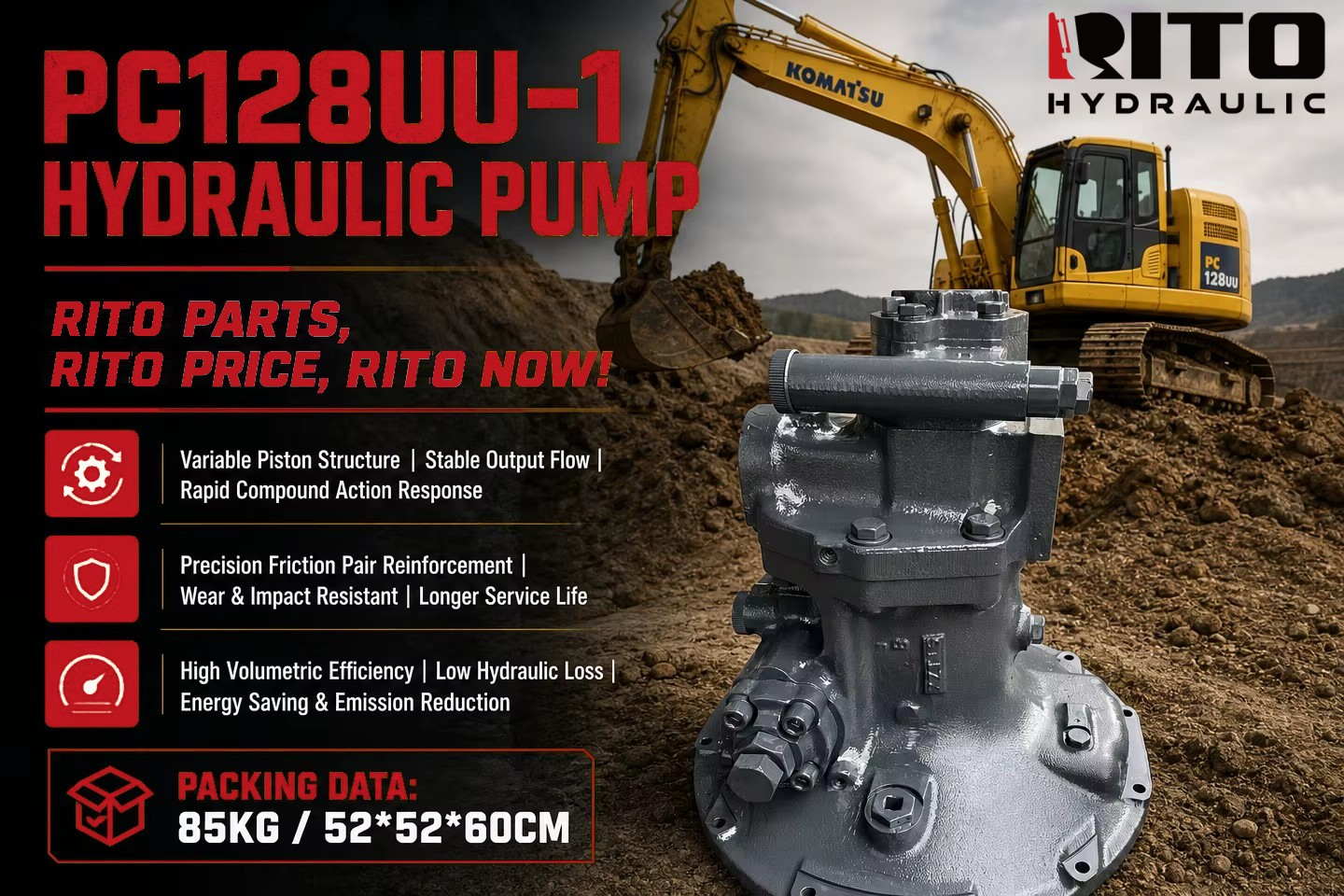
The pump itself is a manageable component: about 85 kg, packed 52 × 52 × 60 cm.
Key Takeaways
- Old machines are worth keeping — the obstacle is part identification, not the machine.
- On a legacy model, part numbers move: original, revised and replacement numbers can all be in circulation.
- Never order from a photo alone — use the plate code plus the machine serial.
- A neighbouring model's pump is not automatically compatible, however similar it looks.
- Flush the system and renew filters before fitting a new pump, or you will repeat the failure.
- New pump installed, still weak? The cause was probably never the pump — test before you buy.
Table of Contents
- 1. Why Reviving an Old Machine Makes Sense
- 2. The Machine: What PC128UU-1 Is
- 3. The Pump at a Glance
- 4. The Core Problem: Numbers Move
- 5. The Five Pitfalls
- 6. The Revival Selection Flow
- 7. The Parts That Fail Around a New Pump
- 8. How to Confirm the Right Pump
- 9. FAQ
- 10. Get Your Pump Confirmed
1. Why Reviving an Old Machine Makes Sense
An older excavator that still digs is a machine with no finance cost and known behaviour. For contractors in Africa, Southeast Asia, the Middle East and Latin America, keeping a PC128UU-1 working is often far cheaper than buying a replacement — and the machine is well suited to the tighter, lighter work these owners actually do.
What stops a revival from succeeding is rarely the machine. It is the parts problem: the model has been out of production for years, numbers have moved, and the market is full of listings that describe similar-looking parts as interchangeable. That gap between "a pump exists" and "the correct pump is identified" is where money is lost.
So this article is written around one idea: the revival succeeds or fails at the selection stage.
2. The Machine: What PC128UU-1 Is
| Aspect | Detail |
|---|---|
| Make and class | Komatsu PC128UU — a compact excavator in the 12–13 tonne bracket |
| "UU" | Denotes the urban / utility variant — a compact, tight-working machine rather than a heavy production digger |
| "-1" | The first generation of that model — an older machine by definition |
| Where they still work | Urban utilities, trenching, landscaping, small sites — and, in many markets, as a first or second machine |
Two of those points matter for buying parts. Because it is a compact machine, its pump is correspondingly smaller than a 20-tonne machine's — about 85 kg rather than 180–200 kg. And because it is a first-generation model, you are dealing with a machine whose original numbers may have been revised or replaced during its production life.
3. The Pump at a Glance
| Item | Detail |
|---|---|
| Application | Komatsu PC128UU-1 class, 12–13 tonne bracket |
| Type | Variable-displacement piston pump assembly |
| Weight | 85 kg |
| Packing | 52 × 52 × 60 cm |
| Design points | Variable piston structure with stable output flow and rapid compound-action response; reinforced precision friction pairs for wear and impact resistance; high volumetric efficiency with low hydraulic loss |
Those design points are also a checklist for a revival. On an old machine:
- "Stable output flow" is precisely what decades of wear degrades — which is why an old machine gets slow and weak rather than failing outright.
- "Precision friction pairs" are the surfaces that contamination attacks first. On a machine of this age, the oil's history matters as much as the pump's.
- "High volumetric efficiency" is what a rebuild has to reproduce. If it is not reproduced, you get a pump that looks new and performs like the old one.
Complete assemblies and the wider range are listed under Komatsu-series hydraulic parts.
4. The Core Problem: Numbers Move
On a current model you can often order by model name and be reasonably safe. On a legacy machine you cannot, for four ordinary reasons:
| Reason | What it means for a buyer |
|---|---|
| Production revisions | A pump specification could change during the model's life, so two machines of the same model can carry different builds |
| Supersession | The original number may have been replaced by a later one; both circulate in the market |
| Discontinued parts | Some original references are gone, so suppliers offer equivalents — which must be checked, not assumed |
| Loose cross-referencing | Sellers group numbers they consider interchangeable — that grouping is not the manufacturer's data |
This is not unique to Komatsu. It is simply how long-lived machines age. The same behaviour is easy to see on a much newer model — our guide to the PC200-8 pump part numbers shows three numbers in circulation for one machine, and that model is still recent. On a first-generation PC128UU-1 you should expect the same, only more so.
The practical consequence: on an old machine, the plate on the pump is not a formality — it is the only reliable starting point.
5. The Five Pitfalls
These are the five ways old-machine owners most often lose money. Each one is avoidable with a single question.
| # | Pitfall | How to avoid it |
|---|---|---|
| 1 | Ordering from a photo alone | Ask for the number on your plate to be matched — not for "one that looks like this" |
| 2 | Assuming a neighbouring model fits | Similar machines in the same family can differ in pump, control and mounting — confirm, don't assume |
| 3 | A rebuild sold as new | Ask what was replaced, and for a per-unit test report |
| 4 | New pump, dirty system | Flush and renew filters before fitting; debris from the old pump destroys the new one |
| 5 | Assuming the pump is at fault | Test pressure and flow first — a "weak" old machine may have a valve, control or engine problem |
Pitfall 4 and pitfall 5 are the expensive ones, because both produce a second failure rather than a first. A new pump put into a contaminated circuit will not survive its warranty period; and a pump replaced for a fault that was never hydraulic will make no difference at all. Our guide to why excavators still fail after a pump replacement describes the pattern in detail.
6. The Revival Selection Flow
Work through this in order. It takes an hour of preparation and removes most of the risk.
| Step | Action | Why it matters on an old machine |
|---|---|---|
| 1 | Read the plate on the existing pump | It records what the machine has actually been running, including any past substitution |
| 2 | Record the machine model and serial | The serial range is what separates one production revision from another |
| 3 | Have the number cross-checked for supersession | On legacy models the original reference may no longer be supplied |
| 4 | Confirm the pump is actually the fault | Pressure and flow test — an old machine has several ways to feel weak |
| 5 | Plan the revival as a package, not a part | Filters, seals and oil are part of the job, not extras |
Step 3 is the one unique to old machines, and step 5 is the one that determines whether the revival lasts. If you want the general matching method rather than the legacy-specific version, our 3-minute pump selection guide covers it for Komatsu and Hitachi machines generally.
7. The Parts That Fail Around a New Pump
An old machine rarely has one tired component. When you open the system, expect to find these as well:
| Item | Why it matters on a legacy machine |
|---|---|
| Suction strainer | Often original and restricted; starving a new pump damages it quickly |
| Return filter | A saturated or bypassing filter stops protecting the system |
| Suction hoses and seals | Hardened, cracked hoses admit air — which looks exactly like a failing pump |
| Hydraulic oil | Unknown history on a used machine; replace it rather than inherit it |
| Cooler and breather | A restricted cooler keeps oil hot, and heat is what killed the old pump |
Budget for these at the same time as the pump. On a revival, the peripheral items are what decide whether the new pump lasts — and they are inexpensive compared with doing the job twice. Complete assemblies sit alongside these in the wider excavator hydraulic parts range.
8. How to Confirm the Right Pump
- Photograph the pump plate straight-on and in focus — the whole plate, not just the model line.
- Photograph the pump from two or three angles, including the ports, the regulator and the mounting flange.
- Send the machine model and serial number. On a first-generation machine the serial is essential.
- Say what the machine is doing — weak, hot, noisy, slow, or stopped. Symptoms help a supplier sanity-check the part.
- Ask specifically about supersession, and whether the current supply number differs from the one on your plate.
Give a supplier those five things and the uncertainty disappears. Without them, the best anyone can offer is an educated guess — and on old machines that is how wrong pumps get sold.
9. FAQ
Q1: Is it worth repairing an old PC128UU-1?
Usually yes. The machine is already paid for, and its compact size suits a lot of work. Cost, downtime and part availability should decide between repairing and replacing components, not the machine's age by itself.
Q2: How do I find the right pump for an older machine?
Start from the plate on the pump and the machine serial number, then have the number cross-checked for supersession. On legacy models this is the only reliable route.
Q3: The number on my pump is obsolete — now what?
Obsolete references are common on first-generation machines. A supplier holding the parts data can identify the current replacement; do not simply accept whatever a listing claims is "equivalent".
Q4: Can I use a pump from a different Komatsu model?
Only if the number cross-reference confirms it. Similar-looking machines in the same family can have different pumps, controls and mountings.
Q5: How heavy is the PC128UU-1 pump?
About 85 kg, packed in a 52 × 52 × 60 cm case — lighter than a 20-tonne machine's pump, and manageable with ordinary lifting equipment.
Q6: I fitted a new pump and the machine is still weak — why?
Because the original fault may not have been the pump. A restricted suction line, worn valve, control setting or engine problem can all make an old machine feel weak — and none is cured by a new pump.
Q7: What should I replace at the same time as the pump?
At minimum: the suction strainer, return filter, hydraulic oil and any hardened suction hoses. Check the cooler and breather as well.
Q8: How do I know if a pump is new or rebuilt?
Ask directly, and ask for a per-unit test report and a written warranty. A rebuild is a legitimate product — a rebuild described as new is not.
Q9: Does an old machine need a different oil?
Use the grade specified for your machine. Old machines are often running on an inherited oil of unknown history, which is a reason to change it rather than to deviate from the specification.
Q10: What should I send to get a quotation?
Machine model, machine serial number, a photograph of the pump plate, two or three photos of the pump, and a description of the symptoms.
10. Get Your Pump Confirmed
Send us your machine model, serial number and the pump plate code — plus a few clear photos — and our team will confirm the correct pump, flag any supersession and quote lead time the same day. RITO HYDRAULIC supplies complete, individually tested main pumps, control valves, travel motors and swing motors for Komatsu, Hitachi, Kobelco, Caterpillar, Hyundai, Doosan and Kawasaki-series machines, including many legacy models — with export packing and a 6–12 month warranty.
Contact our team or learn more about RITO HYDRAULIC.
- CAT 330GC Final Drive — Which Part Number Fits and What Should You Check Before You Buy?
- Why Do Customers Need the TM40 Travel Assembly? When It Is Used, What It Does, and What It Changes
- Komatsu PC300-8 / PC350-8 Hydraulic Pump: Which 708-2G Number Fits, and Why PC300-7 Numbers Keep Appearing
- Why Does a CAT 320C / 320D Hydraulic Pump Lose Power Under Heavy Load?
- Why Does Your CAT 312C Need the SBS80 Hydraulic Pump?