
Hitachi ZX870-3 Travel Device Explained: Complete Unit vs Gearbox, Fitment and Oil Care


Author
JERY WANG
Guangzhou Rito Hydraulic Co.,Ltd., located in Guangzhou, China, is a leading manufacturer and distributor of hydraulic pumps, final drives, swing motors, and main control valves for earthmoving machinery. We supply genuine, OEM, and high-quality aftermarket parts.
We are committed to continuously sharing our expertise regarding construction machinery and excavator hydraulic systems. Our goal is to help you gain a deeper understanding of equipment principles and applications—enabling you to work more efficiently—while also showcasing our professional knowledge and capabilities. We invite you to learn more about us.
Choose us, and you will enjoy the best service, the most favorable prices, and the most reliable supplier!
Marie R. Winters


Quick Answer
There are two things worth understanding before you buy. First, you can buy the function at two levels — the complete travel device, or the travel gearbox (the reduction) on its own. Second, the oil in that unit is the most neglected item on a machine like this, and it is the cheapest thing you will ever do to extend its life.
Key Takeaways
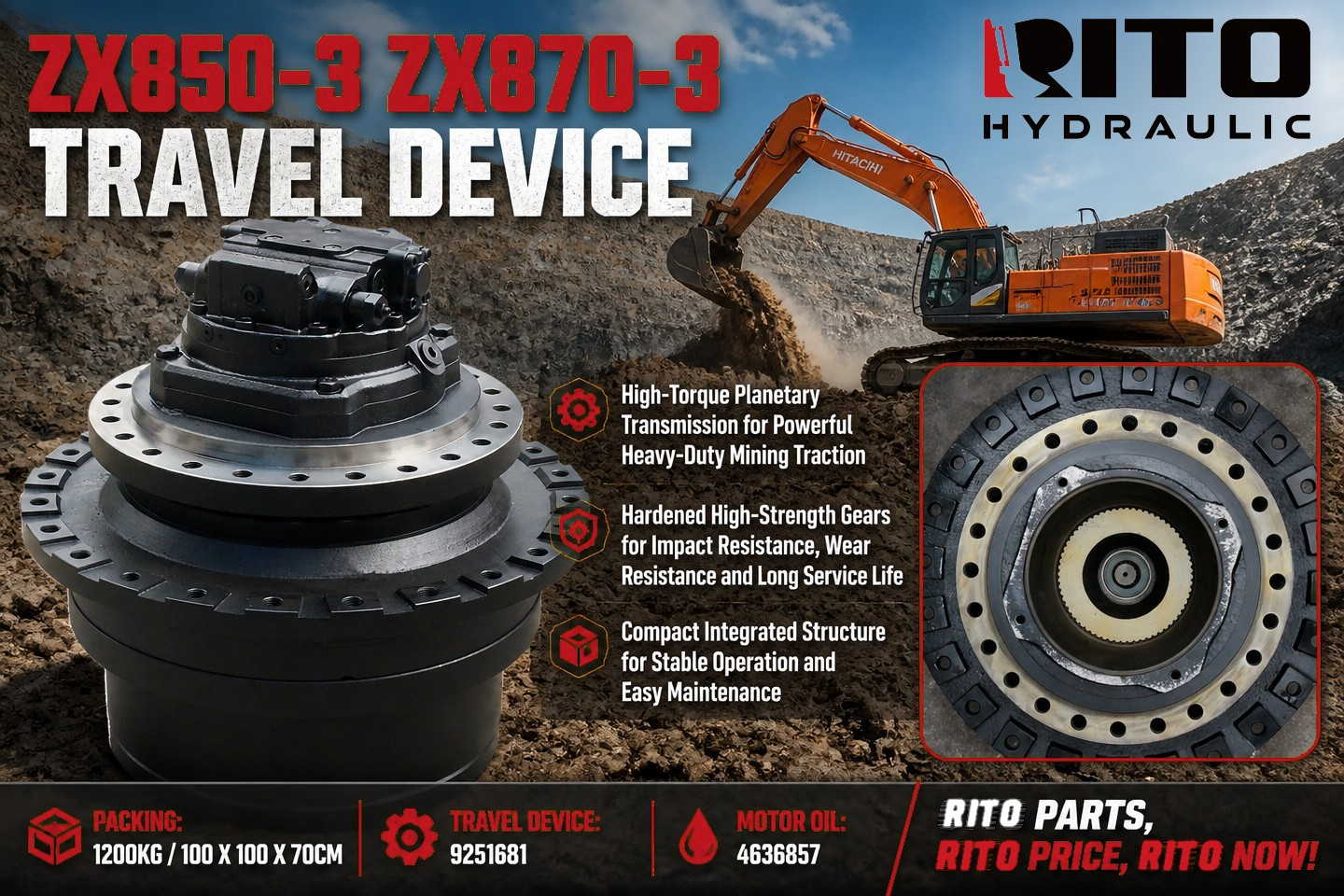
- Travel device 9251681 covers the ZX850-3 and ZX870-3 class — the complete assembly, not just a motor.
- The travel gearbox is the reduction portion; it can be supplied separately from the complete device.
- The assembly is a 1,200 kg component — 100 × 100 × 70 cm — so lifting and freight are part of the plan.
- This unit has its own lubricant sump; the specified oil is listed under 4636857.
- Planetary reductions are built for shock loading and heavy mining traction — which is exactly why they demand the right oil at the right level.
- Diagnosing whether the fault is the gearbox or the complete device is a separate subject — see the diagnostic guide linked below.
Table of Contents
- 1. The Product at a Glance
- 2. One Function, Two Ways to Buy It
- 3. What Is Inside a Travel Device
- 4. Fitment: ZX850-3 and ZX870-3
- 5. Built for Mining Duty
- 6. The Oil Is Not a Detail
- 7. How to Confirm the Right Unit
- 8. FAQ
- 9. Get Your Travel Unit Confirmed
1. The Product at a Glance
| Item | Detail |
|---|---|
| Application | Hitachi ZX850-3 and ZX870-3 class excavators |
| Travel device number | 9251681 |
| Type | Complete travel device — hydraulic motor, brake and planetary reduction |
| Weight | 1,200 kg |
| Packing | 100 × 100 × 70 cm |
| Specified oil | Listed under 4636857 |
| Design points | High-torque planetary transmission for heavy-duty mining traction; hardened high-strength gears for impact and wear resistance; compact integrated structure for stable operation and easy maintenance |
Complete units for this family are listed under Hitachi-series hydraulic parts.
2. One Function, Two Ways to Buy It
"Travel device" and "travel gearbox" are not two names for one thing. They are two levels of the same function:
| Level | What you receive | When it is the right choice |
|---|---|---|
| Complete travel device (9251681) | Motor, parking brake and planetary reduction as one assembly | When the motor is also suspect or worn, when you need the machine back quickly, or when contamination has spread |
| Travel gearbox (reduction) | The planetary reduction alone — no motor, no hydraulics | When the motor has been proven good and the fault is mechanical: noise, binding or metal in the gear oil |
Getting this layer right is the difference between a repair and a repeat purchase. If the motor is worn and you fit only a gearbox, the new reduction is being driven by a tired motor — and the second failure usually arrives sooner than the first.
Deciding which level is faulty is a diagnostic question rather than a product question, and it deserves its own method. Our companion guide to the EX1200-6 travel system walks through that triage — separating hydraulic from mechanical, then gearbox from complete device, then repair from replace. This article covers the product itself: what it is, what it fits, and how to keep it alive.
3. What Is Inside a Travel Device
Three sections, three jobs, three different failure signatures. Knowing which is which is what makes a travel conversation productive.
| Section | Job | How it announces trouble |
|---|---|---|
| Hydraulic motor | Turns oil flow and pressure into rotation | Weak travel, heat, rising case-drain flow |
| Parking brake | Holds the machine when travel is not commanded | Will not release, drags, or slips on a slope |
| Planetary reduction | Converts fast, low-torque rotation into slow, very high torque at the sprocket | Noise that rises with speed, binding, metal in the oil |
The practical rule that comes out of that table: a hydraulic fault makes the machine weak; a mechanical fault makes it noisy. Neither one is a good reason to order a part before testing — and if you are not sure which component you need at all, our travel motor fitment guide covers the matching process step by step.
It is also worth remembering that a travel unit is not isolated. The same oil that lubricates this device arrives from the same tank that feeds everything else. When a travel unit fails and sheds debris, that debris travels — which is why a travel failure is rarely just one part.
4. Fitment: ZX850-3 and ZX870-3
| Machine | Note |
|---|---|
| Hitachi ZX850-3 | The smaller of the two applications in this family |
| Hitachi ZX870-3 | The larger — a mining-class machine where travel duty is severe |
This is a useful reminder about how hydraulics are specified. Two different machine models in the same generation can share one travel device, because the travel duty — not the bucket size — is what the final drive has to carry. That is why the same unit serves both, and it is also why you should not assume the reverse: a machine that looks similar to a ZX870-3 is not automatically on the same travel unit.
Confirm with the machine's own part number and serial range. Generation matters too: the "-3" in the model name identifies the series, and travel components can differ between series even where the machine size is close.
5. Built for Mining Duty
| Design point | What it means where the machine works |
|---|---|
| High-torque planetary transmission | Moving a machine of this size up a grade or through soft ground takes enormous torque at the sprocket, delivered slowly and steadily |
| Hardened high-strength gears | Mining travel is shock loading, not steady running — every rock under a track is an impact, and the gear set has to absorb it |
| Compact integrated structure | Fewer external joints, a stable assembly, and servicing that is easier than it looks from the outside |
Two consequences follow for the owner. First, this is a 1,200 kg component packed in a 100 × 100 × 70 cm case — the logistics are part of the job, so plan lifting at both ends and allow for heavy freight. Second, the loads described above generate heat and metal in the lubricant. That is the bridge to the next section.
6. The Oil Is Not a Detail
Why this is the highest-value maintenance item on a mining excavator's final drive:
| Check | Why it matters |
|---|---|
| Level | Too low starves the gears; too high can cause aeration and overheating. A slow leak often shows as a stain around the unit long before anything fails |
| Condition | Metal or glitter in the drained oil is the earliest reliable warning of gear or bearing damage — and it is free information |
| Water ingress | Milky oil means a seal has let water in — common on machines that work in wet conditions |
| Interval | The lubricant degrades with heat and load; a mining machine reaches those conditions far faster than a utility machine |
| Seals and breather | A blocked breather raises internal pressure and pushes oil past the seals |
The uncomfortable truth about big final drives is this: the oil is checked least often on the machines where it matters most. A gearbox that fails from a long-ignored oil level fails for a reason that cost almost nothing to prevent — and on a 1,200 kg assembly, the difference between a routine oil change and a replacement unit is enormous. Complete assemblies and the wider range are listed under excavator hydraulic parts.
7. How to Confirm the Right Unit
- Read the identification on the existing travel unit. Photograph the plate or stamped number on the housing, straight-on and in focus.
- Record the machine model and serial number. The serial range confirms the build.
- State which level you need — the complete travel device (9251681) or the travel gearbox alone — and ask for it to be verified.
- Note which side of the machine it is, and whether both sides are identical.
- Send your findings from the oil — level, condition, any metal or water. It is the cheapest diagnostic evidence you can provide, and it helps confirm both the part and the diagnosis.
8. FAQ
Q1: What is the Hitachi ZX870-3 travel device?
It is the complete final drive assembly — hydraulic motor, parking brake and planetary reduction in one unit — fitted to the ZX870-3 and ZX850-3 class. It is listed under the travel device number 9251681.
Q2: Does the same travel device fit the ZX850-3 as well?
Yes — 9251681 is listed for both the ZX850-3 and ZX870-3. Confirm against your own machine's part number and serial range before ordering.
Q3: What is the difference between the travel device and the travel gearbox?
The travel device is the complete assembly including the hydraulic motor, brake and reduction. The travel gearbox is just the reduction — no motor, no hydraulics. They are bought at different levels and used in different situations.
Q4: Can I replace only the gearbox?
Yes, provided the motor has been proven good by testing. Fitting a new gearbox to a worn motor usually means repeating the job sooner than expected.
Q5: What oil does this travel device use?
The specified oil is listed under 4636857. Confirm the exact grade and quantity against your machine's specification, and check level and condition regularly.
Q6: How often should the travel gearbox oil be checked?
Treat it as a routine item rather than a rebuild item — check the level and condition on a regular service basis, and drain a sample for inspection. Metal or milky oil is a warning worth acting on immediately.
Q7: How heavy is the complete travel device?
About 1,200 kg, packed in a 100 × 100 × 70 cm case. Plan rated lifting equipment and heavy freight.
Q8: What are the signs that the travel unit is failing?
Weak or uneven travel, drifting on slopes, one track lagging, noise that rises with speed, heat, and metal in the lubricant. Weakness points to the hydraulic side; noise and debris point to the mechanical side.
Q9: Should I flush the system after a travel failure?
Yes. Flush the circuit, renew filters, and check the rest of the hydraulic system for debris — contamination from a failed unit does not stay where it started.
Q10: What should I send to get a quotation?
Machine model and serial number, the identification from the existing travel unit, which side it is, which level you need (device or gearbox), and your findings from the oil.
9. Get Your Travel Unit Confirmed
Send us your machine model, serial number and the identification from the travel unit — plus photos and your oil findings — and our team will confirm whether you need the complete travel device (9251681) or the travel gearbox, flag any supersession, and quote lead time the same day. RITO HYDRAULIC supplies complete, individually tested travel devices, travel gearboxes, main pumps, control valves and swing motors for Hitachi, Komatsu, Caterpillar, Kobelco, Hyundai, Doosan and Kawasaki-series machines — with export packing and a 6–12 month warranty.
Contact our team or learn more about RITO HYDRAULIC.
Related reading: travel motor vs swing motor.
- CAT 330GC Final Drive — Which Part Number Fits and What Should You Check Before You Buy?
- Why Do Customers Need the TM40 Travel Assembly? When It Is Used, What It Does, and What It Changes
- Komatsu PC300-8 / PC350-8 Hydraulic Pump: Which 708-2G Number Fits, and Why PC300-7 Numbers Keep Appearing
- Why Does a CAT 320C / 320D Hydraulic Pump Lose Power Under Heavy Load?
- Why Does Your CAT 312C Need the SBS80 Hydraulic Pump?