
How to Match a Hydraulic Pump to Your Komatsu or Hitachi Excavator: The 3-Minute Selection Guide (2026)


Author
JERY WANG
Guangzhou Rito Hydraulic Co.,Ltd., located in Guangzhou, China, is a leading manufacturer and distributor of hydraulic pumps, final drives, swing motors, and main control valves for earthmoving machinery. We supply genuine, OEM, and high-quality aftermarket parts.
We are committed to continuously sharing our expertise regarding construction machinery and excavator hydraulic systems. Our goal is to help you gain a deeper understanding of equipment principles and applications—enabling you to work more efficiently—while also showcasing our professional knowledge and capabilities. We invite you to learn more about us.
Choose us, and you will enjoy the best service, the most favorable prices, and the most reliable supplier!
Marie R. Winters


Quick Answer
Key Takeaways
- Five matching points: model/serial, displacement, control type, mounting & spline, ports.
- Read two plates: the machine plate and the pump nameplate — photograph both.
- Komatsu and Hitachi pump numbers live in different families — the plate is the truth, the model name is not.
- The control variant (load-sensing vs negative control) is the most common mismatch.
- A pump that looks identical can still be the wrong one internally.
- Send model + serial + plate photos together — that is the whole "3 minutes".
Table of Contents
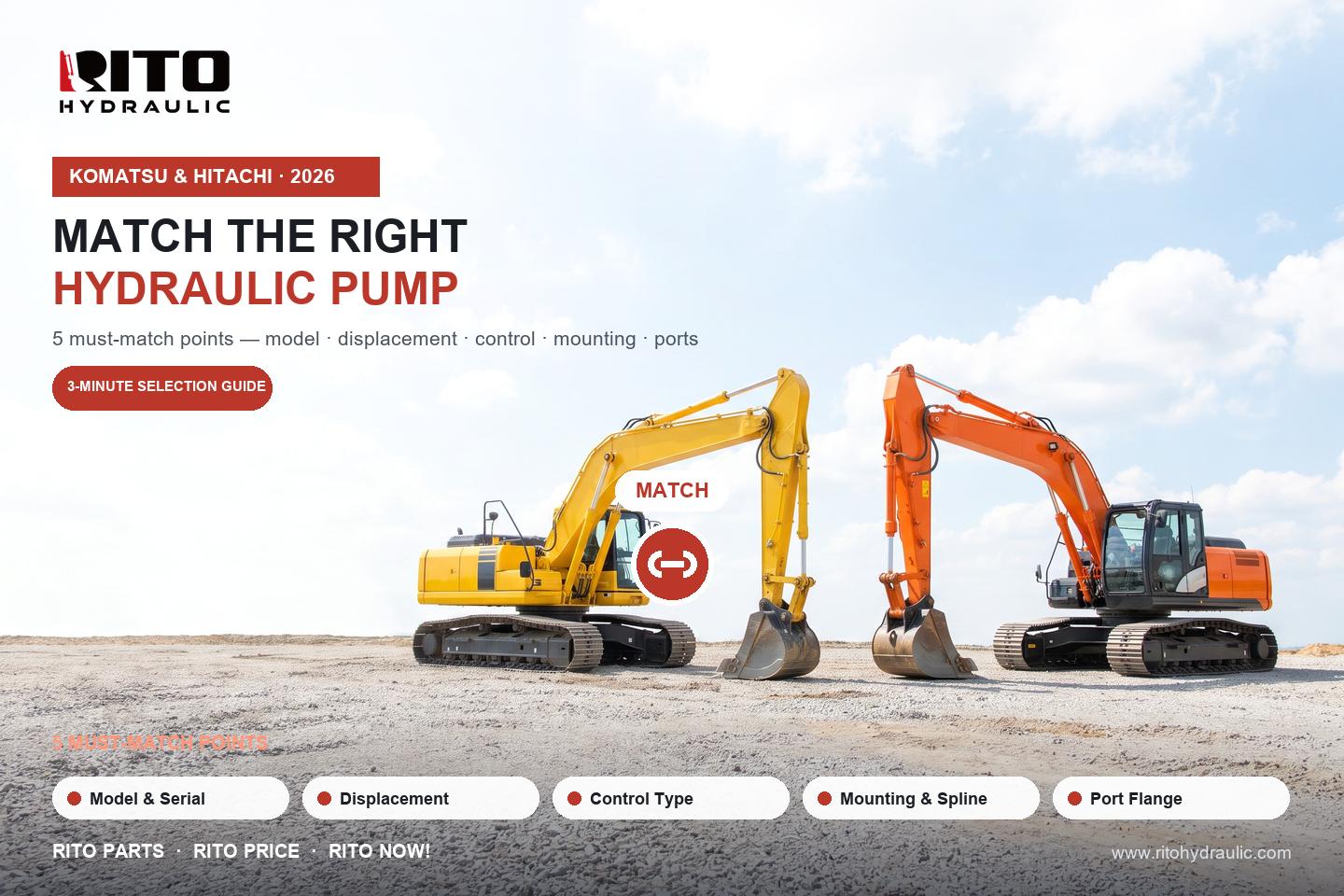
- 1. The 5 Things That Must Match
- 2. Read These Two Plates
- 3. Komatsu vs Hitachi: Where the Numbers Live
- 4. The Control-Variant Trap
- 5. The 3-Minute Matching Checklist
- 6. Mistakes That Cause a Wrong Order
- 7. FAQ
- 8. Get the Right Pump
1. The 5 Things That Must Match
Every correct pump order comes down to these five items. Miss any one and the pump can be wrong even if it "looks right".
| # | Must match | Where to find it |
|---|---|---|
| 1 | Machine model + serial | Machine plate (cab / frame) |
| 2 | Pump displacement | Pump nameplate |
| 3 | Control type | Old pump / machine manual |
| 4 | Mounting & spline | Flange and drive (photo) |
| 5 | Port layout | Old pump (photo) |
2. Read These Two Plates
Ninety percent of correct matching happens at two places on the machine:
- The machine plate. Gives the exact model (e.g., "PC210-8" or "ZX200-3") and the serial number. The serial range often decides which pump variant was fitted at the factory.
- The pump nameplate. Gives the pump model and part number. This is the single most reliable piece of information.
Clean both plates, photograph them straight-on and in focus, and add two or three shots of the pump itself (flange, ports, spline). That is the complete package.
3. Komatsu vs Hitachi: Where the Numbers Live
Komatsu and Hitachi identify pumps differently, which is why a model name alone rarely gives you the pump:
- Komatsu. Pump part numbers commonly sit in a defined numbering family printed on the pump plate. Two machines of the same model and different build periods can carry different pump numbers — so the serial number matters.
- Hitachi. Hitachi pumps frequently carry their own pump-series designation (for example HPV / HPK-style codes) on the nameplate, alongside the machine part number.
In both cases the rule is the same: the plate is the truth, the model name is only the start. This is exactly why our other guides on matching Komatsu parts and Hitachi parts both begin with the nameplate.
4. The Control-Variant Trap
This is the number-one cause of a wrong pump. The same physical pump body may be built with different control arrangements — for example load-sensing or negative control — plus different pressure and regulator settings.
Fit the wrong control variant and the machine will behave wrongly: slow or jumpy functions, poor response, or overheating. So when you order, always state the control type of your original pump, or send the plate photo that shows it. If you are unsure, ask the supplier to confirm from the photos rather than guess.
5. The 3-Minute Matching Checklist
- Photograph the machine plate (model + serial). — 30 sec
- Photograph the pump nameplate (pump model + part number). — 30 sec
- Photograph the pump: flange, ports and spline. — 60 sec
- Note the control type (load-sensing / negative control) and the machine's travel — if you know it. — 30 sec
- Send all of it with your shipping requirement (sea or air, destination). — 30 sec
With those five items, a verified supplier can confirm the correct pump, provide a per-unit test report and quote lead time the same day. Without them, every quote you get is an approximation.
6. Mistakes That Cause a Wrong Order
| Mistake | Consequence |
|---|---|
| Ordering by model name only | Wrong pump number for that build |
| Skipping the control variant | Poor control, heat, repeat repair |
| Judging by a photo of the outside | Internally different pump inside a look-alike body |
| Ignoring the serial number | Mid-series build differences missed |
| Not flushing the system | Debris destroys the new pump |
Every one of these is avoided by the same habit: photograph the plates and send them with the machine details.
7. FAQ
Q1: How do I find the right hydraulic pump for my Komatsu excavator?
Read the pump nameplate for the pump model and part number, plus the machine plate for the model and serial number, then send photos of both. The serial range helps confirm the correct build variant.
Q2: How do I match a pump for a Hitachi excavator?
The same way: Hitachi pumps usually carry a pump-series code on the nameplate (HPV / HPK-style) alongside the machine part number. Photograph the nameplate and send it with the machine model and serial.
Q3: What are the five things that must match?
Machine model and serial number, pump displacement, control type, mounting and spline, and port layout.
Q4: Why does the serial number matter?
Manufacturers can change the fitted pump during a production run. Two machines of the same model and different serial ranges may use different pump numbers.
Q5: What is a "control variant"?
The way the pump regulates flow and pressure — for example load-sensing or negative control, with specific settings. It must match your original pump or the machine will not perform correctly.
Q6: Can I order just from a photo of my old pump?
A photo helps, but it is not enough on its own. Always add the pump nameplate number and the machine model and serial number, because look-alike pumps can differ internally.
Q7: What photos should I send?
The machine plate, the pump nameplate (straight-on and in focus), and two or three shots of the pump covering the mounting flange, ports and spline.
Q8: How long does a correct match take?
The photographs take about three minutes. With them, a verified supplier can usually confirm the correct pump the same day.
Q9: Should I replace the pump alone or the whole assembly?
If only the pump is worn, the pump can be replaced. If the drive coupling or related components are also worn, a complete tested assembly is the safer choice. Confirm from the old unit's condition.
Q10: What about flushing the system?
Always flush and replace the return filter and suction strainer when you fit a new pump — debris from the failed pump will otherwise damage the new one.
8. Get the Right Pump
RITO HYDRAULIC supplies complete, individually tested main pumps, swing motors, travel motors and control valves for Komatsu, Hitachi, Caterpillar, Hyundai, Kobelco, Doosan and Kawasaki / Rexroth-series machines — with per-unit test reports, export packing and a 6–12 month warranty.
Send your machine model, serial number and pump-plate photos, and we will confirm the correct pump and lead time the same day. Contact our team or learn more about RITO HYDRAULIC.
- CAT 330GC Final Drive — Which Part Number Fits and What Should You Check Before You Buy?
- Why Do Customers Need the TM40 Travel Assembly? When It Is Used, What It Does, and What It Changes
- Komatsu PC300-8 / PC350-8 Hydraulic Pump: Which 708-2G Number Fits, and Why PC300-7 Numbers Keep Appearing
- Why Does a CAT 320C / 320D Hydraulic Pump Lose Power Under Heavy Load?
- Why Does Your CAT 312C Need the SBS80 Hydraulic Pump?