
New Hydraulic Pump, Same Problem? Why Excavator Pumps Fail After Replacement (Hitachi ZX40 / ZX50 Guide, 2026)


Author
JERY WANG
Guangzhou Rito Hydraulic Co.,Ltd., located in Guangzhou, China, is a leading manufacturer and distributor of hydraulic pumps, final drives, swing motors, and main control valves for earthmoving machinery. We supply genuine, OEM, and high-quality aftermarket parts.
We are committed to continuously sharing our expertise regarding construction machinery and excavator hydraulic systems. Our goal is to help you gain a deeper understanding of equipment principles and applications—enabling you to work more efficiently—while also showcasing our professional knowledge and capabilities. We invite you to learn more about us.
Choose us, and you will enjoy the best service, the most favorable prices, and the most reliable supplier!
Marie R. Winters


Quick Answer
Key Takeaways
- A pump rarely fails on its own — on a compact machine it is usually a victim of its oil and its circuit.
- The single most common cause of an "early" failure is not flushing the system before fitting the new pump.
- Reusing old oil and filters is a false economy — the old filter holds the debris you are trying to remove.
- A leaking suction line causes cavitation, which erodes internal parts within hours, not months.
- Wrong oil grade, wrong regulator setting and drive misalignment each shorten life measurably.
- Follow a first-start sequence (flush, fill, prime, check, monitor) — it costs an hour and protects a 35 kg pump.
Table of Contents
- 1. The Most Expensive Repair Is the Second One
- 2. ZX40 / ZX50 Pump at a Glance
- 3. The 8 Reasons a New Pump Fails Early
- 4. Contamination: The Number One Killer
- 5. Suction-Side Mistakes and Cavitation
- 6. Setting, Alignment and First-Start Mistakes
- 7. Your First-Start Checklist
- 8. Before You Buy
- 9. FAQ
- 10. Get a Correct-Fit ZX50 Pump
1. The Most Expensive Repair Is the Second One
There is a scenario every mini excavator owner dreads: the pump fails, you buy a new one, the machine works for a few weeks — and then it fails again, with the same symptoms. The second repair costs far more than the first, because you have paid for a pump, labour and downtime twice.
The hard truth is that a hydraulic pump is rarely the villain in its own failure. On a Hitachi ZX40U / ZX50U, it is usually the victim of the oil and the circuit around it. Change the oil quality and the installation discipline, and the same pump that died at 2,000 hours can run for 8,000. This guide covers the mistakes that kill a new pump early — the ones that never make it into the parts catalogue. If you are sourcing Hitachi excavator parts, read this before you install.
2. ZX40 / ZX50 Pump at a Glance
| Parameter | Specification |
|---|---|
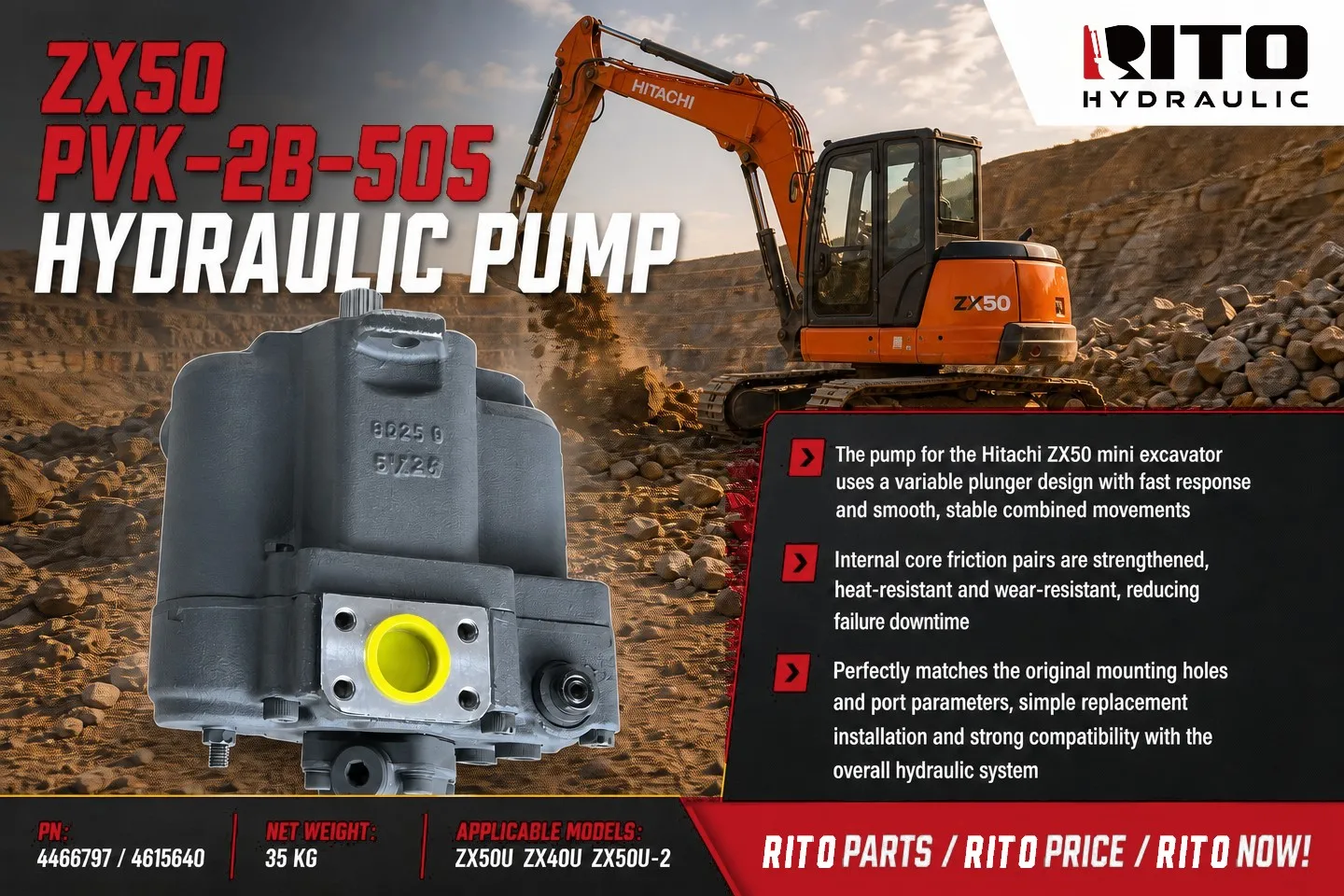
| Pump model | PVK-2B-505 |
| Applicable models | Hitachi ZX50U, ZX40U, ZX50U-2 |
| Part numbers | 4466797 / 4615640 |
| Type | Variable plunger main pump — fast response, smooth combined movements |
| Net weight | 35 kg |
| Mounting | Original mounting holes & port parameters — direct replacement |
3. The 8 Reasons a New Pump Fails Early
| Mistake | What happens |
|---|---|
| 1. No system flush | Old debris circulates and scores the new plungers and valve plate |
| 2. Reused oil & filters | Contaminated oil re-introduces the particles you removed |
| 3. Leaking suction line | Air ingress causes cavitation and rapid internal erosion |
| 4. Wrong oil grade | Too thick = friction heat; too thin = internal leakage and heat |
| 5. Wrong regulator setting | Over-pressure or unstable control shortens life and hurts performance |
| 6. Drive misalignment | Spline and bearing wear; vibration and seal damage |
| 7. Clogged oil cooler | High oil temperature accelerates oil degradation and wear |
| 8. No first-start bleed | Dry running on start-up damages the pump in the first minutes |
Almost all of these are within the owner's control — and almost all cost far less to prevent than a second pump.
4. Contamination: The Number One Killer
When a pump fails, it sheds metal into the oil. That debris does not disappear when you unbolt the old pump — it sits in the tank, the hoses and the cooler, waiting to destroy the new one. This is why the flush matters more than any other single step.
Do it properly:
- Drain and flush the system before fitting the new pump — do not skip straight to installation.
- Replace the return filter and suction strainer at the same time. The old return filter holds the contamination you are trying to remove.
- Fill with fresh oil of the correct grade — never top up with the strained old oil.
- Inspect the old filter element. Cutting it open and looking for metal tells you whether the damage is isolated to the pump or spread through the circuit.
Debris also reaches downstream components. If metal is present, check the control valve and swing and travel motors before the machine goes back to work.
5. Suction-Side Mistakes and Cavitation
Cavitation is the silent killer of new pumps. If the pump cannot draw oil freely, it pulls a partial vacuum, oil vapour bubbles form, and they collapse violently against the internal surfaces — eroding plungers, valve plate and bearings within hours of running.
The usual causes are all on the suction side:
- A loose or cracked suction hose letting air in (often after the hose was disturbed during the swap).
- A clogged suction strainer that was not replaced.
- Low oil level or the wrong oil viscosity at cold start.
- A leaking suction flange or O-ring that seals under pressure but leaks under vacuum.
Symptoms of cavitation are a distinctive whine or rattle from the pump and aeration (foam) in the tank. If you hear it, stop the machine and fix the suction side before continuing.
6. Setting, Alignment and First-Start Mistakes
- Regulator / control setting. Confirm the load-sensing and pressure settings match the machine's specification. A setting copied from a different machine can over-pressure the pump or cause unstable, jerky movement.
- Drive coupling alignment. The pump must sit square to the drive. Misalignment wears the spline and bearings and produces vibration that damages seals.
- Bleed before load. Fill the pump case with clean oil and let the system prime at idle before applying load — never run it dry "just for a moment".
- Cooler and ventilation. Clean the oil-cooler fins and confirm airflow; a compact machine with a blocked cooler runs hot from day one.
7. Your First-Start Checklist
- 1. Flush the system; replace the return filter and suction strainer.
- 2. Fill with fresh, correct-grade hydraulic oil.
- 3. Confirm the suction line, flanges and O-rings are airtight.
- 4. Verify the regulator / pressure setting against the machine spec.
- 5. Prime the pump case; start at idle and let it bleed.
- 6. Run light functions first, watch the temperature and listen for cavitation, then return to full load.
8. Before You Buy
Installation discipline protects the pump you already have; the other half of the equation is buying a sound unit in the first place. Three checks that pay for themselves:
- Confirm the exact fit — model, mounting holes and port parameters must match the PVK-2B-505 (PN 4466797 / 4615640) original.
- Ask for a per-unit test report — flow, pressure and leakage tested before shipment, not just a catalogue photo.
- Check the warranty — a genuine supplier stands behind the unit for 6–12 months; an anonymous listing often offers nothing.
Browse the full range at excavator hydraulic parts and learn more about RITO HYDRAULIC.
9. FAQ
Q1: Why did my new hydraulic pump fail so quickly?
On compact machines, an early failure is usually caused by the circuit, not the pump — residual contamination, reused oil/filters, a leaking suction line, the wrong oil grade or an incorrect regulator setting.
Q2: Do I have to flush the system before installing a new pump?
Yes. Debris from the failed pump stays in the tank, hoses and cooler. Without a flush it will circulate and damage the new pump. Flush and replace the return filter and suction strainer together.
Q3: Can I reuse the old hydraulic oil?
No — not the oil that was in the failed system. It carries the contamination that caused the failure. Fill with fresh oil of the correct grade.
Q4: What does cavitation sound like?
A distinct whine or rattle from the pump, often with foam in the tank. It means the pump is starved of oil — typically a leaking suction line or clogged strainer. Stop the machine and fix it immediately.
Q5: Which oil grade should I use?
A hydraulic oil meeting the OEM specification — commonly ISO VG 46 in temperate climates and ISO VG 68 in hot conditions. Never substitute engine oil.
Q6: How soon can I put the machine back to full work?
Start at idle, bleed the system, run light functions first and watch temperature and noise. Return to full load only after everything is stable.
Q7: What is the pump model and part number for the ZX40U / ZX50U?
The pump is the PVK-2B-505; reference part numbers are 4466797 and 4615640. Net weight is about 35 kg.
Q8: Does installation affect the warranty?
A sound supplier warrants the pump itself, but damage caused by a contaminated circuit or incorrect installation is generally not covered. The first-start discipline in this guide protects your warranty as well as your pump.
Q9: How do I know the new pump is good before it ships?
Ask for the per-unit test report — a verified supplier bench-tests flow, pressure and leakage before shipment.
Q10: Is the ZX50 pump a direct replacement?
Yes. It matches the original mounting holes and port parameters, so it installs directly — but always confirm the model and part number against your machine first.
10. Get a Correct-Fit ZX50 Pump
Send us your machine model (ZX40U / ZX50U / ZX50U-2), serial number and the part number from your pump plate, and our team will confirm the correct fit, provide a test-report sample and quote lead time the same day. RITO HYDRAULIC supplies complete, individually tested pumps, swing motors, travel motors and control valves for Hitachi, Komatsu, Caterpillar, Hyundai, Kobelco, Doosan and Kawasaki / Rexroth-series machines, with export packing and a 6–12 month warranty.
Contact our team for a same-day quotation.
- CAT 330GC Final Drive — Which Part Number Fits and What Should You Check Before You Buy?
- Why Do Customers Need the TM40 Travel Assembly? When It Is Used, What It Does, and What It Changes
- Komatsu PC300-8 / PC350-8 Hydraulic Pump: Which 708-2G Number Fits, and Why PC300-7 Numbers Keep Appearing
- Why Does a CAT 320C / 320D Hydraulic Pump Lose Power Under Heavy Load?
- Why Does Your CAT 312C Need the SBS80 Hydraulic Pump?