CAT Joystick Base Assembly 456-0167: Which Machines It Fits — From 239D to 299D2


Author
JERY WANG
Guangzhou Rito Hydraulic Co.,Ltd., located in Guangzhou, China, is a leading manufacturer and distributor of hydraulic pumps, final drives, swing motors, and main control valves for earthmoving machinery. We supply genuine, OEM, and high-quality aftermarket parts.
We are committed to continuously sharing our expertise regarding construction machinery and excavator hydraulic systems. Our goal is to help you gain a deeper understanding of equipment principles and applications—enabling you to work more efficiently—while also showcasing our professional knowledge and capabilities. We invite you to learn more about us.
Choose us, and you will enjoy the best service, the most favorable prices, and the most reliable supplier!
Marie R. Winters


Quick Answer
It is fitted across Caterpillar's D-series compact track loaders and skid steer loaders — from the small 239D up to the large 299D, and on into the D2 generation such as the 299D2 — as well as M-series wheel loaders such as the 926M, 930M and 938M.
As always with Caterpillar parts: the list tells you where to look, the machine's part number tells you what to order.
Key Takeaways
- 456-0167 = joystick base assembly — the body of the joystick, not the handle.
- It is an electronic joystick: Cat lists a 6-pin DT connector on this part.
- Fitment spans compact track loaders, skid steer loaders and M-series wheel loaders.
- The range runs from the small 239D class up to 299D / 299D2 — and the D2 generation shares the part.
- Measured envelope (per Caterpillar): about 10.39 × 4.25 × 4.25 in.
- Check the wiring and connector first — a poor connection mimics a failed joystick.
Table of Contents
- 1. What a Joystick Base Assembly Actually Is
- 2. The Part at a Glance
- 3. Which Machines It Fits
- 4. From 239D to 299D2: the Range Explained
- 5. The Numbers Around It
- 6. How to Confirm Yours
- 7. When a Joystick "Fails", Check This First
- 8. FAQ
- 9. Get the Right Joystick
1. What a Joystick Base Assembly Actually Is
An operator thinks of the joystick as one thing. It is really two:
| Part | What it does |
|---|---|
| Handle | What the operator grips — carries buttons and, on some machines, the roller or thumb controls |
| Base assembly (this part) | The body underneath: pivot mechanism, sensors, seals and the electrical connector |
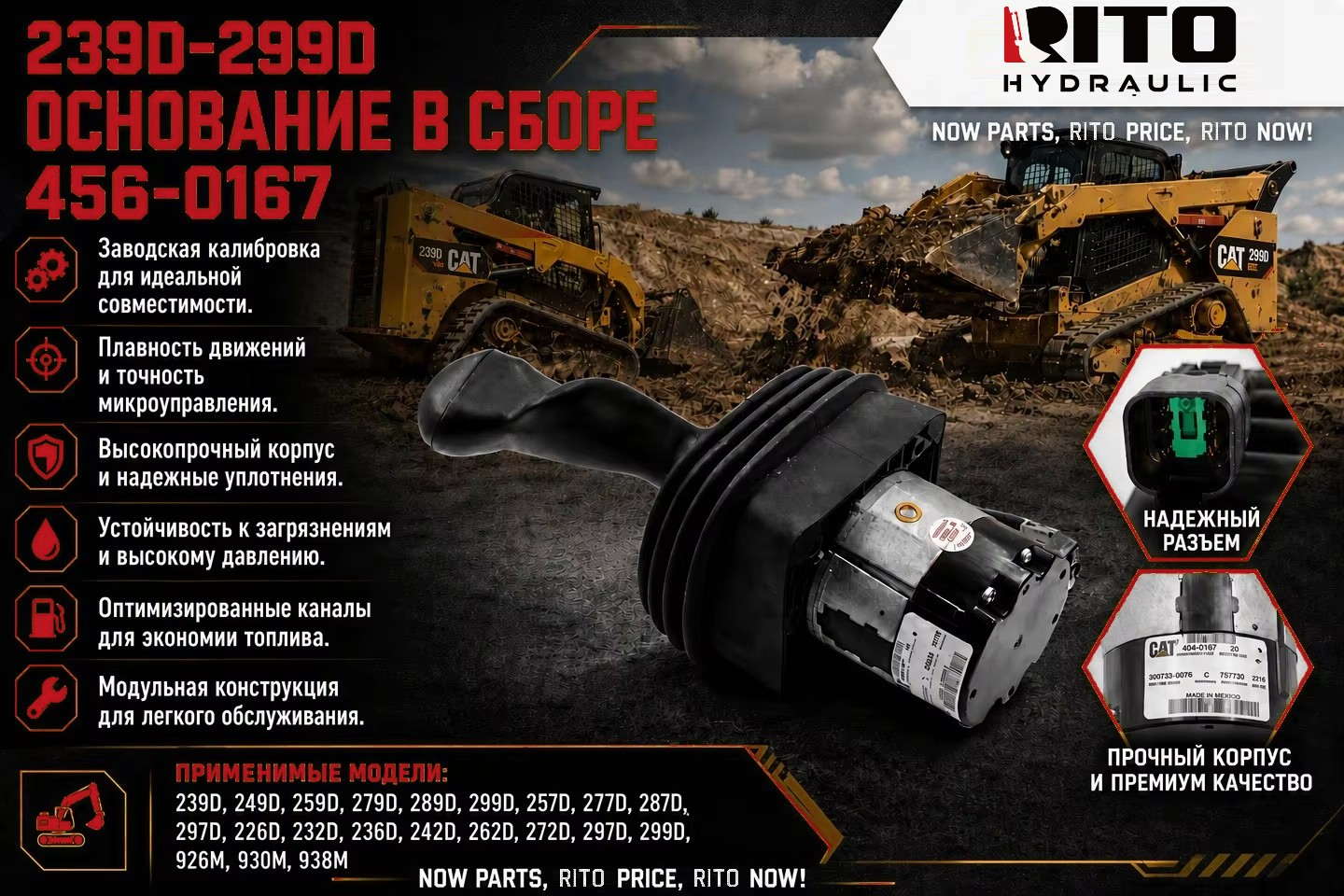
On modern Caterpillar compact loaders the joystick is electronic rather than purely mechanical — which is why this part has a 6-pin DT electrical connector rather than just hydraulic ports. The base senses how far and which way the operator moves the lever, and sends that as a signal to the machine's control system.
That matters for diagnosis. An electronic joystick sits in a chain: base → connector → wiring → controller → the control valve that actually moves the oil. A fault anywhere in that chain can feel like "the joystick is broken", so section 7 walks through the order to check things in.
2. The Part at a Glance
| Item | Detail |
|---|---|
| Part number | 456-0167 |
| Caterpillar description | Base Assembly-Joystick |
| Connector type | 6-pin DT (Deutsch-style), 6 pins |
| Overall size (per Cat) | Approx. 10.39 × 4.25 × 4.25 in |
| Type | Electronic joystick base assembly with rubber boot |
The design points stated for this part, and what they mean in practice:
| Stated design point | Why it matters to you |
|---|---|
| Factory calibration | Correct fit behaviour out of the box, rather than a unit that needs re-learning to work |
| Smooth movement, micro-control precision | Fine, predictable control — the difference operators notice immediately |
| High-strength housing, reliable seals | Survives impact and keeps dust out of the internals |
| Contamination and high-pressure resistance | Built for the dust and washdown of a construction site |
| Optimised internal channels | Cited in the product description for reduced energy loss |
| Modular design | Easier maintenance — the base can be serviced or replaced without disturbing more than necessary |
Complete assemblies and the wider component range are listed under Caterpillar-series parts.
3. Which Machines It Fits
The 456-0167 joystick base is listed across three families of Caterpillar machine. Grouped so you can find your own quickly:
| Family | Models commonly listed |
|---|---|
| Compact track loaders (CTL) | 239D, 249D, 259D, 279D, 289D, 299D, 257D, 277D, 287D, 297D |
| Skid steer loaders (SSL) | 226D, 232D, 236D, 242D, 262D, 272D |
| Wheel loaders | 926M, 930M, 938M |
| Next generation (D2) | The D2 range, including 299D2 / 299D2 XHP |
Two things are worth noticing about that list. First, it is one joystick across many machine sizes — the same base is used from the smallest CTL in the range to the largest. Second, it crosses machine types: compact loaders and wheel loaders share it, because both use the same style of electronic pilot control.
Treat the list as "machines worth checking" rather than a guarantee. Build levels and serial ranges vary, so confirm against the machine's part number before ordering.
4. From 239D to 299D2: the Range Explained
The user's question — "from 239D to 299D2, explain it in one article" — is really about two things: the size spread, and the generation change.
| Dimension | What changes | What does not |
|---|---|---|
| Machine size (239 → 299) | Larger frame, bigger engine, more lift capacity, wider tracks or tyres | The joystick base — the operator interface stays the same |
| Generation (D → D2) | Engine and control refinements, revised hydraulics, new features | Often the same joystick group — but confirm by part number |
| Machine type (CTL / SSL / wheel loader) | Undercarriage, travel system, machine layout | The control interface concept — same electronic pilot style |
That is genuinely useful when you are hunting a part, because it means something counter-intuitive: a joystick from a large machine can serve a small one, and a part from the previous generation may fit the next. The number, not the machine size, is what decides.
The D2 machines illustrate the second point well. When a manufacturer refreshes a generation, some parts change substantially and others carry over. The joystick base is one of the parts that has been listed against both D and D2 machines — good news for owners, provided you confirm the number.
5. The Numbers Around It
Joystick assemblies rarely travel alone. Numbers commonly listed close to 456-0167 include:
| Number | Commonly listed as |
|---|---|
| 456-0167 | Joystick base assembly (the part in this guide) |
| 456-0168 / 456-0169 | Neighbouring joystick base assemblies — check which side and which build |
| 269-0266 | Cross-referenced with this group in some listings |
| 460-5343 | A joystick handle — the upper part, not the base |
Read the wording carefully: "commonly listed as". Adjacent numbers usually differ in a way that matters — left versus right, one button layout versus another, or a different build. Buying 456-0168 when your machine takes 456-0167 is not a near-miss; it is a different part.
Complete assemblies and the wider component range are listed under excavator and loader hydraulic parts.
6. How to Confirm Yours
- Read the label on the existing joystick base. These units normally carry a Cat label with the number and a production code — photograph it straight-on and in focus.
- Record the machine model and serial number. The serial range decides the build, and across the D to D2 change that matters.
- Photograph the whole base and the connector, including the pin arrangement and the boot.
- Note which side it is on (left or right) and whether your machine has one or two joysticks — a common source of wrong orders.
- Have the number cross-checked by a supplier holding the parts data, including any supersession.
Five items, one exchange. On a part this size the risk is not the cost of the part — it is another day of the machine standing still.
7. When a Joystick "Fails", Check This First
Because 456-0167 is an electronic joystick base, the fault is not always inside it. Work in this order — cheapest and most likely first:
| # | Check | Why |
|---|---|---|
| 1 | The connector and pins | Corrosion, water ingress or a backed-out pin mimics a dead joystick exactly |
| 2 | Wiring and harness chafe | A rubbed wire gives intermittent, position-dependent faults |
| 3 | Fault codes and calibration | Some "joystick" complaints are a calibration or code issue, not a failed unit |
| 4 | The boot and seals | A split boot lets water and dust in — the beginning of most joystick failures |
| 5 | Then the base assembly | Internal wear or sensor failure — replace the base |
The pattern to remember: electronic controls fail at the connections as often as at the component. If you have already replaced a joystick and the problem persists, the cause is almost always upstream or downstream in the chain, not in the new part — the same lesson that applies to replacing a control valve assembly.
8. FAQ
Q1: What is part number 456-0167?
It is a Caterpillar joystick base assembly — officially "Base Assembly-Joystick". It is the lower body of the joystick, carrying the pivot, sensors, seals and the electrical connector.
Q2: Which machines does 456-0167 fit?
It is listed across Caterpillar D-series compact track loaders and skid steer loaders — from 239D/249D up to 299D and the D2 range including the 299D2 — as well as M-series wheel loaders such as the 926M, 930M and 938M. Confirm by machine part number.
Q3: Is it the joystick handle or the base?
The base. The handle is a separate item (for example 460-5343 is commonly listed as a joystick handle).
Q4: Does it fit the D2 generation such as the 299D2?
Yes — listings pair 456-0167 with the 299D2 and 299D2 XHP. Still confirm against your machine's serial and part number, since builds vary.
Q5: What connector does it use?
Caterpillar lists a 6-pin DT connector for this part. Inspect the pins on your own unit — corrosion and water ingress at that connector are a frequent cause of joystick faults.
Q6: How big is it?
Approximately 10.39 × 4.25 × 4.25 inches according to Caterpillar's part data.
Q7: Is 456-0168 or 456-0169 the same part?
No. They are neighbouring joystick base assemblies and differ by build or side. Match the number from your machine, not the closest-looking one.
Q8: What are the symptoms of a failing joystick?
Erratic or unresponsive movement, functions that work in one direction only, drift, intermittent faults that appear in certain positions, or a joystick that feels loose or notchy.
Q9: I replaced the joystick and it still does not work — why?
Because the fault was probably not in the joystick. Check the connector pins, harness, earths and calibration, and read any fault codes before buying another unit.
Q10: What should I send to get the right joystick?
Machine model and serial number, a photo of the label on the existing joystick base, photos of the connector and boot, and which side of the machine it is on.
9. Get the Right Joystick
Send us your machine model, serial number and a photo of the label on the joystick — plus a picture of the connector — and our team will confirm whether 456-0167 is the right unit for your machine, note which side it is, flag any supersession, and quote lead time the same day. RITO HYDRAULIC supplies joystick assemblies, control valves, main pumps, travel motors and swing motors for Caterpillar, Komatsu, Hitachi, Kobelco, Hyundai, Doosan and Kawasaki-series machines — with export packing and a 6–12 month warranty.
Contact our team or learn more about RITO HYDRAULIC.
- CAT 330GC Final Drive — Which Part Number Fits and What Should You Check Before You Buy?
- Why Do Customers Need the TM40 Travel Assembly? When It Is Used, What It Does, and What It Changes
- Komatsu PC300-8 / PC350-8 Hydraulic Pump: Which 708-2G Number Fits, and Why PC300-7 Numbers Keep Appearing
- Why Does a CAT 320C / 320D Hydraulic Pump Lose Power Under Heavy Load?
- Why Does Your CAT 312C Need the SBS80 Hydraulic Pump?