
Why Does Your CAT 312C Need the SBS80 Hydraulic Pump?


Author
JERY WANG
Guangzhou Rito Hydraulic Co.,Ltd., located in Guangzhou, China, is a leading manufacturer and distributor of hydraulic pumps, final drives, swing motors, and main control valves for earthmoving machinery. We supply genuine, OEM, and high-quality aftermarket parts.
We are committed to continuously sharing our expertise regarding construction machinery and excavator hydraulic systems. Our goal is to help you gain a deeper understanding of equipment principles and applications—enabling you to work more efficiently—while also showcasing our professional knowledge and capabilities. We invite you to learn more about us.
Choose us, and you will enjoy the best service, the most favorable prices, and the most reliable supplier!
Marie R. Winters


Quick Answer
Key Takeaways
- SBS80 is a size class, not a single part. It is the smallest of the SBS pump family, matched to the 12 to 13 tonne excavator class.
- The same family scales with machine size: SBS80 on the 312C, SBS140 on a 29 tonne machine, SBS180 on a 36 to 40 tonne machine.
- The pump is a twin axial-piston unit with load-sensing control, so output follows demand instead of being delivered at a fixed rate.
- Correct sizing is what prevents engine lugging on one hand and starved functions on the other.
- Symptoms of a worn pump are slowness across every function, heat and higher fuel use — not one weak function.
- Packed weight is about 170 kg, so confirming the number before ordering is worth far more than the freight on a wrong unit.
Table of Contents
- 1. What "SBS80" Actually Tells You
- 2. Why the Machine Needs This Size
- 3. What Load Sensing Does for a 312C
- 4. Why the Pump Is Built the Way It Is
- 5. The Signs the Pump Is Your Problem
- 6. Which Number Fits Your Machine
- 7. FAQ
- 8. Confirm Before You Order
- 9. Get Your Pump Confirmed
1. What "SBS80" Actually Tells You
The first thing worth understanding about SBS80 is that it is not a part number — it is a size class. In the Caterpillar world these three-letter designations identify a pump family, and the number after them scales with the machine it was built to feed.
That is why the same designation keeps appearing across machines of completely different weights, and why the size class alone never tells you the exact unit you need.
| Pump class | Machine class it serves | Why it matters |
|---|---|---|
| SBS80 | 12 to 13 tonne excavators — the 312C | The smallest class: modest flow, matched to a modest engine |
| SBS140 | Around 29 tonne — the 329D class | A larger displacement for a heavier machine — the same family, scaled up |
| SBS180 | 36 to 40 tonne — the 336F and 340F class | The largest of the three: high flow for high production |
Read down that table and the design logic is obvious: Caterpillar scaled one pump family across the whole range. The consequence for an owner is practical, and slightly double-edged. On the good side, a widely used family means parts availability, familiar service and rebuild potential. On the careful side, "SBS80" describes a class, so it never confirms the assembly your 312C was built with — that always comes from the plate.
If you are comparing sizes, our notes on the diagnosis of the SBS140 pump on the 329D show what the next size up looks like in service, and the SBS180 pump on the 336F takes the same logic to the top of the range. The wider Caterpillar-series hydraulic parts range shows where each sits.
2. Why the Machine Needs This Size
This is the heart of the question in the title. A hydraulic pump on an excavator is not a "bigger is better" component — it is a matching component, and the matching happens against two things at once.
| What the pump must match | What happens if the size is wrong |
|---|---|
| The engine's available power | Too large a pump asks the engine for more torque than it can give. The engine lugs, rpm drops, the machine feels heavy and fuel consumption climbs |
| The flow the functions need | Too small a pump cannot supply several functions together. The machine is slow, compound actions stall, and the operator works around the machine instead of with it |
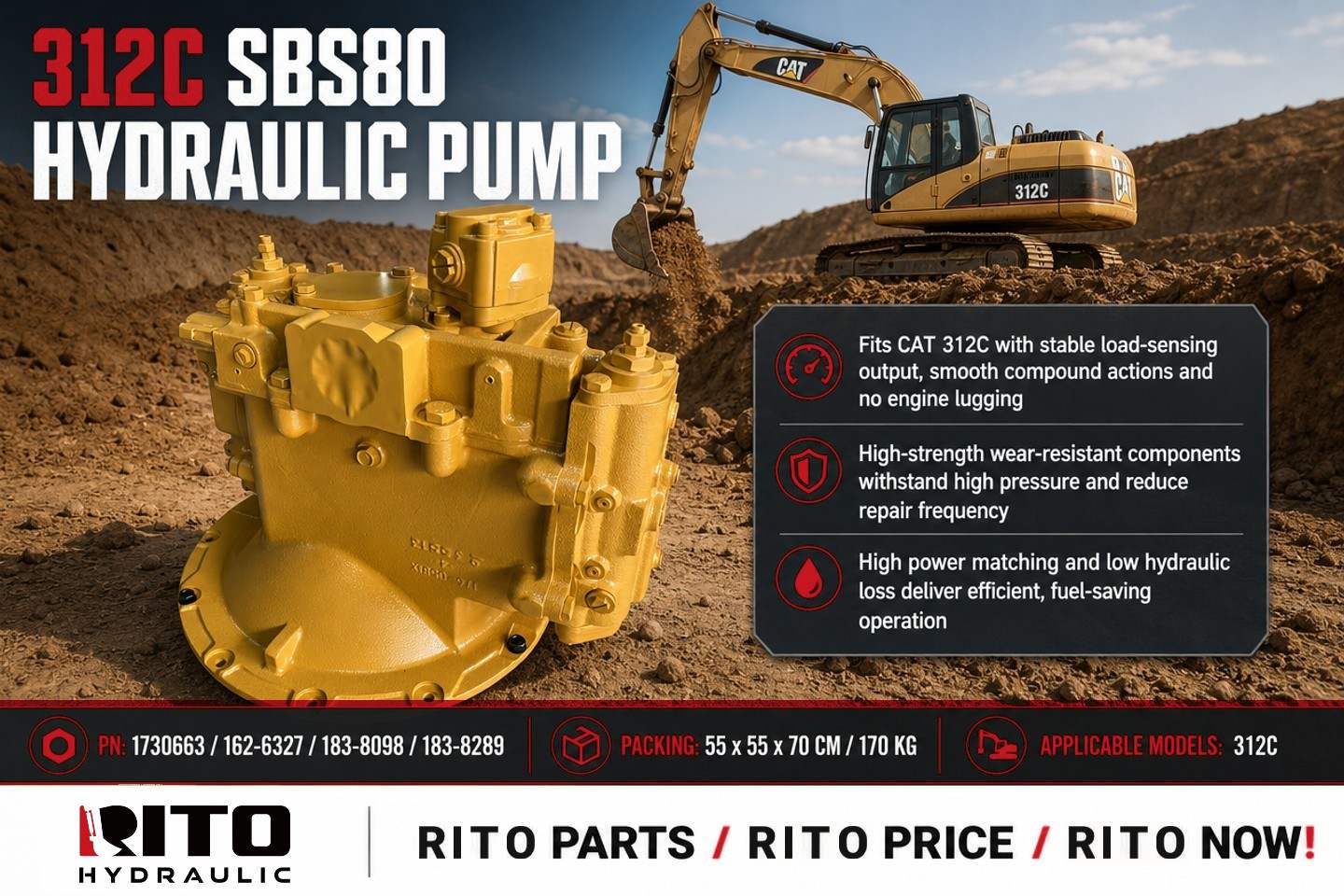
The SBS80 is the answer Caterpillar settled on for a machine of this weight: a pump whose displacement and pressure capability let a 12 to 13 tonne excavator dig with authority without ever overloading its engine. That is what "power matching" means in practice — and it is why fitting a pump of the wrong class, even one that bolts up, produces a machine that is either breathless or sluggish.
Two practical consequences follow for owners of these machines.
First, a 312C is a widely used older machine with a large installed base, which is precisely why the pump remains well supported and why so many of them are still earning. Second, a correct replacement must be matched at the same level: same class, same mounting interface, same control arrangement. A pump from a neighbouring model in the same family may look similar and still be the wrong match.
3. What Load Sensing Does for a 312C
Cat's own literature for this series describes the hydraulics as load-sensing, and the benefit it advertises is exactly what an operator feels every day: smooth starts and stops when handling full loads, and precise control.
Here is what that means mechanically. A load-sensing pump does not deliver a fixed flow all the time. It reads the pressure the work is demanding and varies its own output to match. Three consequences follow, and they explain most of the machine's behaviour:
| Because output follows demand | You get |
|---|---|
| Flow is not pushed over a relief when nothing needs it | Less heat, less noise, and lower fuel burn — the poster's "low hydraulic loss" in real terms |
| Output rises as the load rises | Digging force and holding power stay available in hard ground |
| Output falls when the operator feathers the levers | Smooth, precise control rather than an all-or-nothing response |
It also explains the phrase "no engine lugging" on the product sheet. Because the pump regulates itself against the load, the engine is never asked for torque it cannot supply — the pump reduces its demand before the engine is dragged down. On a small machine this is the difference between an excavator that feels responsive and one that feels like it is always struggling.
And it gives you the first diagnostic rule for this class of machine: if a symptom appears in every function at once, think pump and control; if it appears in one function, think valve and cylinder.
4. Why the Pump Is Built the Way It Is
The SBS80 is a twin axial-piston main pump — two pumping sections in one housing, driven from the engine and feeding the machine's working and travel circuits. That construction is not incidental; it is what makes the pump able to supply a machine that uses several functions together.
The materials story matters just as much as the layout. Inside a piston pump, the parts that wear first are the ones that slide and seal under pressure — pistons, bores, and the valve plate that controls the porting. High-strength, wear-resistant components at those interfaces are what let the unit hold pressure over a long service life instead of leaking internally as the clearances open.
That single property — holding pressure without leaking past its own internals — is what "reduces repair frequency" really means in the field. A pump that maintains its clearances keeps flow going to the actuators instead of letting it escape into the case; the machine keeps its speed and digging force, the oil stays cooler, and the pump does not become the reason the machine comes off site.
5. The Signs the Pump Is Your Problem
Because the pump feeds everything, a worn one announces itself as a change in the whole machine rather than as a single failure. This is the quickest way to judge it from the seat:
| What you observe | Healthy pump | Pump losing efficiency |
|---|---|---|
| Every function together | Consistent speed across boom, arm, bucket and travel | All of them slower at once — the classic pump signature |
| Under hard load | Holds pressure; digging force stays | Fades in the pile and recovers when the load eases |
| Response to the levers | Immediate and progressive — the load-sensing feel | Lag, then a surge; harder to place the bucket accurately |
| Oil temperature | Stable in its normal working range | Creeps up; oil darkens earlier than it used to |
| Fuel use for the same work | Predictable shift to shift | Rises — the engine is working harder to deliver less oil |
Before spending anything, keep the diagnostic order straight. Weakness in one or two functions points at that valve section or cylinder, not the pump. Weakness across all functions points at the pump and its control system — and the cheapest confirmation is a pressure and flow test, by a case drain flow reading to measure how much oil the pump is leaking internally. Those two readings decide the purchase far more reliably than any symptom description.
6. Which Number Fits Your Machine
The main pump for the 312C is supplied under the following numbers:
| Part number |
|---|
| 173-0663 |
| 162-6327 |
| 183-8098 |
| 183-8289 |
| Item | Detail |
|---|---|
| Pump class | SBS80 — twin axial-piston main pump |
| Applications | CAT 312C / 312C L (commonly listed with the 3064 engine) |
| Packing | 55 x 55 x 70 cm, 170 kg |
Two cautions, and they are the same ones that apply across this whole pump family:
- These numbers are quoted in several forms. You will see the same references written with and without the dash (173-0663 and 1730663), and occasionally with a CA prefix. That is normal catalogue variation, not a different part — match the number as a whole.
- A shared number list does not confirm fitment on your machine. Machine build and serial number decide what was actually fitted, which is why the plate on the old pump is the authority. This is exactly the discipline worth applying on a 170 kg assembly.
Replacement pumps and the wider spare range are grouped under excavator hydraulic parts.
7. FAQ
Q1: Why does my CAT 312C need an SBS80 pump specifically?
Because it is the pump size matched to this machine class. A 12 to 13 tonne excavator has a moderate engine and a moderate flow demand, and the SBS80 sits between the two — enough flow to work the functions together, without asking the engine for more torque than it can supply.
Q2: What does SBS80 mean?
It is a size class in the SBS pump family, not a part number. The same family scales with machine size: SBS80 on the 312C, SBS140 on roughly 29 tonne machines, and SBS180 on 36 to 40 tonne machines. The class tells you the size; the part number identifies your unit.
Q3: What is the part number for the 312C main hydraulic pump?
It is supplied under 173-0663, 162-6327, 183-8098 and 183-8289 for the CAT 312C and 312C L. Confirm from the plate on your own pump and the machine serial number before ordering.
Q4: What kind of pump is it?
A twin axial-piston main pump — two pumping sections in one housing, engine driven, with load-sensing control so its output varies with the load the machine is working against rather than being delivered at a fixed rate.
Q5: What does "no engine lugging" mean?
It means the pump regulates itself so it never asks the engine for torque the engine cannot provide. When the load rises, the pump adjusts its demand instead of dragging the engine down, so the machine keeps working at a steady engine speed.
Q6: My 312C is slow in every function. Is that the pump?
Slowness across all functions together is the classic signature of a pump losing volumetric efficiency — oil escaping internally instead of reaching the actuators. Check suction, relief settings and the control signal as well, and have the pump tested before buying.
Q7: One function is weak but the rest are fine. Same answer?
No. A single weak function points at that function's valve section or its cylinder rather than the pump, because the pump feeds everything equally. This single distinction saves more money than any other diagnostic step.
Q8: Can I fit a larger pump to get more power?
It is not a sensible modification. A larger pump asks the engine for torque it does not have, which produces lugging, heat and higher fuel consumption rather than more production. The pump has to match the engine and the machine's circuits.
Q9: Can the pump be repaired rather than replaced?
Often yes, because the internal parts of this family are obtainable. Whether it makes sense depends on how far the damage has spread — a rebuild is reasonable when the damage is confined and the unit is re-tested; replacement is safer when wear spans the rotating group and the control.
Q10: What should I send to get a quotation?
The machine model and serial number, the plate code from the old pump, a note of what the machine does wrong and when, and two or three clear photographs of the pump including the plate, flange and ports. Any pressure, flow or case drain readings you have will shorten the conversation considerably.
8. Confirm Before You Order
Five items, five minutes, and the purchase becomes a single round:
- 1. Machine model and serial number — the serial identifies the build, not the badge.
- 2. The full plate code from the old pump — read it, photograph it, and do not transcribe it from memory.
- 3. Which functions are affected, and when — all of them or one; cold or hot; loaded or idle.
- 4. Photographs of the pump — plate straight-on and in focus, plus the flange and port faces.
- 5. Any test readings you have — pressure, flow or case drain. Numbers shorten the diagnosis dramatically.
9. Get Your Pump Confirmed
Send us your machine model, serial number, the plate code from the old pump and a note of how the machine behaves — plus a few clear photos — and our team will confirm the correct assembly for your 312C, tell you whether a repair or a replacement is the sensible route, and quote lead time the same day. RITO HYDRAULIC supplies complete, individually tested main pumps, control valves, swing devices and travel motors for Caterpillar, Komatsu, Hitachi, Kobelco, Hyundai, Doosan, Kawasaki and SANY machines — with export packing and a 6–12 month warranty.
Contact our team or learn more about RITO HYDRAULIC.
- CAT 330GC Final Drive — Which Part Number Fits and What Should You Check Before You Buy?
- Why Do Customers Need the TM40 Travel Assembly? When It Is Used, What It Does, and What It Changes
- Komatsu PC300-8 / PC350-8 Hydraulic Pump: Which 708-2G Number Fits, and Why PC300-7 Numbers Keep Appearing
- Why Does a CAT 320C / 320D Hydraulic Pump Lose Power Under Heavy Load?
- Why Does Your CAT 312C Need the SBS80 Hydraulic Pump?