
When Should You Replace a Caterpillar 320 GX Final Drive Gearbox?


Author
JERY WANG
Guangzhou Rito Hydraulic Co.,Ltd., located in Guangzhou, China, is a leading manufacturer and distributor of hydraulic pumps, final drives, swing motors, and main control valves for earthmoving machinery. We supply genuine, OEM, and high-quality aftermarket parts.
We are committed to continuously sharing our expertise regarding construction machinery and excavator hydraulic systems. Our goal is to help you gain a deeper understanding of equipment principles and applications—enabling you to work more efficiently—while also showcasing our professional knowledge and capabilities. We invite you to learn more about us.
Choose us, and you will enjoy the best service, the most favorable prices, and the most reliable supplier!
Marie R. Winters


Quick Answer
Key Takeaways
- Replace on evidence, not on noise alone. Metal in the oil, worsening mechanical noise and uncontrollable oil loss are the hard signals.
- Confirm the location first — a hydraulic fault upstream produces the same "slow, weak track" complaint as a worn gearbox.
- Check the motor before choosing the level. A healthy motor means the gearbox alone can be the right answer; a worn motor means the complete device.
- Never fit a new gearbox to a tired motor — that combination is a short-lived repair.
- The gearbox is not a self-healing component: wear accelerates, so waiting usually costs more than planning.
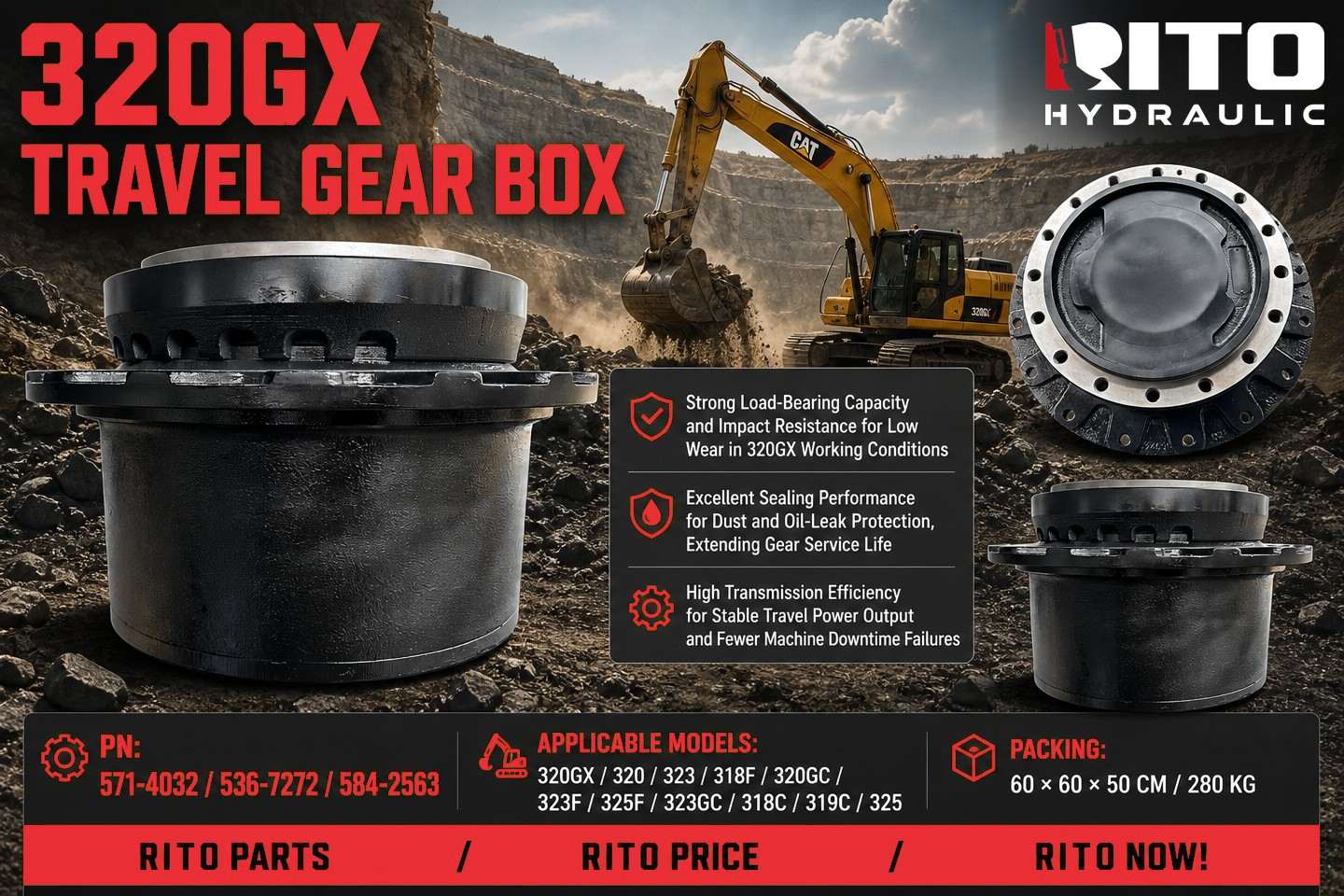
- The 320 GX gearbox is ordered under 571-4032 / 536-7272 / 584-2563, and the family spans the 320GX, 320, 323, 318F, 320GC, 323GC and 325 machines.
Table of Contents
- 1. What a Final Drive Gearbox Is — and What It Is Not
- 2. The Signals That Say Replace, Not Repair
- 3. First Confirm the Fault Is in the Gearbox
- 4. Is the Motor Also Worn? The Question That Sets the Level
- 5. Replace Now, or Run to Failure?
- 6. What Else the Job Requires
- 7. Which Gearbox Fits Your Machine
- 8. FAQ
- 9. Get Your Gearbox Confirmed
1. What a Final Drive Gearbox Is — and What It Is Not
The final drive on each side of a 320 GX contains three job-sharing parts: a hydraulic travel motor that converts oil pressure into rotation, a planetary reduction gearbox that multiplies torque down to track speed, and a brake that holds the machine when the levers are released.
The gearbox is the middle layer — the reduction — and it can be replaced on its own. That matters for cost, and it matters for the decision in this article:
| Item | What it covers |
|---|---|
| Travel gearbox / final drive gearbox | The planetary reduction on its own — the part this article is about |
| Travel motor | The hydraulic motor that drives the gearbox |
| Complete travel device | Motor, reduction and brake as one assembled unit |
Buyers regularly confuse these three, and the confusion runs in both directions — paying for a complete device when the reduction was the only problem, or buying a gearbox and bolting it to a motor that was already failing. The reasoning behind that level decision is worked through on a larger machine in our guide to the EX1200-6 travel device: gearbox or complete unit; the logic is identical here.
One more thing worth stating plainly: the gearbox is a set of gears and bearings running in an oil bath. It has no way to clean itself, no way to re-set its own clearances and no way to recover from a scored surface. Once it is damaged, the only honest options are rebuild it properly or replace it — never "leave it and see".
2. The Signals That Say Replace, Not Repair
These are the findings that justify replacement rather than repair. Any one of them on its own deserves investigation; two together is a decision.
| Signal | What it means | Why it points to replacement |
|---|---|---|
| Metal or silver sheen in the oil | Gear teeth and bearings are already shedding material | Worn surfaces cannot be restored by cleaning; the damage is dimensional |
| Grinding or knocking that is getting worse | Gear or bearing damage that is progressing, not settling | A worsening mechanical noise ends in seizure — and takes the track with it |
| Oil loss you cannot stop | Seal failure, often with dust or water following it in | A unit that has run dry or on contaminated oil is already worn internally |
| Milky or burnt oil | Water ingress or overheating | Both destroy bearings; both mean the unit has been running outside its design conditions |
| One side noticeably hotter | Excess friction from a bearing, gear or dragging brake | Heat is a symptom of internal damage, and it accelerates the damage |
| Excessive play at the sprocket | Bearing or gear wear has opened up the bearing clearances | Backlash beyond specification cannot be adjusted out on this design |
| A previous repair that already failed | The original damage was never fully removed | A second rebuild rarely restores performance; a verified unit is the safer spend |
Note what is not on that list: "the machine tracks slowly". Slow or weak travel on one side can be caused by a relief setting, a valve section, a brake that will not release or a simple oil shortfall — none of which is a gearbox replacement. That is the subject of the next section.
3. First Confirm the Fault Is in the Gearbox
Replacing a gearbox because of a hydraulic fault is one of the most expensive avoidable mistakes in this class of machine. Three checks, in this order, settle it.
| Check | What it tells you |
|---|---|
| Swap the travel hoses left to right | If the slow side follows the hoses, the fault is hydraulic and upstream — the gearbox is innocent. If it stays with the track, the fault is mechanical. This is set out in detail in our guide to one-sided slow travel, and the test works identically here |
| Drain the oil and look at it | Metal, silver sheen, milkiness or a burnt smell are physical evidence of internal damage — photograph it and keep the sample |
| Compare oil level and temperature between the two sides | A side that loses oil or runs hot is the side with the problem — and if the other side is normal, you also have a healthy reference |
Every one of those checks is cheap, and together they replace guesswork with findings. On a 280 kg assembly, that is time very well spent — and if the conclusion is "hydraulic fault", you have just saved the price of a gearbox.
4. Is the Motor Also Worn? The Question That Sets the Level
Once internal gearbox damage is confirmed, one more question decides what you buy: is the travel motor still healthy? The motor wears on the same oil and the same duty as the gearbox, so it is common for both to be tired at the same time — but not inevitable.
| Finding | Sensible level |
|---|---|
| Motor leakage within specification, motor smooth and strong, damage confined to the reduction | Gearbox only — provided the motor has genuinely been tested, not assumed good |
| Motor leakage high, motor noisy or weak, or metal has circulated through the circuit | Complete travel device — one job, one warranty, nothing half-worn left behind |
| Machine needed back in production immediately | Complete tested device, because a second failure costs more than the price difference |
The most useful single measurement here is case drain flow: it is the motor's internal leakage made visible, and comparing it between the two sides tells you whether that motor is worn. The method is set out in our guide to reading case drain flow, and the principle transfers directly from pumps to motors.
And the rule that follows from all of it: never bolt a new gearbox onto a motor you have not assessed. A new reduction multiplying the output of a worn motor produces exactly the second failure you were trying to avoid — usually within a few hundred hours, and usually in the middle of a job.
5. Replace Now, or Run to Failure?
The honest answer is that this component rarely gives you a choice for long. Gear and bearing wear does not stabilise; it accelerates, because a worn surface increases load on the surfaces next to it, and because the debris it sheds contaminates the oil that lubricates everything else.
| Route | What it usually costs |
|---|---|
| Plan the replacement | The unit, a planned stop, and a clean installation — done on your schedule, on your terms |
| Wait for failure | The unit, an unplanned stop, recovery of a dead machine from wherever it stopped, a flush of the whole circuit, and often a second component damaged downstream |
The exception is genuine early-stage noise with clean oil and normal temperature, where a re-test at the next service interval is a reasonable plan. But "early-stage" only stays early-stage if someone is actually watching it — which means a recorded oil check and a re-test, not simply hoping.
6. What Else the Job Requires
A gearbox replacement is not finished when the last bolt is tight. Four things decide whether the new unit lasts:
- Flush the circuit and change the oil and filters. If the old unit shed metal, that debris is spread through the travel circuit. Fitting a new gearbox into a contaminated system is how repeat failures are manufactured.
- Use the correct oil, to the correct level. The reduction is an oil-lubricated assembly; the wrong grade or a low level is the fastest way to destroy a new one.
- Seal it properly, and check the sealing surfaces. Dust and water are the two things that shorten a travel gearbox's life most, and every sealing component on the installation is part of the defence — not just the unit's own seals.
- Look at the other side too. Both sides have worked the same hours on the same ground. If the failed side shows a wear pattern, sampling the oil in the other side is sensible rather than pessimistic.
Cleanliness during the job deserves its own emphasis. Travel devices fail from contamination more than from abuse; the workshop practice around the replacement — capped hoses, clean fittings, a covered unit — is part of the service life you bought.
7. Which Gearbox Fits Your Machine
The travel gearbox for the CAT 320 GX is ordered under the following numbers:
| Part number |
|---|
| 571-4032 |
| 536-7272 |
| 584-2563 |
Applications listed for this gearbox span a wide slice of the 20-tonne class: 320GX / 320 / 323 / 318F / 320GC / 323F / 325F / 323GC / 318C / 319C / 325. Packed weight is around 280 kg in a 60 x 60 x 50 cm case.
Three cautions before you order — and the third is the one that catches people.
- A broad model list is a lead, not a confirmation. Machines within one family were built in different configurations, so the serial number decides what was actually fitted.
- Related numbers circulate in the same listings. You will also see references such as 571-4033 and 507-6557 quoted alongside 571-4032 for this family. Treat all of them as leads to verify against your own plate.
- These numbers appear at different levels. In the market, some of them are quoted as a gearbox / reduction, some as a complete final drive, and some as final drive internal parts for the same machine family. Before you buy, be certain which level you are getting — because "the same number" does not always mean the same goods. This is exactly the decision set out in section 4.
Replacement gearboxes and the wider spare range are grouped under excavator hydraulic parts, and the same family sits within the wider Caterpillar-series range.
8. FAQ
Q1: When should I replace a CAT 320 GX final drive gearbox?
When the reduction has damage that cannot be cleaned out or re-set: metal or silver sheen in the oil, a grinding or knocking noise that is worsening, oil loss you cannot stop, milky or burnt oil, or a unit that runs hotter than the other side. Prove first that the fault is inside the gearbox and not upstream in the circuit.
Q2: What is the part number for the 320 GX travel gearbox?
The gearbox is ordered under 571-4032, 536-7272 or 584-2563, with applications listed across the 320GX, 320, 323, 318F, 320GC, 323F, 325F, 323GC, 318C, 319C and 325. Confirm the number from the plate on your own unit and the machine serial.
Q3: How do I know it is the gearbox and not the travel motor?
Compare case drain flow between the two sides: noticeably higher flow on the failed side points at the motor's internal leakage. Mechanical noise, metal in the oil and heat with normal leakage point at the reduction.
Q4: Can I replace just the gearbox and keep the motor?
Yes, where the motor has genuinely been tested and is within specification. It is a legitimate and cheaper route — but only when the motor has been assessed, not assumed good. A new gearbox on a worn motor will fail again.
Q5: The machine just travels slowly on one side. Is the gearbox finished?
Not necessarily. Slow travel can come from a relief setting, a control valve section, a brake that will not release, unequal track tension or low oil. Swap the travel hoses left to right first — if the slow side moves, the gearbox is probably not the problem.
Q6: What does metal in the gearbox oil mean?
That gear teeth or bearings are already shedding material. Unlike a contaminated oil charge, this is dimensional damage — cleaning the oil will not restore the surfaces. It is one of the clearest signals that replacement is the right answer.
Q7: What else should be done with the replacement?
Flush the travel circuit and change the oil and filters, use the correct oil to the correct level, seal the installation properly against dust and water, and check or sample the other side, which has worked the same hours.
Q8: Can the gearbox be repaired instead of replaced?
Sometimes a proper rebuild is viable, provided the damage is fully removed and the unit is re-tested. But if a previous repair has already failed, or the damage spans gears and bearings, a verified unit is usually the better spend.
Q9: Why is a broad model list not enough to confirm fitment?
Because machines in the same family were built in different configurations, and Caterpillar part numbers are revised over time. The plate on your own unit plus the machine serial number is what confirms the correct assembly.
Q10: What should I send to get a quotation?
The machine model and serial number, the plate number from the old gearbox, which side it is, photographs of the unit and its ports, and the results of any tests or oil inspection you have carried out — plus a note of what the machine does wrong and when.
9. Get Your Gearbox Confirmed
Send us your machine model, serial number, which side is affected and the plate number from the old gearbox — plus a few clear photos and your oil or test findings — and our team will help you decide between a gearbox and a complete travel device, confirm the correct assembly for your 320 GX, and quote lead time the same day. RITO HYDRAULIC supplies complete, individually tested travel gearboxes, final drives, travel motors, main pumps and control valves for Caterpillar, Komatsu, Hitachi, Kobelco, Hyundai, Doosan, Kawasaki and SANY machines — with export packing and a 6–12 month warranty.
Contact our team or learn more about RITO HYDRAULIC.
- CAT 330GC Final Drive — Which Part Number Fits and What Should You Check Before You Buy?
- Why Do Customers Need the TM40 Travel Assembly? When It Is Used, What It Does, and What It Changes
- Komatsu PC300-8 / PC350-8 Hydraulic Pump: Which 708-2G Number Fits, and Why PC300-7 Numbers Keep Appearing
- Why Does a CAT 320C / 320D Hydraulic Pump Lose Power Under Heavy Load?
- Why Does Your CAT 312C Need the SBS80 Hydraulic Pump?