
Komatsu PC200-8 Hydraulic Pump OEM Part Numbers: 708-2L-00500, 708-2L-00400 or 708-2L-00490 — Which One Do You Need?


Author
JERY WANG
Guangzhou Rito Hydraulic Co.,Ltd., located in Guangzhou, China, is a leading manufacturer and distributor of hydraulic pumps, final drives, swing motors, and main control valves for earthmoving machinery. We supply genuine, OEM, and high-quality aftermarket parts.
We are committed to continuously sharing our expertise regarding construction machinery and excavator hydraulic systems. Our goal is to help you gain a deeper understanding of equipment principles and applications—enabling you to work more efficiently—while also showcasing our professional knowledge and capabilities. We invite you to learn more about us.
Choose us, and you will enjoy the best service, the most favorable prices, and the most reliable supplier!
Marie R. Winters


Quick Answer
Key Takeaways
- All three numbers share 708-2L — the same Komatsu pump family. Only the final block differs.
- Different final block = different build, tied to application and serial range.
- There is no reliable way to choose from the model name alone — use the nameplate code + machine serial.
- A definitive per-number allocation comes from the manufacturer's parts data for your serial range, not from the number itself.
- The wrong number often still bolts up — which is why the mistake is expensive.
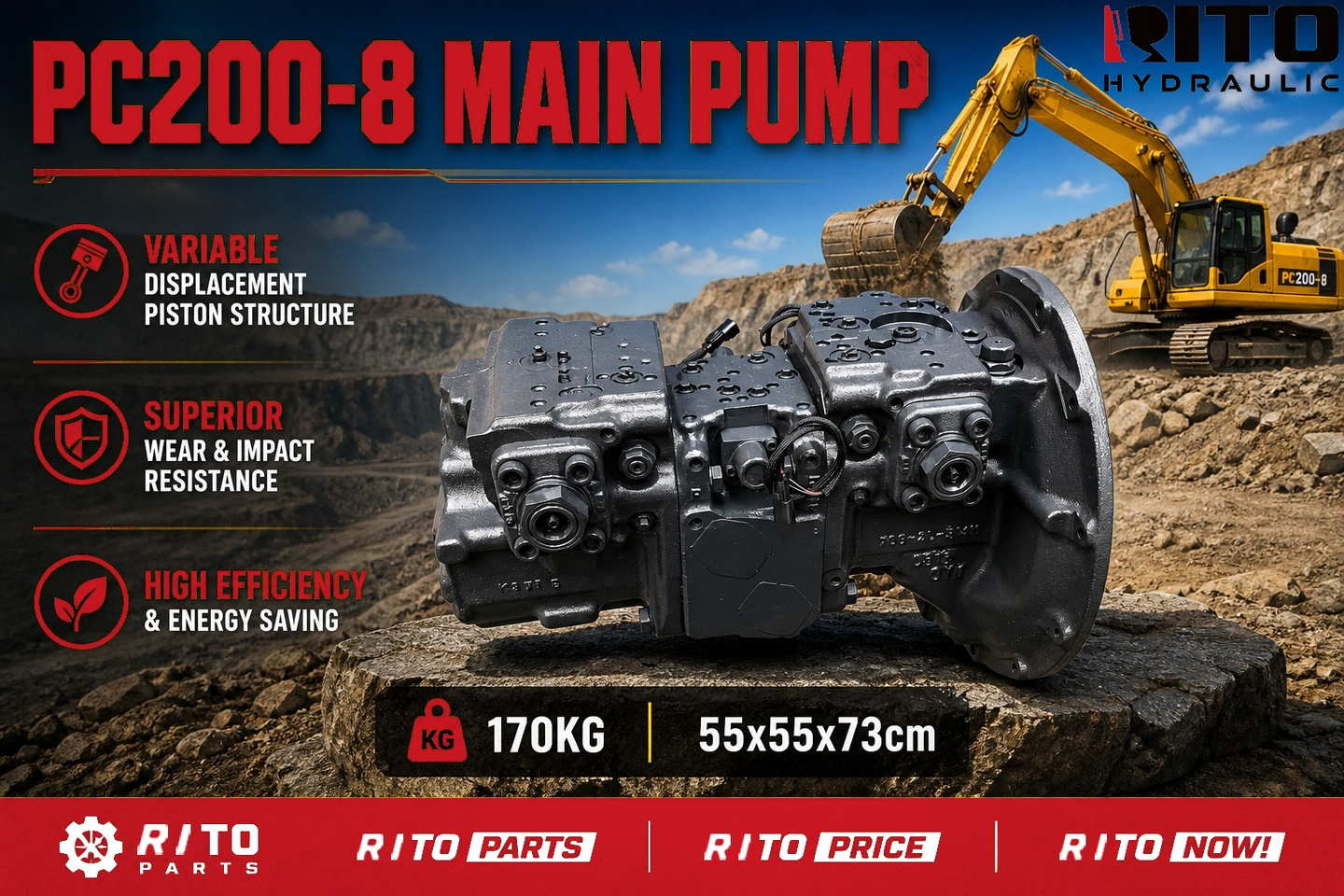
- Product facts for reference: about 170 kg, packed 55 × 55 × 73 cm.
Table of Contents
- 1. The Three Numbers at a Glance
- 2. Why One Machine Has Several Numbers
- 3. Reading 708-2L-00500 / 00400 / 00490
- 4. What Can Differ Between Them
- 5. The Selection Flow: 5 Steps
- 6. Where to Find Your Number
- 7. Common Mistakes When Choosing
- 8. One Level Up: Number vs Quality Tier
- 9. FAQ
- 10. Get Your Number Confirmed
1. The Three Numbers at a Glance
| Order number | Shared part | What it identifies |
|---|---|---|
| 708-2L-00500 | 708-2L (pump family) | One build of the PC200-8 main pump |
| 708-2L-00400 | 708-2L (pump family) | A different build of the same family |
| 708-2L-00490 | 708-2L (pump family) | A third build of the same family |
Read that table carefully, because it contains the whole answer: the numbers differ only in the last block, and the last block is the build. Everything else — what the pump looks like, how it mounts, which family it belongs to — can be identical across all three.
2. Why One Machine Has Several Numbers
A single excavator model rarely ships with a single unique pump for its entire production life. Numbers multiply for ordinary, practical reasons:
- 1. Configurations. One model is sold in several versions — standard and long undercarriage, for instance — and the pump specification can follow the configuration.
- 2. Running changes. Manufacturers revise parts during a production run. When a change is significant enough to affect interchangeability, it gets a new number.
- 3. Serial ranges. Because of those running changes, "which number" is often a question about which serial range your machine falls into.
- 4. Supersession. An older number can be replaced by a newer one, so both appear in circulation — one as the original fitment, one as the current supply.
So seeing three numbers for one machine is normal. It is not a sign that any of them will do. You can browse the wider Komatsu-series hydraulic parts range to see how these numbers sit alongside other models in the same generation.
3. Reading 708-2L-00500 / 00400 / 00490
| Block | 708-2L-00500 | 708-2L-00400 | 708-2L-00490 |
|---|---|---|---|
| Component group | 708 | 708 | 708 |
| Pump series | 2L | 2L | 2L |
| Build / variant | 00500 | 00400 | 00490 |
Notice how little changes. This is typical of Komatsu numbering in this family: the group (708) and the series (2L) place the part in the same hydraulic family, and the final block carries the build identity. The practical consequence is important, and worth stating plainly:
4. What Can Differ Between Them
When the last block of the number changes, the difference is real — it is never cosmetic. In practice the variation sits in one or more of these areas:
| Area | Why it changes |
|---|---|
| Application / fitment | The pump family serves more than one machine or configuration |
| Serial range | Running changes during production split the model into serial bands |
| Control / regulator | The pump's control is matched to the machine's hydraulic control system |
| Build level | Supersessions and minor revisions inside the pump |
Because these differences affect behaviour and fit rather than appearance, two builds can look almost the same on a bench and behave quite differently on a machine.
5. The Selection Flow: 5 Steps
| Step | Do this | You now have |
|---|---|---|
| 1 | Read the pump nameplate | The number your machine actually has |
| 2 | Write down the machine model and serial | The serial band that decides the build |
| 3 | Check the parts manual for your serial | The number specified for your build |
| 4 | Cross-check with a supplier who holds the data | Confirmation, including any supersession |
| 5 | Confirm the product, not just the number | The correct build, from a defined quality tier |
Steps 1–2 take ten minutes and prevent the whole problem. Steps 4–5 are what a good supplier adds: confirmation of the correct build, plus assurance about the product itself.
6. Where to Find Your Number
| Source | What it gives you |
|---|---|
| Pump nameplate | The number of the pump physically on your machine — the primary source |
| Machine serial plate | The serial band used to look up the specified part |
| Parts manual | The number listed for your machine and serial range |
| Supplier cross-check | Confirmation, plus any supersession to a current number |
Photograph the nameplate straight-on and in focus, and take two or three photos of the whole pump including the ports. That set answers the question in one exchange instead of five.
7. Common Mistakes When Choosing
- Choosing from the model name. "For a PC200-8" does not identify which of the three builds you need.
- Assuming the numbers are interchangeable because they share 708-2L. They do not, by default.
- Picking the cheapest number quoted. A lower price on a different build is not a saving; it is a different part.
- Skipping the serial. The serial is precisely what distinguishes the builds.
- Judging by a photo. The builds can look nearly identical.
- Fitting without flushing. Contamination from the old pump will shorten the life of the new one — and can damage the control valve assembly too.
Replacements across this range are listed with the wider excavator hydraulic parts catalogue.
8. One Level Up: Number vs Quality Tier
Getting the number right is only half the job. Two sellers can both quote "708-2L-00500" while offering very different products — a new, individually tested assembly on the one hand, and a low-end rebuild on the other. The number identifies the build; it says nothing about the quality tier.
So there are really two questions, in this order:
- Which build? — answered by your nameplate code and serial.
- Which tier? — answered by a per-unit test report, a parts declaration, photos of the actual unit and a written warranty.
You can see both questions worked through for a related pump in our guide to the PC200-7 pump HPV95 and the difference between its two numbers. And if you want the background on what the pump actually does, start with how the PC200-8 main pump works.
9. FAQ
Q1: What are 708-2L-00500, 708-2L-00400 and 708-2L-00490?
They are three order numbers quoted for the Komatsu PC200-8 main pump. All three belong to the same 708-2L pump family; the final block identifies the specific build.
Q2: How do I know which one my machine needs?
Read the pump nameplate on your machine and check the parts manual against your machine serial number. The build is tied to the machine application and serial range, so the plate and serial decide.
Q3: Can I use any of the three if they all fit?
No. They may all bolt up, but only the correct build will perform as designed. Fitting a different build is how "it fits but runs wrong" problems happen.
Q4: What does the final block of the number mean?
It identifies the build or variant. The shared blocks (708 and 2L) place the part in the Komatsu pump group and the 2L series; the final block carries the build identity.
Q5: Why can't I work out the machine from the number alone?
Because the number encodes a build, and the build-to-machine mapping lives in the manufacturer's parts data by serial range. Guessing from the digits is not reliable.
Q6: What if my number has been superseded?
Supersession is common. Confirm the current number with a supplier who can check the parts data, rather than assuming the old number is still supplied.
Q7: Where exactly is the pump nameplate?
On the pump body itself. Photograph it straight-on and in focus — a clear plate photo is the single most useful thing you can send a supplier.
Q8: How heavy is the PC200-8 main pump?
About 170 kg as a complete assembly, packed in a 55 × 55 × 73 cm case.
Q9: Is the cheapest number the best choice?
No. A lower price on a different build means a different part, and a low price on the same build usually means a lower quality tier. Judge the product, not only the number.
Q10: What should I send to get my number confirmed?
Machine model, machine serial number, a straight-on photo of the pump nameplate, and two or three photos of the pump itself. That is enough for a same-day confirmation.
10. Get Your Number Confirmed
Send us your machine model, serial number and the full pump code from the nameplate — plus a few clear photos — and our team will confirm which build your machine uses, flag any supersession, and provide a test-report sample and lead time the same day. RITO HYDRAULIC supplies complete, individually tested main pumps, control valves, travel motors and swing motors for Komatsu, Hitachi, Kobelco, Caterpillar, Hyundai, Doosan and Kawasaki-series machines — with export packing and a 6–12 month warranty.
Contact our team or learn more about RITO HYDRAULIC.
- CAT 330GC Final Drive — Which Part Number Fits and What Should You Check Before You Buy?
- Why Do Customers Need the TM40 Travel Assembly? When It Is Used, What It Does, and What It Changes
- Komatsu PC300-8 / PC350-8 Hydraulic Pump: Which 708-2G Number Fits, and Why PC300-7 Numbers Keep Appearing
- Why Does a CAT 320C / 320D Hydraulic Pump Lose Power Under Heavy Load?
- Why Does Your CAT 312C Need the SBS80 Hydraulic Pump?