
Why Is Kawasaki K3V112DT So Common on 20-Ton Excavators?


Author
JERY WANG
Guangzhou Rito Hydraulic Co.,Ltd., located in Guangzhou, China, is a leading manufacturer and distributor of hydraulic pumps, final drives, swing motors, and main control valves for earthmoving machinery. We supply genuine, OEM, and high-quality aftermarket parts.
We are committed to continuously sharing our expertise regarding construction machinery and excavator hydraulic systems. Our goal is to help you gain a deeper understanding of equipment principles and applications—enabling you to work more efficiently—while also showcasing our professional knowledge and capabilities. We invite you to learn more about us.
Choose us, and you will enjoy the best service, the most favorable prices, and the most reliable supplier!
Marie R. Winters


Quick Answer
Key Takeaways
- K3V112DT is the class standard for 20-tonne excavators because many OEMs adopted the same Kawasaki pump.
- The letters matter: D = double (two sections), T = tandem — the parallel version is DP, as used on the Hyundai R210W-9.
- The machine-deciding difference is the input spline: Z14 or Z12.
- Z14 serves Volvo EC210 / EC210B / EC240, Sumitomo SH200-1/2 and LG922D; Z12 serves Hyundai R200-7 / R215-7 / R215-9 / R220-7 and Doosan HD820.
- The trailing suffix (-9N24, -9N2A, -9C32 and others) is the build variant — it must come from your own unit.
- A huge installed base is a buyer's advantage: broad parts commonality, easy servicing and lower operating cost — and the reason low-quality copies exist too.
Table of Contents
- 1. The Short Answer: One Pump, Many Brands
- 2. What K3V112DT Actually Means
- 3. The Only Real Difference: Z14 or Z12
- 4. Where 112 Sits in the K3V Range
- 5. Why Commonality Is a Buyer's Advantage — and a Trap
- 6. Why It Suits Heavy 20-Tonne Work
- 7. Confirm Before You Order
- 8. FAQ
- 9. Get Your Pump Confirmed
1. The Short Answer: One Pump, Many Brands
Ask why a single pump model turns up on so many different 20-tonne excavators and the answer is not technical at all — it is commercial. In the 1990s and 2000s, excavator builders around the world faced the same problem: design a 20-tonne machine with reliable, modern hydraulics. Rather than develop their own, most of them bought the same thing from the same place.
That place was Kawasaki, and the thing was the K3V series. Volvo, Hyundai, Doosan, Sumitomo, Kobelco — and through them brands such as Case and Link-Belt — all specified Kawasaki K3V pumps for their 20-tonne machines. The K3V112 became the version that fitted that size class, and the K3V112DT — the double, tandem version — became one of the most numerous hydraulic pumps in the world.
| Why this happened | What it means today |
|---|---|
| One proven pump, many buyers | OEMs avoided development risk by specifying an established Kawasaki design |
| Cost and service network | A pump bought in volume is cheaper, and easier to service worldwide |
| A single 20-tonne size class | 112 became the natural displacement class for that weight of machine |
| Decades of production | An enormous installed base — and therefore an enormous aftermarket |
So the honest answer to the title question is: K3V112DT is common because the whole industry standardised on it. Volvo's EC210B and Hyundai's R215-7 are different machines from different companies, and the same Kawasaki pump family sits inside both. The wider Kawasaki range is grouped under Kawasaki-series hydraulic parts.
2. What K3V112DT Actually Means
Kawasaki model codes are not random, and reading them correctly is what separates a confident order from a guess. Here is the breakdown of this one:
| Part of the code | Meaning |
|---|---|
| K3V | The Kawasaki pump series — the K3V family runs from small machines up to large ones |
| 112 | The displacement class within that series (the K3V range also includes 63, 140, 180 and 280) |
| D | Double — two pumping sections in one housing |
| T | Tandem arrangement of those two sections |
| -9N24 and similar | Build variant — the designation that changes between machines and markets |
| Z14 / Z12 | Input spline — 14-tooth or 12-tooth (the subject of section 3) |
The second letter of the two-letter code is the one most often misread. DT is not the same as DP:
- K3V112DT — double, tandem. This is the pump in this article, the one that served most 20-tonne machines.
- K3V112DP — double, parallel. A different arrangement, used on machines such as the Hyundai R210W-9 — the R210W-9 K3V112DP is a good example of how a single letter changes the assembly.
There is a third variation you will meet in the field: DTP, as on the Kobelco SK200-6E. If you want the full explanation of what changes between these designations, our guide to what the K3V112 model number actually means walks through it number by number.
3. The Only Real Difference: Z14 or Z12
Now the part that decides whether the pump you buy will actually go on your machine. Because the K3V112DT was supplied to many OEMs, the differences between their installations are small — and the one that matters most is the input spline, the toothed shaft that engages the engine-side coupling.
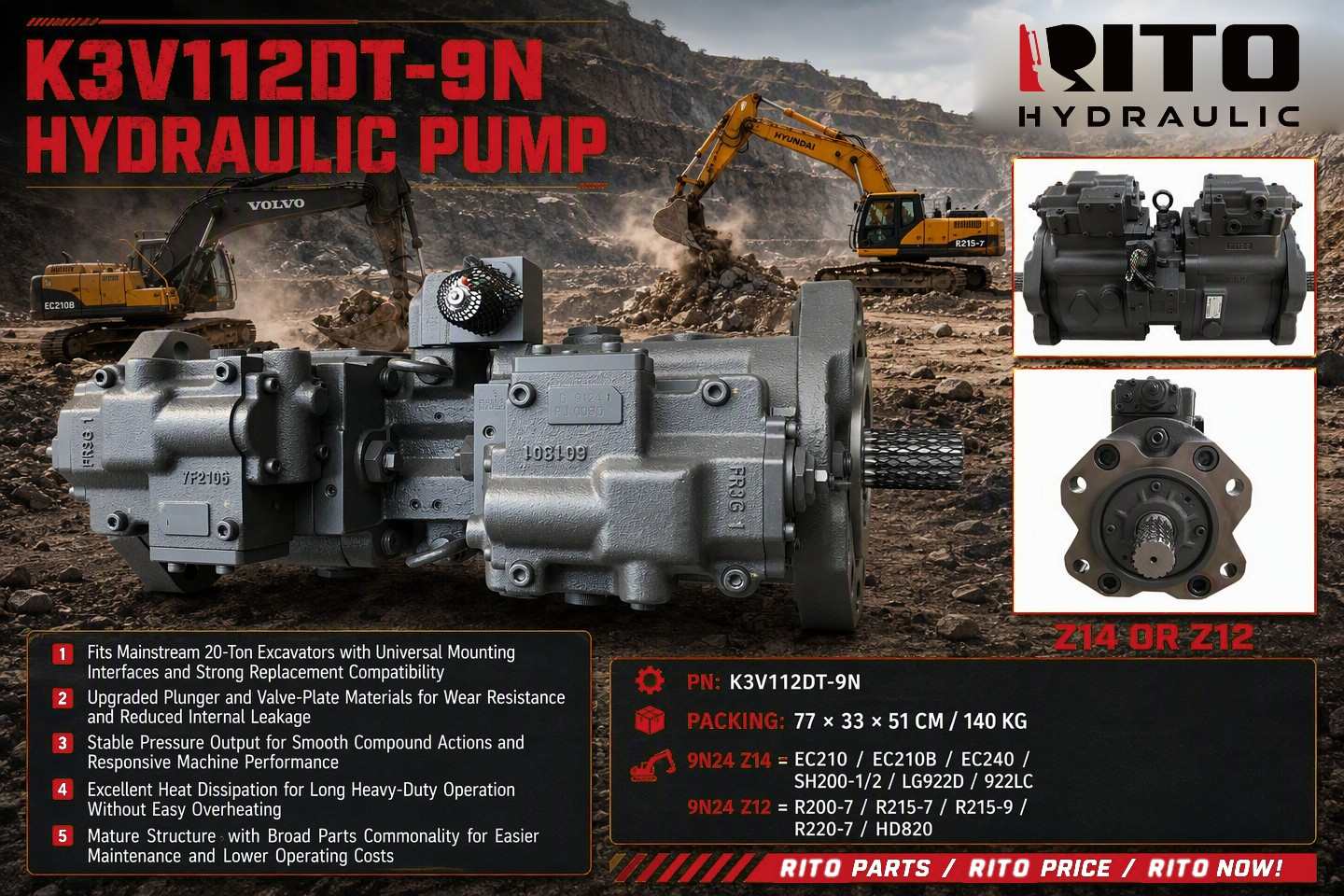
This pump is offered with two spline options, and the product sheet maps them to specific machines:
| Spline option | Machines listed on the product sheet |
|---|---|
| Z14 (14-tooth) | Volvo EC210, EC210B, EC240; Sumitomo SH200-1 / SH200-2; LG922D, 922LC |
| Z12 (12-tooth) | Hyundai R200-7, R215-7, R215-9, R220-7; Doosan HD820 |
From a photograph, the two units are indistinguishable. From the coupling side, they are different parts — and the wrong one will not slide on. Three things follow, and they are the practical core of this article:
- Never order by machine name alone. "For EC210" and "for R215-7" describe two different splines of the same pump.
- Count the teeth on your old unit and photograph the shaft end straight-on, so the count is visible in the picture.
- A "nearly right" fit is worse than a wrong one. If a pump goes on but does not seat properly, it will fret, generate debris and fail again — quietly, over months.
The same trap exists on other machines in the Kawasaki and CAT ranges, which is why we treat the spline as a first-class ordering detail. If you want to see how far that logic goes, our guide to the CAT 336/340 pump and its 13T / 15T spline options works through exactly the same problem on a different brand.
One more layer exists above the spline: the build suffix. Market listings attach suffixes such as -9N24, -9N2A and -9C32 to K3V112DT pumps, and some of them are quoted against particular machine groups. Treat all of those as leads to verify. Your own plate — not a listing — is the authority on your machine's suffix.
4. Where 112 Sits in the K3V Range
The K3V family is not one pump — it is a series of displacement classes, numbered 63, 112, 140, 180 and 280. Each class is sized to a band of machine weight, and 112 is the class that landed squarely on the 20-tonne excavator.
| Class in the K3V range | What it tells you |
|---|---|
| Larger numbers | More oil displaced per revolution — sized for heavier machines |
| Smaller numbers | Less oil per revolution — sized for lighter machines |
| 112 | The class matched to the 20-tonne band, which is why it is everywhere |
This matters when you are cross-referencing, because people often quote a number that belongs to a different class and assume it is a variant. A K3V112 and a K3V140 are not two versions of one pump — they are two different sizes for two different machines. The naming logic inside the series is the same one we broke down for the Kobelco SK200-6E and its K3V112DTP variant, where a single extra letter changes the assembly.
5. Why Commonality Is a Buyer's Advantage — and a Trap
An installed base this large changes the economics of owning one, and it cuts both ways.
| Advantage | The other side of it |
|---|---|
| Parts are obtainable. Internals are shared across a wide model spread, so regulators, plates, pistons and seal kits are readily available | Quality varies enormously. High demand attracts low-grade copies and careless rebuilds |
| Servicing is straightforward. A mature design that mechanics know well | "Fits K3V112" is not a fitment guarantee — family membership says nothing about spline or suffix |
| Repair is often viable, which keeps a 20-tonne machine economical to keep working | A rebuild is only as good as its parts and testing — ask what was replaced, and demand a test report |
| Competitive pricing, because suppliers compete on a well-known part | The cheapest unit is rarely the cheapest outcome when it is fitted to a contaminated system |
The practical rule: buy from a supplier who tests the unit and can tell you what level of repair it is, and treat the family name as the start of the conversation rather than the end of it. Replacement pumps and the wider spare range are grouped under excavator hydraulic parts.
6. Why It Suits Heavy 20-Tonne Work
Commonality explains why the pump is everywhere. It does not explain why it stayed. Four characteristics are why the design survived decades of hard use:
| Characteristic | Why it matters on a 20-tonne machine |
|---|---|
| Upgraded plunger and valve-plate materials | Wear resistance at the surfaces that fail first, keeping internal leakage low over a long service life |
| Stable pressure output | Smooth compound actions — the boom, arm and bucket working together without one function starving another |
| Excellent heat dissipation | Long heavy-duty shifts without the oil temperature climbing into the range where seals and clearances suffer |
| Mature structure and common internals | Quicker diagnosis, faster parts and lower total operating cost over the life of the machine |
Heat deserves emphasis, because it is how most of these pumps actually die. A K3V112DT that is losing efficiency turns engine power into heat instead of oil flow. The operator notices slower cycles first, then rising oil temperature, then leaks appearing in seals that were fine last month. By the time a pump is visibly leaking or noisy, the cause has usually been running for a long time.
Two habits protect it more than anything else: keep the oil and filters clean, and do not work the machine hard on cold, thick oil. The clearances inside a piston pump are measured in microns; grit that gets past the filtration is the beginning of the end.
7. Confirm Before You Order
Because the family is shared so widely, ordering the correct unit comes down to a short, specific list:
- 1. Machine model and serial number — the serial identifies the build, not the badge.
- 2. The full code from your old pump's plate — including the suffix (-9N24, -9N2A, -9C32 or whatever yours carries).
- 3. The spline tooth count — count it and photograph the shaft end straight-on. Z14 or Z12.
- 4. Photographs of the whole pump — two or three angles including the flange, ports and regulator.
- 5. What the machine does wrong and when — every function or only some; cold or hot; loaded or idle.
On a 140 kg assembly, five minutes of identification is worth far more than the freight on a wrong unit.
8. FAQ
Q1: Why is the Kawasaki K3V112DT so common on 20-ton excavators?
Because most excavator manufacturers bought the same pump. Volvo, Hyundai, Doosan, Sumitomo and Kobelco all specified Kawasaki's K3V112 for their 20-tonne machines, so it became the de facto standard for the class and built the largest installed base of any pump in that size.
Q2: Which excavators use the K3V112DT?
Commonly listed applications include Volvo EC210, EC210B and EC240, Sumitomo SH200-1 / SH200-2, LG922D and 922LC, and Hyundai R200-7, R215-7, R215-9 and R220-7, plus Doosan HD820. Always confirm against your own machine and plate.
Q3: What does DT mean, and how is it different from DP?
D means double — two pumping sections in one housing. T means tandem; P means parallel. So K3V112DT is the tandem version and K3V112DP is the parallel version, as used on the Hyundai R210W-9. One letter, a different assembly.
Q4: What is the difference between Z14 and Z12?
It is the input spline — the toothed shaft that drives the pump from the engine side. Z14 has 14 teeth, Z12 has 12. The pump will not fit a machine whose coupling expects the other count, and it cannot be adapted on site.
Q5: Which spline do I need for a Volvo EC210 or EC240?
The product sheet lists these machines against the Z14 (14-tooth) spline, together with Sumitomo SH200-1 / SH200-2 and LG922D / 922LC. Confirm by counting the teeth on your own pump before ordering.
Q6: Which spline do I need for a Hyundai R215-7 or R220-7?
These are listed against the Z12 (12-tooth) spline, along with the Hyundai R200-7, R215-9 and Doosan HD820. As always, verify the tooth count on your own unit rather than relying on the model name.
Q7: What does the -9N24 suffix mean?
It is the build variant code within the K3V112DT family. Different variants carry different suffixes (-9N24, -9N2A, -9C32 and others) and are quoted against different machine groups, so the suffix has to come from your own pump's plate.
Q8: Can I use a K3V112DP where a K3V112DT is fitted?
No. They are different arrangements of the same size class. Treat the full code — series, class, arrangement letter, suffix and spline — as one identity, and change none of it without confirmation.
Q9: The machine got slower and the oil runs hot — is it the pump?
Slower cycles across every function, together with rising oil temperature, is the classic signature of a pump losing volumetric efficiency. Check suction, relief settings and the control signal as well, and have the pump tested before you buy anything.
Q10: What should I send to get a quotation?
The machine model and serial number, the full plate code from the old pump, the input spline tooth count, two or three clear photographs of the pump, and a description of what the machine does wrong and when.
9. Get Your Pump Confirmed
Send us your machine model, serial number, the full plate code from your old pump and your spline tooth count (Z14 or Z12) — plus a few clear photos — and our team will confirm the correct assembly for your machine, flag any variant difference, and quote lead time the same day. RITO HYDRAULIC supplies complete, individually tested main pumps, swing devices, travel motors and control valves for Kawasaki, Volvo, Hyundai, Doosan, Sumitomo, Komatsu, Hitachi, Caterpillar and Kobelco machines — with export packing and a 6–12 month warranty.
Contact our team or learn more about RITO HYDRAULIC.
- CAT 330GC Final Drive — Which Part Number Fits and What Should You Check Before You Buy?
- Why Do Customers Need the TM40 Travel Assembly? When It Is Used, What It Does, and What It Changes
- Komatsu PC300-8 / PC350-8 Hydraulic Pump: Which 708-2G Number Fits, and Why PC300-7 Numbers Keep Appearing
- Why Does a CAT 320C / 320D Hydraulic Pump Lose Power Under Heavy Load?
- Why Does Your CAT 312C Need the SBS80 Hydraulic Pump?