
Hyundai R210W-9S Hydraulic Pump Explained: What the K3V112DP Model Number Actually Means


Author
JERY WANG
Guangzhou Rito Hydraulic Co.,Ltd., located in Guangzhou, China, is a leading manufacturer and distributor of hydraulic pumps, final drives, swing motors, and main control valves for earthmoving machinery. We supply genuine, OEM, and high-quality aftermarket parts.
We are committed to continuously sharing our expertise regarding construction machinery and excavator hydraulic systems. Our goal is to help you gain a deeper understanding of equipment principles and applications—enabling you to work more efficiently—while also showcasing our professional knowledge and capabilities. We invite you to learn more about us.
Choose us, and you will enjoy the best service, the most favorable prices, and the most reliable supplier!
Marie R. Winters


Quick Answer
K3V — Kawasaki's variable-displacement, swash-plate type axial piston pump series. 112 — the displacement class, about 112 cc/rev per pumping section. DP — Double pump, Parallel type: two pumping sections in one assembly, arranged in a parallel configuration.
That last part is where most people go wrong, because Kawasaki uses different letters for different double-pump arrangements — and "double pump" alone does not tell you which one you have. This guide explains the whole code, in plain language.
Key Takeaways
- K3V = Kawasaki's variable-displacement swash-plate axial piston pump series.
- 112 = the displacement class — roughly 112 cc/rev per section (not a pressure rating).
- D = double pump; DT = double pump, tandem type; DP = double pump, parallel type; S = single pump.
- The short model code is not the full part number — everything after it (suffix, spline, regulator) identifies the exact build.
- K3V and K5V are different series — the same displacement number does not make them interchangeable.
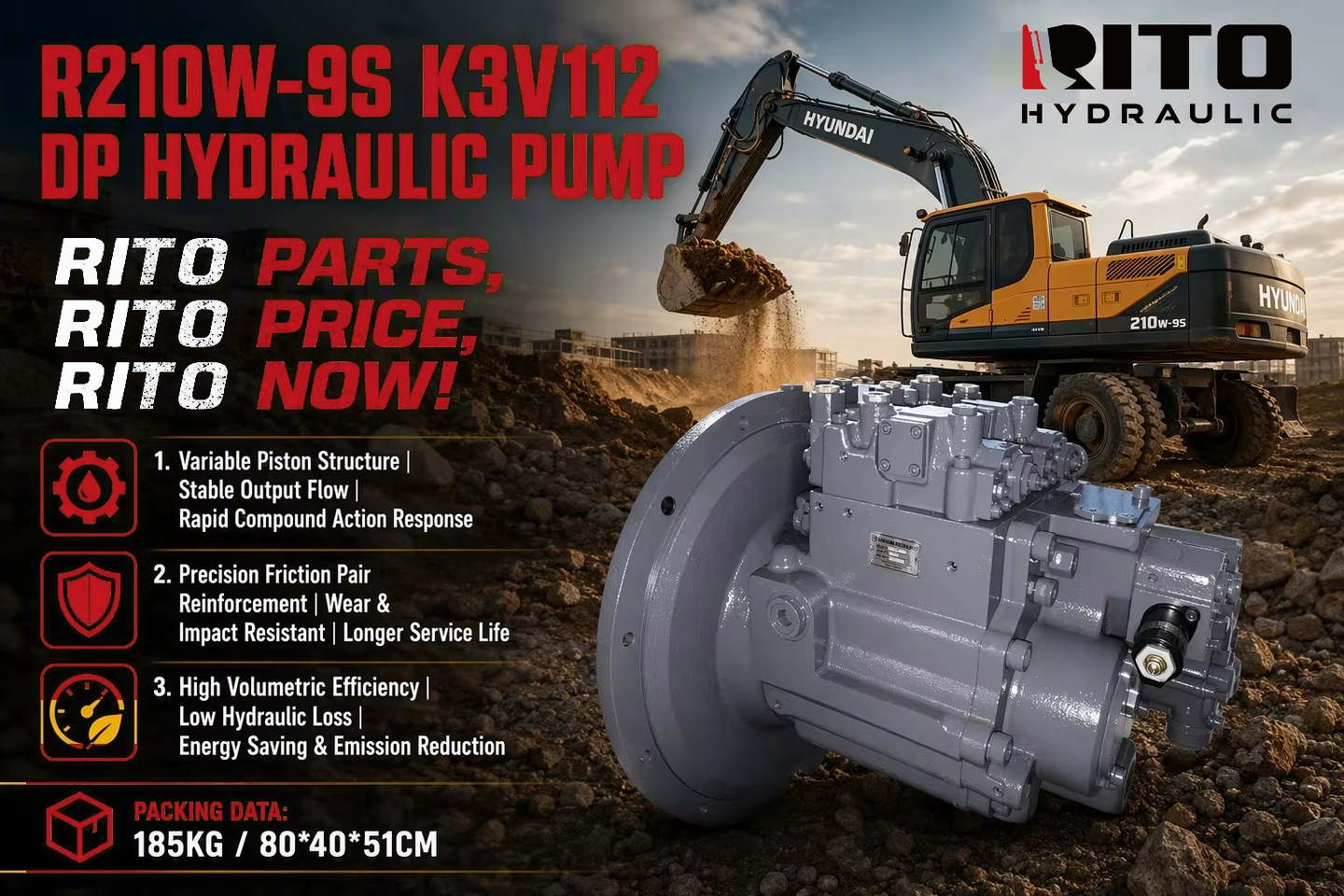
- Product facts for reference: about 185 kg, packed 80 × 40 × 51 cm.
Table of Contents
- 1. The Product: What This Pump Is
- 2. Decoding K3V112DP, Piece by Piece
- 3. D, DT, DP, S: What the Configuration Letters Mean
- 4. What a "Parallel" Double Pump Actually Is
- 5. What the "112" Does and Does Not Tell You
- 6. The Part of the Code Everyone Misses
- 7. K3V vs K5V, and the Family Ladder
- 8. What This Pump Delivers on a Wheeled Excavator
- 9. How to Use This Knowledge
- 10. FAQ
- 11. Confirm Your Pump
1. The Product: What This Pump Is
The Hyundai R210W-9S is a wheeled excavator in the 21-tonne class. Like every machine in this class, its work is done hydraulically — and the component that creates that hydraulic power is the main pump.
On this machine, the main pump is a Kawasaki K3V112DP. Two things are worth understanding up front:
- It is a Kawasaki pump fitted by Hyundai. The pump's maker and the machine's maker are different companies — which is exactly why you will meet two layers of naming (see section 6).
- It is a double pump. Excavators have to run several functions at once, so the assembly contains two pumping sections in one unit.
Complete, individually tested assemblies in this family are listed under Kawasaki-series hydraulic parts.
2. Decoding K3V112DP, Piece by Piece
| Segment | Value | What it means |
|---|---|---|
| Series | K3V | Kawasaki variable-displacement axial piston pump series (swash-plate type, open circuit) |
| Displacement class | 112 | About 112 cc/rev per pumping section |
| Configuration | DP | Double pump, Parallel type — two sections in one assembly |
That is the whole basic code. It is short — and that brevity is the point of the next section.
3. D, DT, DP, S: What the Configuration Letters Mean
Kawasaki uses the letters after the displacement number to describe the pump configuration. The pattern is consistent across the K3V series:
| Code | Meaning | Example |
|---|---|---|
| S | Single pump | K3V112S |
| D | Double pump | K3V112D |
| DT | Double pump, Tandem type | K3V112DT |
| DP | Double pump, Parallel type | K3V112DP |
This is the single most useful piece of nomenclature in the whole family, because it explains why two pumps that are both "K3V112 double pumps" can still be built differently — and it is why we distinguish DT from DP rather than treating "double pump" as one thing. You can see the same family at work in a different machine on our R210W-9 pump selection guide.
4. What a "Parallel" Double Pump Actually Is
Both DT and DP pumps contain two variable-displacement sections — the difference is how those sections are arranged and how their output is used.
| Aspect | Tandem (DT) | Parallel (DP) |
|---|---|---|
| Sections | Two | Two |
| Arrangement | In line, one behind the other | Set in a parallel arrangement in the assembly |
| Why it matters | Affects the physical envelope, coupling and port layout | Affects the physical envelope, coupling and port layout |
For a buyer, the practical takeaway is simple: "double pump" describes the concept; the letter pair describes the build. Do not treat a DT pump and a DP pump as interchangeable just because both are "double" — and always match the code, not the concept. The same family is used in tracked machines too, with its own codes — see our Kobelco K3V112DTP guide for an example with a different suffix.
5. What the "112" Does and Does Not Tell You
The number in the middle is the pump's displacement class — the theoretical volume of oil moved per revolution, expressed in cc/rev (cm³/rev). A K3V112 is therefore a pump in the roughly 112 cc/rev class per section.
Displacement matters because it drives flow:
At the same engine speed, a larger displacement class can produce more flow — which is why the number goes up as machines get bigger.
But two things the number does not tell you are worth remembering:
- It is not a pressure rating. A bigger number does not automatically mean "more pressure" or "more power". Pressure comes from the system — relief settings, load and the machine's design — not from the displacement figure alone.
- It is not the whole specification. Two pumps can share the same displacement class and still differ in regulator, shaft, ports and settings.
So treat "112" as the size class, not as a complete identity. For the bigger machines in this family, the same logic applies — for example the K3V180DTP on the Hyundai R340/R340L, which sits one displacement class up.
6. The Part of the Code Everyone Misses
The short model code is only the beginning. On a real pump you will find a longer identification string after it — and that is where the exact build lives. Those extra characters can describe:
| What the extra characters can specify | Why it matters |
|---|---|
| Specification variant | A suffix such as -9N identifies which variant of the assembly you have |
| Input spline | A marking such as Z14 or Z12 denotes the number of teeth on the drive coupling — 14 or 12. The wrong spline will not engage the machine's coupling |
| Regulator / control | The part that decides how the pump responds to demand — matched to the machine |
| Shaft, rotation and ports | Physical interface details that decide whether it installs correctly |
That is why a pump can look identical to yours and still be wrong: the difference hides in the part of the code people do not write down.
7. K3V vs K5V, and the Family Ladder
Kawasaki's construction-machinery pumps are organised into series, each with its own displacement ladder:
| Series | Typical displacement classes seen | Note |
|---|---|---|
| K3V | 63, 112, 140, 180 … | The series your R210W-9S pump belongs to |
| K5V | 80, 140, 160, 200 … | A different Kawasaki series — not a drop-in substitute |
Two rules follow directly:
- Same number, different series ≠ interchangeable. A K3V140 and a K5V140 share a displacement class and nothing more.
- Bigger number ≠ automatically better. The right pump is the one matched to the machine's system, not the largest one that fits.
Inside the K3V series itself, the ladder runs from compact classes up to large ones — the same series, sized for different machine weights. That is why "K3V" alone tells you almost nothing until you read the number and the letters after it.
8. What This Pump Delivers on a Wheeled Excavator
Understanding the code is useful; understanding what the product does is what makes a difference on site. On the R210W-9S, the K3V112DP is the pump behind every function — boom, arm, bucket, swing and travel.
| Design point | What it means in use |
|---|---|
| Variable piston structure | Output follows demand instead of being fixed — smoother and more efficient |
| Stable output flow | Consistent speed and response across the working range |
| Rapid compound action response | Two functions working together — swing while lifting, for example — stay coordinated |
| Reinforced precision friction pairs | The closely fitted working surfaces resist wear and impact, extending service life |
| High volumetric efficiency | More of the oil the pump moves reaches the circuit, so less energy is lost as heat |
On a wheeled machine there is an extra dimension: it travels far more often than a crawler, repositioning between jobs and running on roads. That duty pattern is one reason the pump is matched specifically to this machine rather than shared blindly with a tracked model of a similar size.
9. How to Use This Knowledge
- Read the full code on the pump plate — not just "K3V112DP", but the whole string, including the suffix and spline marking.
- Add your machine model and serial number — the same model can be built with more than one pump specification.
- Confirm before ordering — a supplier who holds the cross-reference can verify the build, the variant and the interface in one step.
Complete, individually tested assemblies are listed under excavator hydraulic parts. And when you plan the job, remember the physical facts: about 185 kg, packed 80 × 40 × 51 cm — heavy freight, so arrange lifting at both ends.
10. FAQ
Q1: What is a K3V112DP pump?
It is a Kawasaki variable-displacement swash-plate axial piston pump in the roughly 112 cc/rev class, built as a double pump in the parallel (DP) configuration. On the Hyundai R210W-9S it is the main hydraulic pump.
Q2: What does "DP" mean in K3V112DP?
DP stands for "double pump, parallel type" — two pumping sections in one assembly, arranged in a parallel configuration. It is a different configuration from DT (double pump, tandem type).
Q3: What does the 112 mean?
It is the displacement class — about 112 cc/rev per pumping section. It describes the size of the pump, not its pressure rating.
Q4: Is K3V112DP the same as K3V112DT?
No. Both are double pumps in the 112 class, but DT and DP describe different configurations. Do not treat them as interchangeable — match the code on your pump plate.
Q5: Is K3V112 the same as K5V140?
No. K3V and K5V are different Kawasaki series. Even where displacement classes are similar, the design, dimensions, control and application can differ.
Q6: Is the short code K3V112DP enough to order a pump?
No. The short code identifies the type and size. The exact build is defined by the full identification string on the pump plate — including the specification variant and the input spline marking such as Z14 or Z12.
Q7: What do Z14 and Z12 mean?
They indicate the number of teeth on the input spline of the drive coupling — Z14 is 14 teeth, Z12 is 12. The spline must match the coupling on your machine, so confirm it before ordering.
Q8: Why do two pumps with the same model look identical but differ?
Because the differences are in the details the short code does not show: the regulator, the shaft and spline, the ports, and the factory settings.
Q9: How heavy is the K3V112DP assembly?
About 185 kg, packed in an 80 × 40 × 51 cm case — plan lifting equipment and heavy freight.
Q10: Where is the pump code on my machine?
On the identification plate attached to the pump body. Clean it carefully and photograph the entire plate, plus two or three photos of the whole pump including the ports.
11. Confirm Your Pump
Send us your machine model, serial number and the full pump code from the identification plate — plus a few clear photos — and our team will confirm the correct K3V112DP build, including any variant and spline detail, and quote lead time the same day. RITO HYDRAULIC supplies complete, individually tested main pumps, control valves, travel motors and swing motors for Hyundai, Kawasaki-series, Komatsu, Hitachi, Kobelco, Caterpillar and Doosan machines — with export packing and a 6–12 month warranty.
Contact our team or learn more about RITO HYDRAULIC.
- CAT 330GC Final Drive — Which Part Number Fits and What Should You Check Before You Buy?
- Why Do Customers Need the TM40 Travel Assembly? When It Is Used, What It Does, and What It Changes
- Komatsu PC300-8 / PC350-8 Hydraulic Pump: Which 708-2G Number Fits, and Why PC300-7 Numbers Keep Appearing
- Why Does a CAT 320C / 320D Hydraulic Pump Lose Power Under Heavy Load?
- Why Does Your CAT 312C Need the SBS80 Hydraulic Pump?