
CAT 336 / 340 Hydraulic Pump: 568-3006 vs 568-3007 and the 13T / 15T Spline Fitment Guide (2026)


Author
JERY WANG
Guangzhou Rito Hydraulic Co.,Ltd., located in Guangzhou, China, is a leading manufacturer and distributor of hydraulic pumps, final drives, swing motors, and main control valves for earthmoving machinery. We supply genuine, OEM, and high-quality aftermarket parts.
We are committed to continuously sharing our expertise regarding construction machinery and excavator hydraulic systems. Our goal is to help you gain a deeper understanding of equipment principles and applications—enabling you to work more efficiently—while also showcasing our professional knowledge and capabilities. We invite you to learn more about us.
Choose us, and you will enjoy the best service, the most favorable prices, and the most reliable supplier!
Marie R. Winters


Quick Answer
Key Takeaways
- The 336 / 340 pump is ordered under two numbers: 568-3006 and 568-3007.
- They are one pump family — the spline and the machine build decide which applies.
- The pump comes with a 13T or 15T input spline; matching it is what makes installation direct.
- Never order by photo or by machine name alone — read the plate on your old pump.
- "Fits 336 / 340" in a listing is a starting point, not a confirmation.
- Send plate code + machine serial + spline tooth count + photos, and this becomes a one-round purchase.
Table of Contents
- 1. The Pump at a Glance
- 2. Two Numbers: 568-3006 vs 568-3007
- 3. The Spline Interface: 13T or 15T
- 4. What "No Modification" Installation Requires
- 5. Three Features That Decide How It Performs
- 6. How to Confirm the Right Number
- 7. Numbers You May See Listed Alongside
- 8. FAQ
- 9. Get Your Pump Confirmed
1. The Pump at a Glance
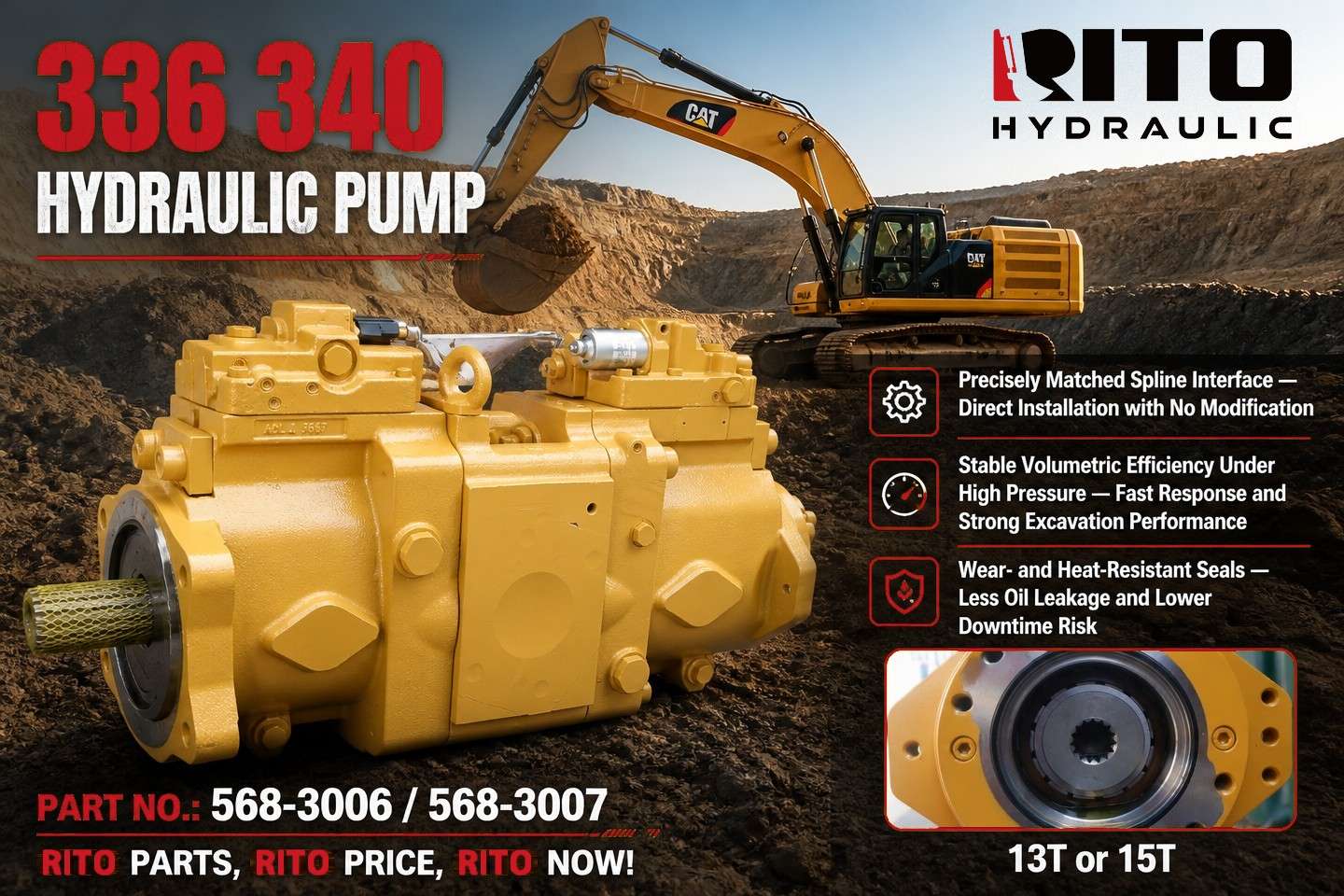
On a 36–40 tonne excavator the main pump is the machine's heart: it converts engine power into hydraulic flow, and every function the operator touches depends on it. On the CAT 336 and 340, that component is a variable-displacement axial-piston pump with two pumping sections in one housing — the layout Caterpillar uses on this size class to feed the travel and working circuits from one compact unit.
| Item | Detail |
|---|---|
| Application | CAT 336 / 340 class excavators (36–40 t) |
| Component | Main hydraulic pump (variable-displacement axial piston) |
| Configuration | Two pumping sections in one housing, engine-driven |
| Order numbers | 568-3006 / 568-3007 |
| Input interface | Spline drive — 13T or 15T option |
| Supplied as | Complete, individually tested assembly |
Because the pump is mounted directly on the engine side and driven through a splined coupling, it is a machined, matched assembly — not a part you can "make fit" on site. That single fact explains why the interface details in this guide matter more than the headline model name. Complete units and the wider range sit under Caterpillar-series hydraulic parts.
2. Two Numbers: 568-3006 vs 568-3007
Two order numbers for one machine family is normal Caterpillar practice, and it is the first thing buyers get wrong. Both numbers describe the same type of pump; they exist because the machine family branches into different builds and because Cat part numbers are revised over time.
| Why more than one number exists | What it means when you order |
|---|---|
| Different machine builds | The 336 / 340 family includes different configurations, so the fitted pump can differ by build, not just by model name |
| Production revision and supersession | An earlier number may have been replaced by a later one, while the older number still circulates in the market |
| Remanufactured references | Cat's reman programme adds its own reference alongside the new part number |
Two practical rules follow:
- 1. Do not pick a number because you saw it first. Read the plate on your own pump and have it cross-checked against the current reference.
- 2. Two numbers "listed together" is a seller's grouping, not the manufacturer's equivalence. Treat any grouping as a lead to verify, never as proof.
Buyers who skip this step usually discover the problem at the worst moment — when the machine is already stripped down. The same "buy before testing" lesson shows up on other CAT machines too; our guide to the classic faults on the 320GC pump works through it for the 20-tonne class.
3. The Spline Interface: 13T or 15T
This is the part of the purchase that catches the most people, because it is invisible in every product photo. The pump is driven by a splined input shaft that mates with the coupling on the engine side. On this pump that shaft is offered in two versions: a 13-tooth (13T) spline and a 15-tooth (15T) spline.
From a metre away, the two units look the same. From the coupling side, they are different parts.
| Situation | What happens |
|---|---|
| Correct spline matched | The pump slides onto the coupling and bolts up — direct installation, no modification |
| Wrong tooth count | It will not seat at all. Forcing it destroys the coupling — and can damage the engine-side drive |
| "Nearly right" fit | The worst case: it goes on, then frets. Expect noise, vibration, debris and a second failure |
Because the difference cannot be seen in a listing photo, the only reliable method is to read it from your own machine:
- Count the teeth on the input shaft of the pump you are replacing.
- Photograph the shaft end straight-on, in focus and well lit — the tooth count must be countable in the picture.
- Record the plate code and the machine serial at the same time, and send all three together.
If you cannot read the old pump — for example because it has already gone for scrap — the machine serial is the fallback, and a verified supplier can confirm the build from it. What you should never do is order from a photo of the pump body alone.
4. What "No Modification" Installation Requires
"Direct installation" is not a slogan; it is the result of six things being right at once. Any one of them wrong turns a one-day job into a week of fabrication and waiting.
| # | Must match | Why it decides the fit |
|---|---|---|
| 1 | Input spline (13T / 15T) | The pump must engage the engine-side coupling — there is no adaptation |
| 2 | Mounting flange and bolt pattern | The unit must bolt to the mounting group as the original did |
| 3 | Pilot / spigot diameter | Centres the pump on the drive; a mismatch causes vibration and early wear |
| 4 | Port positions and sizes | Hoses must reconnect without re-plumbing; wrong ports invite leaks |
| 5 | Regulator / control type and setting | Governs how output responds to load; the wrong control type makes the machine behave badly even though it "fits" |
| 6 | Rotation and orientation | The assembly must sit correctly against the engine and the hose runs |
Point 1 is the one unique to this pump and the one most often missed; points 2 to 6 are the standard checks that apply to every main pump on the machine. If you are also doing the fitting and the first start, the commissioning sequence is set out in our CAT main pump installation and long-life care guide — the order of flushing, first start and settings is the same regardless of the pump model.
5. Three Features That Decide How It Performs
Three characteristics of this pump do most of the work in service. Each one maps to a complaint you will recognise on a worn machine:
| Feature | In plain language | Why it matters when something feels wrong |
|---|---|---|
| Precisely matched spline interface | The drive interface is made to the original dimensions, so the unit installs directly | No machining, no adapter, no modified coupling — and no fretting wear from a slack fit |
| Stable volumetric efficiency under high pressure | The pump holds its flow as pressure rises, instead of leaking it internally | Weak, slow or hot-running behaviour under load is exactly what lost volumetric efficiency feels like |
| Wear- and heat-resistant seals | Sealing materials are chosen for hot, high-pressure duty | Less oil leakage and a lower risk of the pump taking the oil, filters and cooler down with it |
Read that table against a machine that has lost its edge and the diagnosis becomes clearer: flow loss is a pump matter, while one or two weak functions point to the valve. New assemblies and the wider spare range are listed under excavator hydraulic parts.
6. How to Confirm the Right Number
Five minutes of reading beats a wrong shipment on a part this size. Do this before you ask anyone for a price:
- 1. Read the plate on your old pump. Clean it, then photograph it straight-on and in focus. This is the single most valuable photo you can take.
- 2. Record the machine model and serial number. The serial is what tells a supplier which build and revision applies.
- 3. Count and photograph the input spline. 13T or 15T — write the number down next to the plate code.
- 4. Photograph the whole pump from two or three angles, including the flange and the port face.
- 5. Note what the machine actually does wrong. If it is weak only in one function, say so — it changes what should be checked first.
7. Numbers You May See Listed Alongside
Walk through any parts marketplace and you will see 568-3007 and 568-3006 quoted next to a crowd of other references — for example 20R-9707 (the remanufactured reference), 550-4341, 551-1118, 571-7932, 564-9801, 524-0924 and 505-0527. These appear in listings for the same machine family.
Two cautions, and they are not small ones:
- Listing groups are commercial, not engineering documents. Sellers group numbers they consider equivalent; that grouping is not a manufacturer's statement that the parts interchange.
- A reman reference is not a new part. A remanufactured number describes a rebuilt unit — know which tier you are buying before you compare prices.
Treat every one of those references as a lead to verify against your plate and serial, never as a substitute for them. If you are weighing a complete assembly against opening the pump and replacing internals, our complete assembly or internal parts breakdown covers that decision on a larger CAT machine, and the same logic applies here.
8. FAQ
Q1: What hydraulic pump does the CAT 336 / 340 use?
It uses a variable-displacement axial-piston main pump with two pumping sections in one housing, ordered under the Cat numbers 568-3006 and 568-3007. Confirm which number applies to your machine from the pump plate and the machine serial.
Q2: Are 568-3006 and 568-3007 the same pump?
They belong to the same pump family for the 336 / 340 class, but they are not automatically interchangeable. Which one your machine takes depends on its build and serial, so the plate and serial decide — not the number you happened to see first.
Q3: What does 13T or 15T mean on this pump?
It is the input spline option — a 13-tooth (13T) or 15-tooth (15T) splined shaft. The pump must match the coupling on your machine, so this is the number to confirm before ordering.
Q4: Why is the spline so important?
Because it cannot be adapted. A spline with the wrong tooth count will not seat at all, and a "nearly right" fit will fret, causing noise, vibration, debris and a second failure. Matching it is what makes installation a direct bolt-on.
Q5: How do I find my spline tooth count?
Count the teeth on the input shaft of the pump you are removing and photograph the shaft end straight-on so the teeth are countable. If the old pump is already gone, the machine serial is the fallback.
Q6: Can I order by machine model alone?
No. "Fits 336 / 340" is a starting point. Within one machine family, more than one pump number and more than one spline option can apply, so the plate, serial and spline count are what confirm the order.
Q7: What else has to match besides the spline?
The mounting flange and bolt pattern, the pilot diameter, the port positions, the regulator type and setting, and the orientation. Together these decide whether the pump is a true bolt-on replacement.
Q8: The machine is weak under load — is it the pump?
Weakness in all functions points to the pump or its control system. Weakness in only one or two functions usually points to the control valve, not the pump. A pressure and flow test separates the two before you spend anything.
Q9: What should I send to get a quotation?
The machine model and serial number, the plate code from the old pump, the spline tooth count, two or three photos of the pump, and any pressure, flow or fault-code readings you have.
Q10: How can I be sure the replacement is good before it ships?
Ask for a per-unit test report, a written warranty and a clear statement of whether the unit is new or remanufactured. A verified supplier bench-tests flow, pressure and leakage and provides the data before shipment.
9. Get Your Pump Confirmed
Send us your machine model, serial number, the plate code from the old pump and your spline tooth count (13T or 15T) — plus a few clear photos — and our team will confirm which of the two numbers applies to your 336 / 340, flag any supersession, and quote lead time the same day. RITO HYDRAULIC supplies complete, individually tested main pumps, travel motors, swing motors and control valves for Caterpillar, Komatsu, Hitachi, Kobelco, Hyundai, Doosan and Kawasaki-series machines — with export packing and a 6–12 month warranty.
Contact our team or learn more about RITO HYDRAULIC.
- CAT 330GC Final Drive — Which Part Number Fits and What Should You Check Before You Buy?
- Why Do Customers Need the TM40 Travel Assembly? When It Is Used, What It Does, and What It Changes
- Komatsu PC300-8 / PC350-8 Hydraulic Pump: Which 708-2G Number Fits, and Why PC300-7 Numbers Keep Appearing
- Why Does a CAT 320C / 320D Hydraulic Pump Lose Power Under Heavy Load?
- Why Does Your CAT 312C Need the SBS80 Hydraulic Pump?