
Kobelco SK200-6E Hydraulic Pump (K3V112DTP): How to Match the Right Variant & Avoid the #1 Ordering Mistake (2026 Guide)


Author
JERY WANG
Guangzhou Rito Hydraulic Co.,Ltd., located in Guangzhou, China, is a leading manufacturer and distributor of hydraulic pumps, final drives, swing motors, and main control valves for earthmoving machinery. We supply genuine, OEM, and high-quality aftermarket parts.
We are committed to continuously sharing our expertise regarding construction machinery and excavator hydraulic systems. Our goal is to help you gain a deeper understanding of equipment principles and applications—enabling you to work more efficiently—while also showcasing our professional knowledge and capabilities. We invite you to learn more about us.
Choose us, and you will enjoy the best service, the most favorable prices, and the most reliable supplier!
Marie R. Winters


Quick Answer
Key Takeaways
- The SK200-6E hydraulic pump is a Kawasaki K3V112DTP, order number YN10V00022F2 (approx. 150 kg).
- "K3V112DTP" is only the family name — the suffix code decides whether it actually fits.
- Two pumps with the same family name but a different control type or regulator suffix will not work interchangeably.
- Match five points: full pump code, machine model & serial, control type, port/rotation, mounting.
- K3V112DT and K3V112DTP are related but not identical — confirm the exact suffix.
- Photograph the nameplate and serial plate and send them together — that single step prevents most wrong orders.
Table of Contents
- 1. What Pump Does the SK200-6E Use
- 2. Decode the K3V112DTP Part Number
- 3. Why the Same Code Can Still Be Wrong
- 4. The 5-Point Match Check
- 5. K3V112DT vs K3V112DTP and Other Confusions
- 6. Symptoms That Point to the Pump
- 7. Mistakes That Cause the Wrong Order
- 8. FAQ
- 9. Get the Right SK200-6E Pump
1. What Pump Does the SK200-6E Use
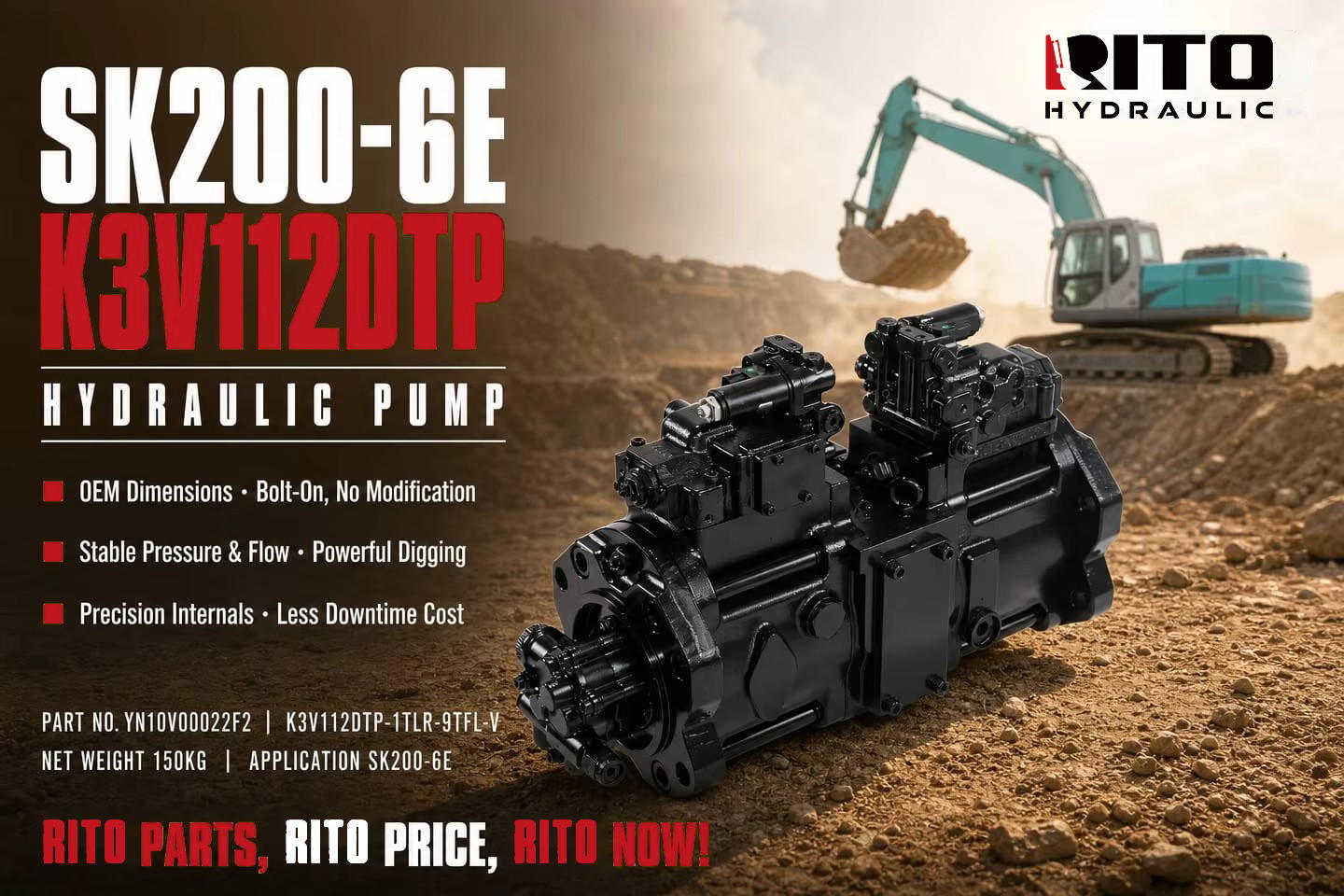
The Kobelco SK200-6E sits in the 20-tonne class and is one of the most widely used Kobelco machines in Africa, the Middle East and Southeast Asia. Its main hydraulic pump is a Kawasaki K3V112DTP tandem axial-piston pump, ordered under Kobelco part number YN10V00022F2 and carrying a system weight of around 150 kg.
Because the K3V112 platform is shared across many brands, the pump itself is not rare — the difficulty is picking the correct variant. Kawasaki builds the K3V112 in a long list of configurations, and each machine maker (and even each machine model and serial range) receives its own tailored code. That is why our Kawasaki-series hydraulic parts listings are organised by full pump code rather than by family name alone.
2. Decode the K3V112DTP Part Number
The full pump code reads like a sentence once you know the grammar. Using K3V112DTP-1TLR-9TFL-V as the example:
| Segment | Value | What it tells you |
|---|---|---|
| Series | K3V112 | 112 cc/rev family — the pump's displacement class |
| Type | DTP | Configuration code (tandem + control/regulator type) |
| Design / control | 1TLR | Regulator & control variant — the critical block |
| Rotation / shaft | 9TFL | Rotation direction, shaft and mounting details |
| Revision | V | Build/suffix revision — small changes, still must match |
| Order number | YN10V00022F2 | Kobelco's own part number for this assembly |
The important lesson: the first block (K3V112) only narrows you to a family of hundreds of possible configurations. The blocks after it — 1TLR in particular — are what make the pump correct for your machine.
3. Why the Same Code Can Still Be Wrong
Here is the mistake that costs the most money. A buyer searches "K3V112DTP", finds a pump that physically bolts up, installs it — and the machine still behaves badly: slow functions, poor power, or an engine that loads up and stalls. The pump "fits" but the control logic is wrong.
| Mismatch | What happens on the machine |
|---|---|
| Different regulator suffix | Pump output does not match the machine's demand — weak or over-loaded |
| Different control type | Pump and valve no longer communicate; response is sluggish or erratic |
| Wrong rotation / shaft | Won't install, or drives backwards |
| Different port layout | Lines do not route without re-plumbing |
| Different mounting | Bolt pattern and pilot do not line up |
In practice, the regulator / control suffix is the single most common reason a "correct-looking" K3V112DTP under-performs. This is exactly why a reputable supplier will ask for your serial number before quoting.
4. The 5-Point Match Check
Before you order, confirm all five. If any one is unknown, stop and verify it — the cost of a return far exceeds the time it takes to check.
| # | Must match | Where to find it |
|---|---|---|
| 1 | Full pump code | Nameplate on the pump body |
| 2 | Machine model & serial | Serial plate on the machine frame |
| 3 | Control type | Regulator suffix + machine manual |
| 4 | Rotation & port layout | Pump photos, front and rear |
| 5 | Mounting & fittings | Flange face and bolt pattern |
A quick, reliable shortcut: photograph the pump nameplate straight-on, photograph the whole pump from two angles, and photograph the machine serial plate. Those four images let a supplier confirm the correct variant without guesswork. The full range of complete assemblies is listed under excavator hydraulic parts.
5. K3V112DT vs K3V112DTP and Other Confusions
Because the K3V112 family is used on Komatsu, Hitachi, Kobelco, Hyundai and others, buyers frequently mix up neighbouring codes. Keep these straight:
- K3V112DT vs K3V112DTP — related members of the same 112 cc family, but the trailing letters change the configuration. Never assume they are interchangeable; confirm the exact suffix.
- K3V112 vs K3V140 / K3V180 — different displacement classes. They look similar in photos but belong to different machine sizes.
- Same family, different machine — a K3V112DTP built for one brand's 20-ton machine may not suit another, because the regulator setting is matched to that brand's control system.
- Rebuild sold as new — a "K3V112DTP" that is actually a remanufactured unit. Ask for a per-unit test report and a real warranty.
6. Symptoms That Point to the Pump
Operators often blame the pump for faults that live elsewhere — and vice versa. These signs most often trace back to the main pump:
- 1. All functions are weak and slow at the same time (a single weak function usually points to the control valve instead).
- 2. Rising oil temperature and a hot case drain — internal wear converts flow into heat.
- 3. Metal in the filter or a magnetic plug full of debris.
- 4. Whining or grinding noise that follows pump speed.
- 5. The machine stalls or lugs under load as the pump loses efficiency.
If several of these appear together, book a pressure-and-flow test before ordering — the numbers confirm whether the pump or the valve is at fault.
7. Mistakes That Cause the Wrong Order
- Ordering by "K3V112DTP" alone — the family name is not a part number.
- Ignoring the regulator suffix — the most common and most costly mismatch.
- Skipping the machine serial — a mid-series change can alter the fitted pump.
- Judging by an online photo — two pumps can look identical and still differ inside.
- Not flushing after fitting — debris from the failed pump destroys the new one.
After replacement, always flush the system, renew the return filter and suction strainer, fill with fresh correct-grade oil, and run light functions first before returning to full load.
8. FAQ
Q1: What hydraulic pump does the Kobelco SK200-6E use?
A Kawasaki K3V112DTP tandem pump, order number YN10V00022F2 (full code K3V112DTP-1TLR-9TFL-V), weighing around 150 kg.
Q2: Why can two K3V112DTP pumps be different?
Because "K3V112DTP" is only the family name. The suffix blocks — especially the regulator/control code — are tailored to each machine, so the same family can come in many non-interchangeable variants.
Q3: Will a K3V112DT fit instead of a K3V112DTP?
Do not assume it. They are related but different configurations. Confirm the exact suffix code and machine details before ordering.
Q4: What information do I need to order correctly?
The full pump code from the nameplate, your machine model and serial number, and clear photos of the pump from two angles. That is usually enough to confirm the correct variant.
Q5: What are the symptoms of a failing SK200-6E pump?
All functions weak and slow together, rising oil temperature, metal in the filter, whining under load, and engine lugging. A single weak function usually points to the control valve instead.
Q6: How heavy is the K3V112DTP pump?
Around 150 kg as a complete assembly, so plan lifting equipment and export packing accordingly.
Q7: Is the K3V112DTP a common pump?
Yes — the K3V112 family is one of the most widely used 20-ton-class excavator pumps, shared across several brands. Availability is good; the challenge is matching the right variant.
Q8: Should I replace the pump or repair it?
If the fault is wear in the rotating group or regulator, a complete, individually tested assembly is usually the lower total-cost route once downtime is counted.
Q9: Do I need to flush the system after fitting a new pump?
Yes. Flush and renew the filters first, then fill with fresh correct-grade oil — otherwise debris left by the old pump will damage the new one.
Q10: How can I be sure the pump is right before it ships?
Ask for a per-unit test report, a 6–12 month warranty, and confirmation that it is a new, complete assembly matched to your exact code — not a rebuild sold as new.
9. Get the Right SK200-6E Pump
Send us your machine model, serial number and the full pump code from the nameplate — plus a few clear photos — and our team will confirm the correct K3V112DTP variant, provide a test-report sample and quote lead time the same day. RITO HYDRAULIC supplies complete, individually tested main pumps, travel motors, swing motors and control valves for Kobelco, Komatsu, Hitachi, Caterpillar, Hyundai, Doosan and Kawasaki-series machines — with export packing and a 6–12 month warranty.
Contact our team or learn more about RITO HYDRAULIC.
- CAT 330GC Final Drive — Which Part Number Fits and What Should You Check Before You Buy?
- Why Do Customers Need the TM40 Travel Assembly? When It Is Used, What It Does, and What It Changes
- Komatsu PC300-8 / PC350-8 Hydraulic Pump: Which 708-2G Number Fits, and Why PC300-7 Numbers Keep Appearing
- Why Does a CAT 320C / 320D Hydraulic Pump Lose Power Under Heavy Load?
- Why Does Your CAT 312C Need the SBS80 Hydraulic Pump?