
Hyundai R210W-9 (K3V112DP) Hydraulic Pump: How to Choose the Best-Matched Main Pump — Technical Guide & Selection Flow


Author
JERY WANG
Guangzhou Rito Hydraulic Co.,Ltd., located in Guangzhou, China, is a leading manufacturer and distributor of hydraulic pumps, final drives, swing motors, and main control valves for earthmoving machinery. We supply genuine, OEM, and high-quality aftermarket parts.
We are committed to continuously sharing our expertise regarding construction machinery and excavator hydraulic systems. Our goal is to help you gain a deeper understanding of equipment principles and applications—enabling you to work more efficiently—while also showcasing our professional knowledge and capabilities. We invite you to learn more about us.
Choose us, and you will enjoy the best service, the most favorable prices, and the most reliable supplier!
Marie R. Winters


Quick Answer
Key Takeaways
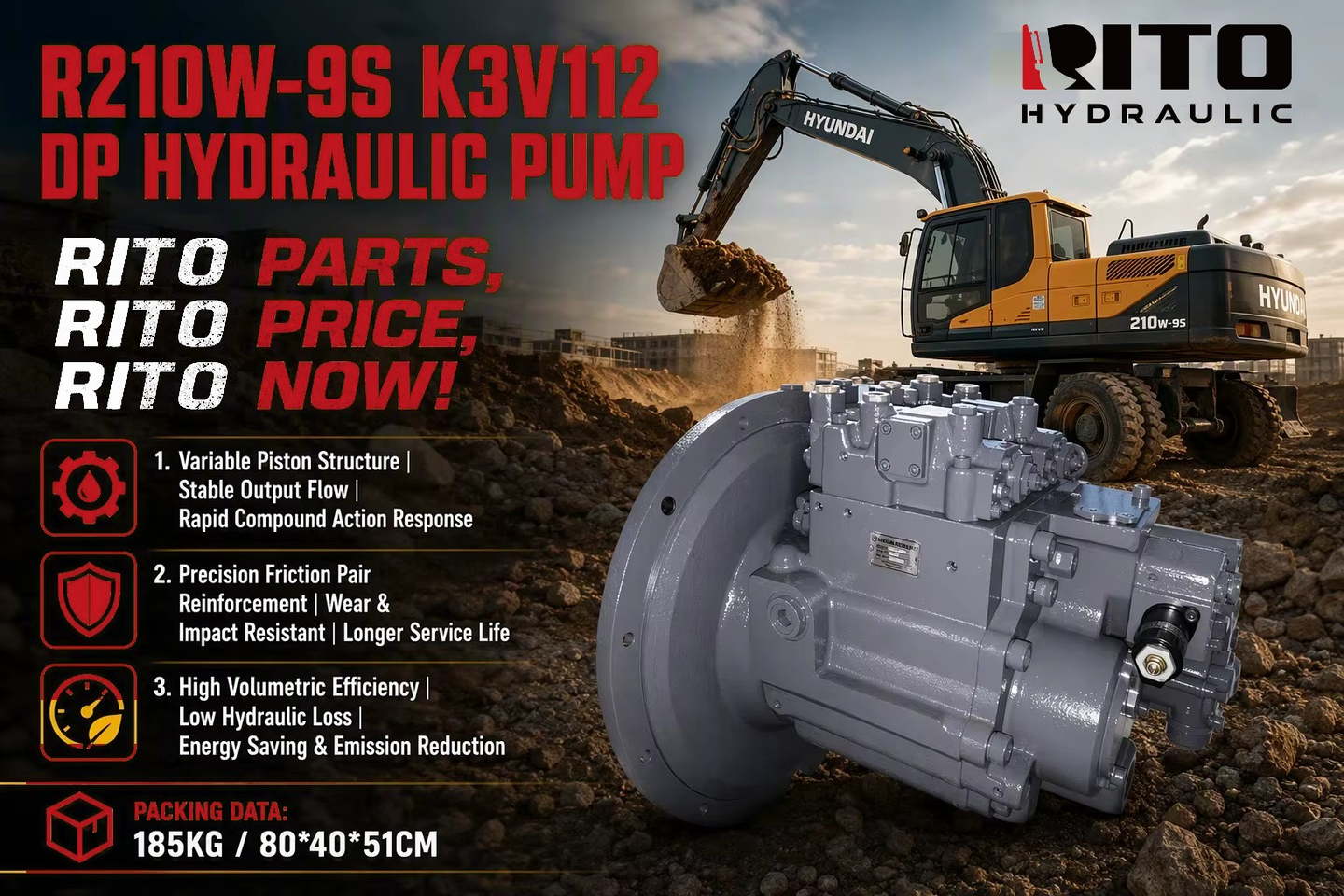
- Application: Hyundai R210W-9 / R210W-9S — a wheeled excavator; pump model K3V112DP.
- K3V112DP belongs to the Kawasaki K3V112 family — a widely used 20-tonne class pump.
- Use the selection flow: machine → pump code → control variant → mounting/shaft/ports → packing & warranty.
- A wheeled machine puts different demands on the pump than a crawler — do not swap by appearance.
- The nameplate code, not the model name, confirms the correct unit.
- Weight and packing matter in selection too: about 185 kg, 80 × 40 × 51 cm.
Table of Contents
- 1. A Wheeled Excavator Is Not a Crawler
- 2. The Pump: What "K3V112DP" Tells You
- 3. How the Main Pump Works (in Plain Words)
- 4. The Selection Flow: 6 Steps
- 5. Step by Step: What to Check
- 6. Why You Cannot Sub a Crawler Pump
- 7. Buying Guide: What a Good Supplier Provides
- 8. The Mistakes That Cost You Twice
- 9. FAQ
- 10. Get Your Pump Matched
1. A Wheeled Excavator Is Not a Crawler
Start here, because it changes everything downstream. The R210W-9 / R210W-9S is a wheeled excavator — the "W" in the model name says so, and it travels on wheels rather than tracks. That single fact shapes how the machine is used and therefore what its hydraulic pump is asked to do.
| Aspect | Crawler excavator | Wheeled excavator (R210W-9S) |
|---|---|---|
| Travel | Tracks, slow, high traction | Wheels, road-capable and fast to reposition |
| Typical work | Heavy digging, quarry, mining | Urban construction, roadworks, trenching, mixed sites |
| Duty pattern | Long, steady digging cycles | Frequent travel and repositioning, more start-stop |
| What the pump must handle | Sustained high pressure | Varied demand, roading, and a wheel-drive circuit |
In other words: a wheeled machine is a different hydraulic job, not a crawler on wheels. That is why the pump on a 210W machine is matched specifically to it — and why a pump that suits a tracked machine of a similar size is not automatically the right one here.
2. The Pump: What "K3V112DP" Tells You
The main pump on this machine is a K3V112DP. Read the name in two pieces:
| Part of the name | What it tells you |
|---|---|
| K3V112 | The Kawasaki K3V112 pump family — a variable-displacement piston pump widely used in the 20-tonne class |
| DP | The variant suffix — the build/control configuration for this application |
Because the K3V112 platform is shared across several excavator brands, the family name alone is not enough. The suffix is what ties a pump to a particular machine and control system — so K3V112DP is a model-level answer, and the nameplate code is the final one. The full Kawasaki-series range shows how this pump family scales across models, and our Hyundai K3V180DTP (R340/R340L) guide covers the larger end of the same story.
3. How the Main Pump Works (in Plain Words)
A quick technical grounding helps you read a supplier's answer with confidence:
- 1. It converts power. The engine spins the pump, and the pump turns that mechanical power into hydraulic power — pressurised oil flow.
- 2. It is variable. Unlike a fixed pump, it changes its output to match what the operator asks for. That is what makes the machine smooth and efficient, and it is the meaning behind "stable output flow" on a product sheet.
- 3. It is a parallel-type double pump (DP). The assembly is effectively two pump sections sharing one housing and shaft, so the machine can combine flows for speed or divide them when several functions work together.
- 4. Its output goes to the valve. The control valve assembly distributes that oil to the boom, arm, bucket, swing and travel circuits.
- 5. Its surfaces decide its life. "Precision friction pairs" are the closely fitted working surfaces inside — barrels, pistons, shoes. Their condition, and the cleanliness of the oil around them, decide how long the pump stays efficient.
Complete, individually tested assemblies in this family are listed with the wider excavator hydraulic parts range.
4. The Selection Flow: 6 Steps
Here is the whole selection process on one page. Work top to bottom; do not skip a step because it "looks fine".
| Step | Action | Result |
|---|---|---|
| 1 | Identify the machine: model + serial | Narrows the correct pump build |
| 2 | Read the pump nameplate code | Confirms the exact unit fitted |
| 3 | Confirm the control / regulator variant | Prevents a pump that "fits but runs wrong" |
| 4 | Check mounting, shaft, ports and rotation | Confirms it physically installs |
| 5 | Confirm weight, packing and freight method | No surprises on delivery |
| 6 | Verify test report and warranty | Confirms you are buying a new, complete assembly |
The first three steps decide whether the pump is correct; the last three decide whether the purchase is safe. Most bad purchases fail on a step people thought was optional.
5. Step by Step: What to Check
| Check | Where to find it | Why it matters |
|---|---|---|
| Machine model & serial | Serial plate on the frame | Mid-production changes are tracked by serial |
| Pump nameplate code | Plate on the pump body | The suffix decides fitment, not the family name |
| Control / regulator variant | Nameplate suffix + machine manual | Wrong variant = sluggish, weak or over-loaded |
| Mounting flange & bolts | Photos of the pump | Must bolt up without adapters |
| Shaft / spline | Photos of the drive end | Must engage the coupling correctly |
| Ports & rotation | Photos from two or three angles | Lines must route without re-plumbing; wrong rotation will not work |
Take four photos and you have everything a supplier needs: the nameplate straight-on, the whole pump from two angles, and the machine serial plate.
6. Why You Cannot Sub a Crawler Pump
The K3V112 family is used across many excavators, which tempts buyers to assume that any K3V112 pump will do. It will not. The family name describes the size and platform, not the application.
- Different machine, different suffix. The same family carries different variant codes for different machines and control systems. As one example, our Kobelco SK200-6E (K3V112DTP) guide covers the same family in a different application, with its own code.
- Different duty cycle. A wheeled machine spends far more time travelling and repositioning; its pump and control are matched to that pattern.
- Different control communication. The regulator is tuned to the machine's control system, so a "same-size" pump can still fight the valve it is connected to.
The practical rule: match by nameplate code and serial, not by family or appearance. That rule saves more money than any discount.
7. Buying Guide: What a Good Supplier Provides
Once the pump is confirmed correct, judge the purchase on these five points:
| Look for | Why it matters to you |
|---|---|
| Per-unit test report | Evidence the pump meets its flow/pressure performance before shipping |
| 6–12 month warranty | Real cover, in writing, not a verbal promise |
| New, complete assembly | Confirms it is not a rebuild being sold as new |
| Export packing | About 185 kg in an 80 × 40 × 51 cm case — protected for heavy freight |
| Confirmation of the code | The supplier verifies your nameplate code before shipping, not after |
8. The Mistakes That Cost You Twice
- Selecting by family name only ("K3V112") — the suffix is what fits your machine.
- Assuming a tracked machine's pump will do — the duty cycle differs on a wheeled excavator.
- Skipping the serial — production changes mean the same model can take different builds.
- Buying on photo alone — two pumps can look identical and behave differently.
- Fitting without flushing — debris from the old pump shortens the life of the new one.
After fitting: flush the system, renew the return filter and suction strainer, fill with fresh correct-grade oil, and check pressures and settings before returning to full load.
9. FAQ
Q1: What hydraulic pump does the Hyundai R210W-9 use?
The main pump is a K3V112DP — a variable-displacement piston pump from the Kawasaki K3V112 family. Confirm the exact build from the pump nameplate and your machine serial.
Q2: What does "DP" mean in K3V112DP?
It is the variant suffix — the build/control configuration for this application. The family name (K3V112) is shared; the suffix ties the pump to a particular machine and control system.
Q3: Is the R210W-9 a wheeled excavator?
Yes. The "W" denotes the wheeled version, which travels on wheels and is designed for fast repositioning and road-capable travel — a different duty pattern from a tracked machine.
Q4: Can I use a pump from a tracked 20-tonne machine instead?
Do not assume so. Even where the family matches, the variant, control settings and duty matching can differ. Confirm by nameplate code and serial.
Q5: What information do I need to order correctly?
Machine model, machine serial number, the full pump code from the nameplate, and two or three clear photos of the pump including the ports.
Q6: How heavy is it, and how is it packed?
About 185 kg, packed in an 80 × 40 × 51 cm case. Plan lifting equipment and heavy freight in advance.
Q7: Why does the control variant matter so much?
The regulator decides how much oil the pump produces and how it communicates with the hydraulic system. The wrong variant bolts up but makes the machine feel sluggish, weak or over-loaded.
Q8: What are the symptoms of a worn main pump?
All functions weak and slow together, rising oil temperature, metal in the filter, noise that follows pump speed, and sluggish compound movements.
Q9: Should I flush the system after fitting a new pump?
Yes. Flush and renew the return filter and suction strainer, then fill with fresh correct-grade oil — otherwise debris from the old pump will damage the new one.
Q10: How can I be sure before it ships?
Ask for a per-unit test report, a 6–12 month warranty, and confirmation that the pump is a new, complete assembly matched to your exact code — not a rebuild sold as new.
10. Get Your Pump Matched
Send us your machine model, serial number and the full pump code from the nameplate — plus a few clear photos — and our team will confirm the correct K3V112DP build, provide a test-report sample and quote lead time the same day. RITO HYDRAULIC supplies complete, individually tested main pumps, control valves, travel motors and swing motors for Hyundai, Kawasaki-series, Komatsu, Hitachi, Kobelco, Caterpillar and Doosan machines — with export packing and a 6–12 month warranty.
Contact our team or learn more about RITO HYDRAULIC.
- CAT 330GC Final Drive — Which Part Number Fits and What Should You Check Before You Buy?
- Why Do Customers Need the TM40 Travel Assembly? When It Is Used, What It Does, and What It Changes
- Komatsu PC300-8 / PC350-8 Hydraulic Pump: Which 708-2G Number Fits, and Why PC300-7 Numbers Keep Appearing
- Why Does a CAT 320C / 320D Hydraulic Pump Lose Power Under Heavy Load?
- Why Does Your CAT 312C Need the SBS80 Hydraulic Pump?