
Komatsu HPV140 Hydraulic Pump OEM Part Numbers: 20+ Numbers in the 708-2G Series Explained

Author
JERY WANG
Guangzhou Rito Hydraulic Co.,Ltd., located in Guangzhou, China, is a leading manufacturer and distributor of hydraulic pumps, final drives, swing motors, and main control valves for earthmoving machinery. We supply genuine, OEM, and high-quality aftermarket parts.
We are committed to continuously sharing our expertise regarding construction machinery and excavator hydraulic systems. Our goal is to help you gain a deeper understanding of equipment principles and applications—enabling you to work more efficiently—while also showcasing our professional knowledge and capabilities. We invite you to learn more about us.
Choose us, and you will enjoy the best service, the most favorable prices, and the most reliable supplier!
Marie R. Winters


Quick Answer
Key Takeaways
- 708 = hydraulic piston pump/motor category. 2G = the PC300/PC350 class series. The last five digits = the build.
- The series holds 20+ numbers — and they sit at different levels, not all as complete pumps.
- Some 708-2G numbers are complete assemblies; others are components (a cylinder block, a slider) — ordering the wrong level is a classic mistake.
- The same middle segment appears on other machines too, so "708-2G" alone is never your answer.
- Supersession is common: an old number is often replaced by a newer one.
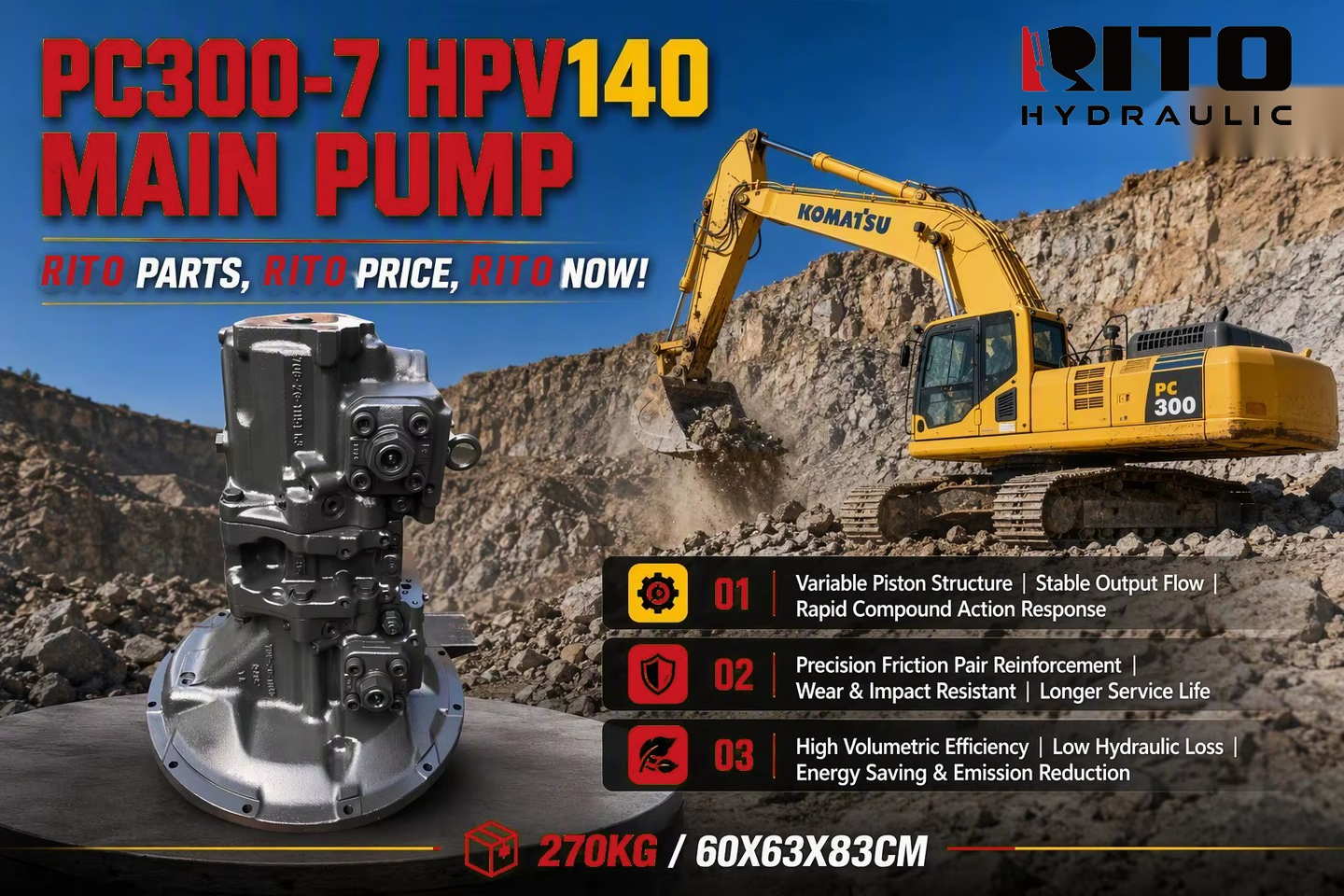
- HPV140 is a variable-displacement swashplate axial-piston pump, nominally about 140 cc/rev per section, in a tandem twin-section arrangement.
Table of Contents
- 1. What the 708-2G Series Is — and Is Not
- 2. How to Read 708-2G-xxxxx
- 3. The Complete Pump Assembly Numbers
- 4. Numbers That Are Parts, Not Pumps
- 5. The Same Series on Other Machines
- 6. Why There Are So Many Numbers
- 7. HPV140: What the Pump Actually Is
- 8. Confirm Yours in Three Steps
- 9. FAQ
- 10. Get Your Number Confirmed
1. What the 708-2G Series Is — and Is Not
Komatsu pump numbers follow a fixed pattern, and the middle segment is what people recognise first. The 708-2G series covers the PC300, PC350 and PC360 class excavators — the 30-tonne platform whose main pump is the HPV140.
What the series is not:
- It is not a single part number. Twenty-plus numbers sit inside it.
- It is not a single level of part. The series contains complete pumps and the components inside them.
- It is not exclusive to one machine. The same middle segment is quoted for other Komatsu machines as well.
Understanding those three points is most of what "reading the series" means here — the rest is knowing how to look your own number up. Complete assemblies in this platform are listed under Komatsu-series hydraulic parts.
2. How to Read 708-2G-xxxxx
| Block | Value | What it tells you |
|---|---|---|
| Category | 708 | A hydraulic piston pump or motor assembly group |
| Series | 2G | The 30-tonne PC300 / PC350 / PC360 pump family |
| Variant | xxxxx | The specific build — where fitment actually lives |
Compare that with the sibling series: 708-2L covers the 20-tonne class (PC200/PC210/PC220) and 708-2H the larger PC400 class. Same first block, different middle segment — which is exactly why the middle segment should never be used on its own. Our PC200-8 number guide walks the same logic through the 708-2L series.
3. The Complete Pump Assembly Numbers
These are the 708-2G numbers commonly quoted as complete main-pump assemblies for the 30-tonne platform. Vendors describe the applications slightly differently, so treat the right-hand column as a starting point, then confirm on your own machine.
| OEM number | Level | Commonly quoted for |
|---|---|---|
| 708-2G-00021 | Assembly | PC300-7 / PC350-7 class |
| 708-2G-00022 | Assembly | PC300-7 / PC340-7 / PC350-7 / PC360-7 |
| 708-2G-00023 | Assembly | PC300-7 / PC340-7 / PC350-7 / PC360-7 |
| 708-2G-00024 | Assembly | PC300-7 / PC300-8 / PC350-8 |
| 708-2G-00150 | Assembly | PC300-8 / PC350-8 |
| 708-2G-00152 | Assembly | PC300-8 / PC350-8 |
| 708-2G-00700 | Assembly | PC300-7 / PC350-7 and PC300-8 / PC350-8 |
| 708-2G-01021 | Assembly | PC300-7 / PC340-7 / PC350-7 |
| 708-2G-01022 | Assembly | PC300-7 / PC340-7 / PC350-7 |
| 708-2G-01025 | Assembly | PC300-7 / PC340-7 / PC350-7 |
| 708-2G-01073 | Assembly | PC300-8 / PC350-8 class |
| 708-2G-01074 | Assembly | PC300-8 / PC350-8 class |
| 708-2G-11116 | Assembly | PC300-7 / PC360-7 |
| 708-2G-11620 | Assembly | PC300-7 / PC300-8 |
| 708-2G-12151 | Assembly | PC300-8 / PC350-8 |
| 723-41-08100 | Assembly (cross-ref) | Quoted alongside the numbers above |
Read the disclaimer carefully: different sellers label these numbers differently, and the correct allocation for your machine comes from the manufacturer's parts data for your serial range. Treat the table as a map of what exists — not as a substitute for your nameplate.
4. Numbers That Are Parts, Not Pumps
Here is the trap that catches people searching a 708-2G number: not every 708-2G number is a pump. Some are the components that live inside it, and they share the same series prefix. Order one of these expecting a pump and you will receive a single part.
| Number | Level | Reported as |
|---|---|---|
| 708-2G-04141 | Component | Cylinder block and rotating-group parts |
| 708-2G-04161 | Component | Internal pump part |
| 708-2G-13311 | Component | Internal pump part |
| 708-2G-14120 | Component | Slider (swashplate assembly part) |
The practical rule: if you are replacing a failed pump, you want an assembly number. If you are overhauling a pump, you may want component numbers — but confirm each one individually, because component-level listings are the least consistent in the aftermarket. Complete, individually tested assemblies are listed under excavator hydraulic parts.
5. The Same Series on Other Machines
One more thing the series map teaches: the middle segment is not a machine. You will also meet 708-2G numbers quoted for machines outside the 30-tonne excavator class — for example the 708-2G-00510, 708-2G-00520 and 708-2G-00530 numbers, which are listed for Komatsu WA900 wheel loaders rather than PC300 excavators.
So "708-2G" tells you the family. It does not tell you the machine, and it does not tell you whether the part is a pump, a component or something else. Only the full number, checked against your plate, does that.
6. Why There Are So Many Numbers
| Reason | What it means for you |
|---|---|
| Several machine models share the platform | PC300, PC340, PC350, PC360 variants each appear in listings |
| Running production changes | A new build introduced mid-series gets its own number |
| Serial ranges | Which number applies can depend on which serial band your machine is in |
| Supersession | An older number is replaced by a newer one; both stay in circulation |
| Different levels of part | Assemblies and components share the prefix |
None of this is a catalogue error. It is normal lifecycle behaviour — and it is exactly why the number on your pump matters more than any list, including this one.
7. HPV140: What the Pump Actually Is
The pump behind these numbers is the HPV140:
- Type: variable-displacement, swashplate-type axial-piston pump.
- Size: nominally about 140 cc/rev per section — which is what the "140" denotes.
- Arrangement: a tandem twin-section unit — two pump sections in one housing, driven directly from the engine, feeding the working, swing and travel circuits.
- Control: a regulator continuously tilts the swashplate so pump output follows demand.
On a 30-tonne machine, weight and packing matter when you plan a replacement: the assembly is about 270 kg, packed 60 × 63 × 83 cm. For the machine-side view — which models take this pump and how to match it — see our companion PC300-7 HPV140 matching guide.
8. Confirm Yours in Three Steps
- Read the pump nameplate. Photograph it straight-on and in focus — this is the number that matters.
- Add your machine model and serial. The serial band decides whether a running change applies to you.
- Have the cross-reference checked. A supplier who holds the parts data can confirm the number, flag any supersession, and tell you whether you need an assembly or a component.
Send those three things and the whole 20-number puzzle collapses into one answer. Remember too that a pump is not the only component worth checking on a weak machine — the control valve assembly shares the blame in many "no power" complaints, so test before you order.
9. FAQ
Q1: What is the 708-2G series?
It is the Komatsu main-pump number group used on the 30-tonne PC300 / PC350 / PC360 class excavators — the platform that carries the HPV140 pump. It contains more than twenty numbers.
Q2: Are all 708-2G numbers complete pumps?
No. Some are complete pump assemblies, some are internal components (such as cylinder blocks and sliders), and some are quoted for other machines entirely. Check the level of the part, not just the prefix.
Q3: How do I know which 708-2G number my PC300-7 needs?
Read the nameplate on your pump, note your machine model and serial number, and have a supplier confirm the cross-reference. The serial band can decide between two otherwise similar builds.
Q4: What does the "140" in HPV140 mean?
It denotes the pump's size class — nominally about 140 cc/rev per section. On the PC300 class it is arranged as a tandem twin-section unit.
Q5: Why do sellers quote different numbers for the same pump?
Because several numbers exist across production changes and serial ranges, and because aftermarket sellers sometimes cross-reference groups of numbers they consider interchangeable. Confirm against your plate rather than choosing a number by price.
Q6: What is a superseded part number?
An older number that has been replaced by a newer one as the build was updated. Ordering the old number can add lead time; a supplier can tell you the current one.
Q7: Can I fit a 708-2G number quoted for a different machine?
Not safely. Even within the same series, builds differ by machine, serial range and level of part. Treat any cross-machine match as something to verify, not assume.
Q8: How heavy is the HPV140 assembly?
About 270 kg as a complete assembly, packed in a 60 × 63 × 83 cm case — plan lifting equipment and heavy freight.
Q9: Where is the part number on a Komatsu pump?
On the nameplate attached to the pump body. Photograph it straight-on and in focus, and take two or three photos of the whole pump including the ports.
Q10: What should I send to get the right pump?
Machine model, machine serial number, the full pump number from the nameplate, and clear photos. That is enough for a same-day confirmation.
10. Get Your Number Confirmed
Send us your machine model, serial number and the full pump number from the nameplate — plus a few clear photos — and our team will confirm which 708-2G number applies to your machine, flag any supersession, and quote lead time the same day. RITO HYDRAULIC supplies complete, individually tested main pumps, control valves, travel motors and swing motors for Komatsu, Hitachi, Kobelco, Caterpillar, Hyundai, Doosan and Kawasaki-series machines — with export packing and a 6–12 month warranty.
Contact our team or learn more about RITO HYDRAULIC.
- CAT 330GC Final Drive — Which Part Number Fits and What Should You Check Before You Buy?
- Why Do Customers Need the TM40 Travel Assembly? When It Is Used, What It Does, and What It Changes
- Komatsu PC300-8 / PC350-8 Hydraulic Pump: Which 708-2G Number Fits, and Why PC300-7 Numbers Keep Appearing
- Why Does a CAT 320C / 320D Hydraulic Pump Lose Power Under Heavy Load?
- Why Does Your CAT 312C Need the SBS80 Hydraulic Pump?