
Why Your CAT 329D Excavator Loses Power? Ultimate Troubleshooting & SBS140 Hydraulic Pump Guide


Author
JERY WANG
Guangzhou Rito Hydraulic Co.,Ltd., located in Guangzhou, China, is a leading manufacturer and distributor of hydraulic pumps, final drives, swing motors, and main control valves for earthmoving machinery. We supply genuine, OEM, and high-quality aftermarket parts.
We are committed to continuously sharing our expertise regarding construction machinery and excavator hydraulic systems. Our goal is to help you gain a deeper understanding of equipment principles and applications—enabling you to work more efficiently—while also showcasing our professional knowledge and capabilities. We invite you to learn more about us.
Choose us, and you will enjoy the best service, the most favorable prices, and the most reliable supplier!
Marie R. Winters


Quick Answer
Key Takeaways
- "Loses power" can come from the engine, pump, valve or control system — identify which one first.
- Divide the problem by pattern: engine-related vs all-functions vs one-function.
- Two measurements decide most cases: engine rpm under load and pump pressure/flow.
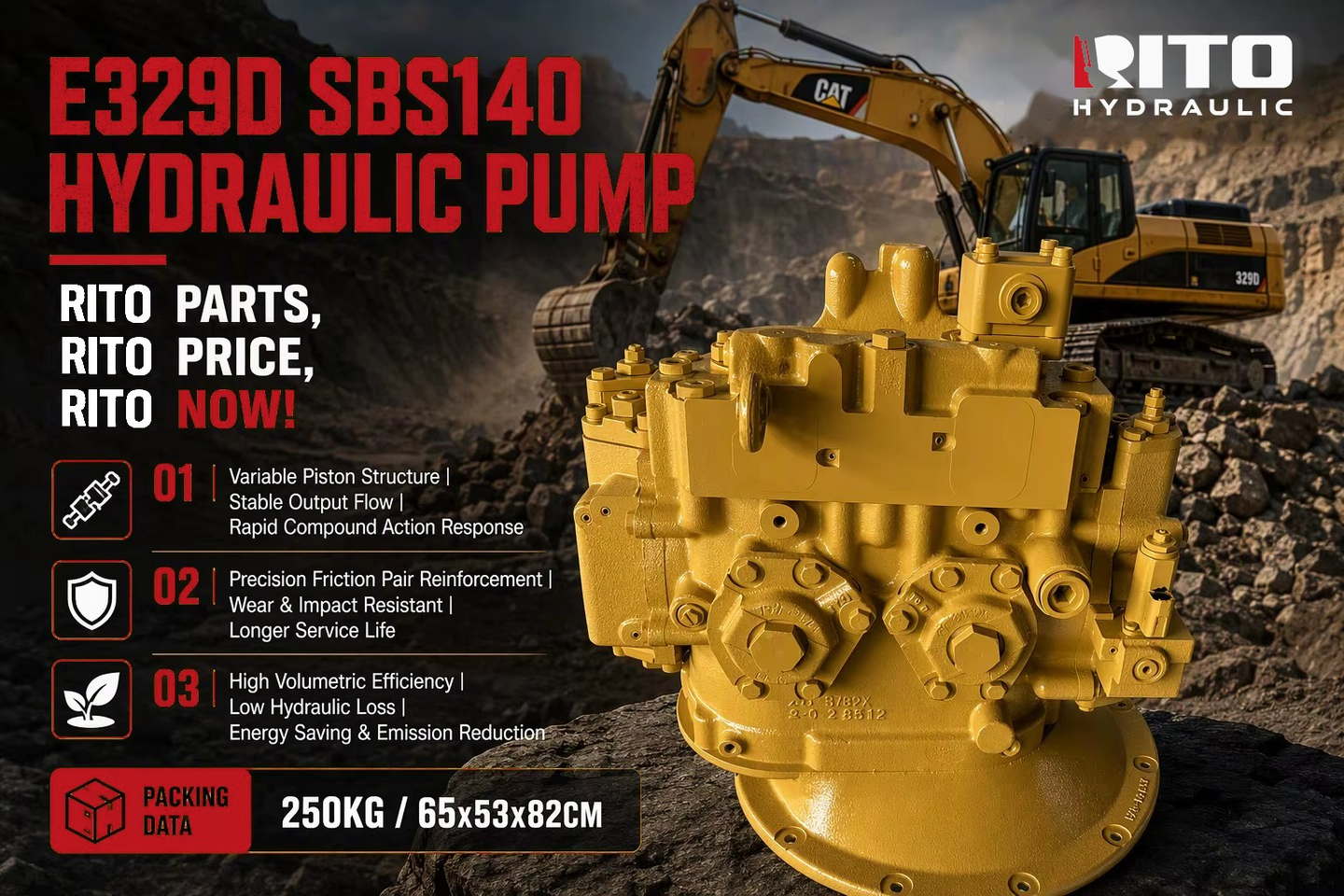
- The CAT 329D main pump in this guide is the SBS140, about 250 kg, packed 65 × 53 × 82 cm.
- Check the cheap causes first — filters, oil level, suction leaks, settings — before condemning the pump.
- Always match a replacement by the nameplate code and machine serial, not by model name alone.
Table of Contents
- 1. First, Define "Loses Power"
- 2. The Troubleshooting Flow: 4 Zones
- 3. Zone 1: Rule Out the Engine
- 4. Zone 2: Test the Pump (Pressure & Flow)
- 5. Zone 3: Check the Valve & Settings
- 6. Zone 4: Control System & Sensors
- 7. The SBS140 Pump: What You Need to Know
- 8. Most Common Causes, Ranked
- 9. Before You Buy a Replacement
- 10. FAQ
- 11. Get Your Pump Matched
1. First, Define "Loses Power"
Owners use "loses power" for four quite different complaints. Naming the right one turns a guessing game into a checklist:
| What the operator says | What it usually means |
|---|---|
| "It digs slowly, but the engine sounds fine" | A hydraulic issue — pump output or valve |
| "The engine lugs / drops revs / stalls under load" | An engine or control issue before it is a pump issue |
| "It's weak only when hot" | Wear — oil thins and internal leakage rises |
| "Only the boom/arm is weak" | Usually a valve section, not the pump |
Write down which line fits — everything that follows depends on it.
2. The Troubleshooting Flow: 4 Zones
Work through the zones in order. Stop as soon as one produces a clear fault.
| Zone | Test | If it fails here |
|---|---|---|
| 1. Engine | Engine rpm under load; fuel and air supply | Service the engine before touching hydraulics |
| 2. Pump | Main pressure and flow at the pump | Repair or replace the pump |
| 3. Valve | Per-function pressure; check relief settings | Service or replace the affected section |
| 4. Control | Pump control signal, sensors, wiring | Repair the control system |
Most "loses power" jobs are solved in Zones 1–3. Zone 4 matters more on machines with electronic pump control, where a faulty signal can hold the pump at low output.
3. Zone 1: Rule Out the Engine
Before blaming the hydraulics, answer one question: does the engine hold its rpm when the hydraulics load up?
- Engine drops revs or stalls under load → the engine is not delivering its rated power. Check fuel filters and supply, air filter and intake restriction, turbo/intercooler condition, and governor/control settings. A hydraulic fault does not make a healthy engine lose revs.
- Engine holds rpm, machine is still weak → the engine is fine; move to Zone 2.
- Engine hunts or derates → on electronically controlled machines, there may be a fault code. Read it before proceeding.
This single check prevents the most expensive mistake of all: replacing a healthy pump to fix an engine problem.
4. Zone 2: Test the Pump (Pressure & Flow)
Two measurements tell you whether the SBS140 is the problem — pressure and flow. A pump can make full pressure but deliver poor flow (worn internals), and it can also fail to reach pressure (regulator or relief issue). You need both numbers.
| Test | What it reveals |
|---|---|
| Main pressure at full load | Low reading = pressure cannot build: regulator, relief or internal leakage |
| Flow / cycle speed | Slow cycle at good pressure = the pump is moving too little oil (wear) |
| Case drain flow | Rising leakage = internal wear; an early, reliable wear indicator |
| Oil temperature | Rising temperature with falling performance = internal losses |
Always compare the readings against the machine's own specification and record them — a before-and-after record is also the best evidence if you ever need to claim warranty. And before condemning the pump, check the cheap causes: oil level, filters, and air leaks on the suction line. A restricted suction line starves the pump and mimics internal wear. Complete, individually tested pump assemblies are listed with the wider excavator hydraulic parts range.
5. Zone 3: Check the Valve & Settings
If the pump tests well, the next suspect is how the oil is distributed. The control valve assembly sets priorities, limits pressure and routes flow to each function.
| Find | Likely cause |
|---|---|
| All functions weak, pump OK | Main relief setting low, or internal leakage in the valve |
| One function weak | That section's spool, seal or relief |
| Compound movements slow | Flow sharing / priority setting — a control-side issue |
| Function drifts when held | Spool wear or internal leak in that section |
If the valve itself is the fault, our guide on when to replace a control valve assembly covers the decision in detail.
6. Zone 4: Control System & Sensors
On a CAT 329D, the pump's output is also influenced by the machine's control system. If the earlier zones all pass but the machine is still down on power, look at the control side:
- Pump control signal — is the pump being told to increase output when it should?
- Sensors and wiring — a faulty reading can hold the pump at low output.
- Fault codes — read them; a stored code is often the shortest route to the answer.
- Settings / calibration — confirm the machine's settings have not been altered or drifted.
This zone is where "the pump is fine but the machine is weak" cases usually live — which is exactly why replacing the pump is not a diagnosis.
7. The SBS140 Pump: What You Need to Know
The main pump in this guide is the SBS140 — a variable-displacement piston pump assembly for the CAT 329D, a 30-tonne class excavator.
| Item | Detail |
|---|---|
| Application | CAT 329D (30-tonne class) |
| Pump model | SBS140 |
| Type | Variable-displacement piston pump assembly |
| Weight | 250 kg |
| Packing | 65 × 53 × 82 cm |
| Design highlights | Variable piston structure; stable output flow; rapid compound-action response; reinforced precision friction pairs for wear and impact resistance; high volumetric efficiency and low hydraulic loss |
| Confirm with | The nameplate code on your pump + machine serial |
"SBS140" identifies the pump model; as with any pump, the code on your own nameplate is what confirms the exact build. The wider range sits under Caterpillar-series hydraulic parts. The design notes matter for troubleshooting too: "stable output flow" is exactly what wear erodes, and "low hydraulic loss" is what declining volumetric efficiency destroys — so a worn pump shows up as reduced flow and rising heat long before it fails outright.
8. Most Common Causes, Ranked
| Rank | Cause | Confirm by |
|---|---|---|
| 1 | Restricted suction / clogged filters | Visual + suction vacuum |
| 2 | Low relief / regulator setting | Pressure test against spec |
| 3 | Internal pump wear | Flow + case-drain test |
| 4 | Valve section fault | Per-function pressure test |
| 5 | Engine fuel / air restriction | Rpm under load |
| 6 | Control signal / sensor fault | Fault codes + signal check |
Note what is not at the top of that list: a failed pump. Contamination, settings and restrictions cause more "power loss" complaints than genuine pump failure — and if a replacement pump did not solve the problem the first time, the real cause is still upstream. Our related guide on why excavators still fail after a pump replacement explains how that happens.
9. Before You Buy a Replacement
- Confirm the fault is the pump — pressure and flow test, not guesswork.
- Match by nameplate code and machine serial — not by model name alone.
- Photograph the plate and the pump — straight-on plate, plus two or three angles.
- Flush and renew the filters before fitting — contamination from the old pump will damage the new one.
- Check the purchase: per-unit test report, a 6–12 month warranty, and confirmation it is a new, complete assembly — not a rebuild sold as new.
- Plan the freight: about 250 kg in a 65 × 53 × 82 cm case is heavy freight; arrange lifting at both ends.
10. FAQ
Q1: Why does my CAT 329D lose power?
It is usually one of four things: the engine (loses revs under load), the main pump (reduced pressure or flow), the control valve, or the control/electronic system. Start by checking whether the engine holds its rpm under load.
Q2: What hydraulic pump does the CAT 329D use?
The main pump covered here is the SBS140, a variable-displacement piston pump assembly. Confirm the exact build from the nameplate on your own pump and your machine serial.
Q3: How can I tell if the pump is the problem or the engine?
Watch the engine rpm under load. If the engine drops revs or stalls, the engine is not delivering its power. If it holds rpm and the machine is still slow or weak, move on to pressure and flow testing of the pump.
Q4: What tests confirm a worn hydraulic pump?
A pressure test and a flow test taken together, plus case-drain flow and oil temperature. A pump can hold pressure while delivering poor flow, so measuring only pressure is not enough.
Q5: Could a clogged filter cause power loss?
Yes. A restricted suction line or clogged filter starves the pump and mimics internal wear, so always check oil level, filters and suction leaks before condemning the pump.
Q6: Why is only one function weak?
When a single function is weak, the fault is usually in that section of the control valve rather than the pump, which serves all functions.
Q7: How heavy is the SBS140 pump, and how is it packed?
About 250 kg, packed in a 65 × 53 × 82 cm case.
Q8: I replaced the pump and it is still weak — why?
Because the original fault was probably not the pump. Contamination, a restricted suction line, a low relief setting or a control fault can all cause power loss and will not be cured by a new pump.
Q9: Should I flush the system after fitting a new pump?
Yes. Flush and renew the return filter and suction strainer, then fill with fresh correct-grade oil, and check pressures and settings before returning to full load.
Q10: What should I send to get the right replacement pump?
Machine model, machine serial number, the full pump code from the nameplate, and two or three clear photos of the pump including the ports.
11. Get Your Pump Matched
Send us your machine model, serial number and the full pump code from the nameplate — plus a few clear photos — and our team will confirm the correct SBS140 build, provide a test-report sample and quote lead time the same day. RITO HYDRAULIC supplies complete, individually tested main pumps, control valves, travel motors and swing motors for Caterpillar, Komatsu, Hitachi, Kobelco, Hyundai, Doosan and Kawasaki-series machines — with export packing and a 6–12 month warranty.
Contact our team or learn more about RITO HYDRAULIC.
Related reading: installing, commissioning and caring for a CAT main pump and classic CAT pump faults and the money-saving fix.
- CAT 330GC Final Drive — Which Part Number Fits and What Should You Check Before You Buy?
- Why Do Customers Need the TM40 Travel Assembly? When It Is Used, What It Does, and What It Changes
- Komatsu PC300-8 / PC350-8 Hydraulic Pump: Which 708-2G Number Fits, and Why PC300-7 Numbers Keep Appearing
- Why Does a CAT 320C / 320D Hydraulic Pump Lose Power Under Heavy Load?
- Why Does Your CAT 312C Need the SBS80 Hydraulic Pump?