
Aftermarket Hitachi Hydraulic Pumps: How to Spot a High-Quality HPV102 from Low-End Remanufactured Ones

Author
JERY WANG
Guangzhou Rito Hydraulic Co.,Ltd., located in Guangzhou, China, is a leading manufacturer and distributor of hydraulic pumps, final drives, swing motors, and main control valves for earthmoving machinery. We supply genuine, OEM, and high-quality aftermarket parts.
We are committed to continuously sharing our expertise regarding construction machinery and excavator hydraulic systems. Our goal is to help you gain a deeper understanding of equipment principles and applications—enabling you to work more efficiently—while also showcasing our professional knowledge and capabilities. We invite you to learn more about us.
Choose us, and you will enjoy the best service, the most favorable prices, and the most reliable supplier!
Marie R. Winters


Quick Answer
Key Takeaways
- "Aftermarket" covers four very different tiers — price alone does not tell you which one you are buying.
- A high-quality aftermarket pump is new and built to OEM fit and performance; a low-end reman is a used core with the minimum done to it.
- Judge on evidence: test report, parts replaced, internal components, packing and warranty.
- HPV102 serves ZX200 / ZX210 / ZX230 / ZX270 families — but always confirm by nameplate code and machine serial.
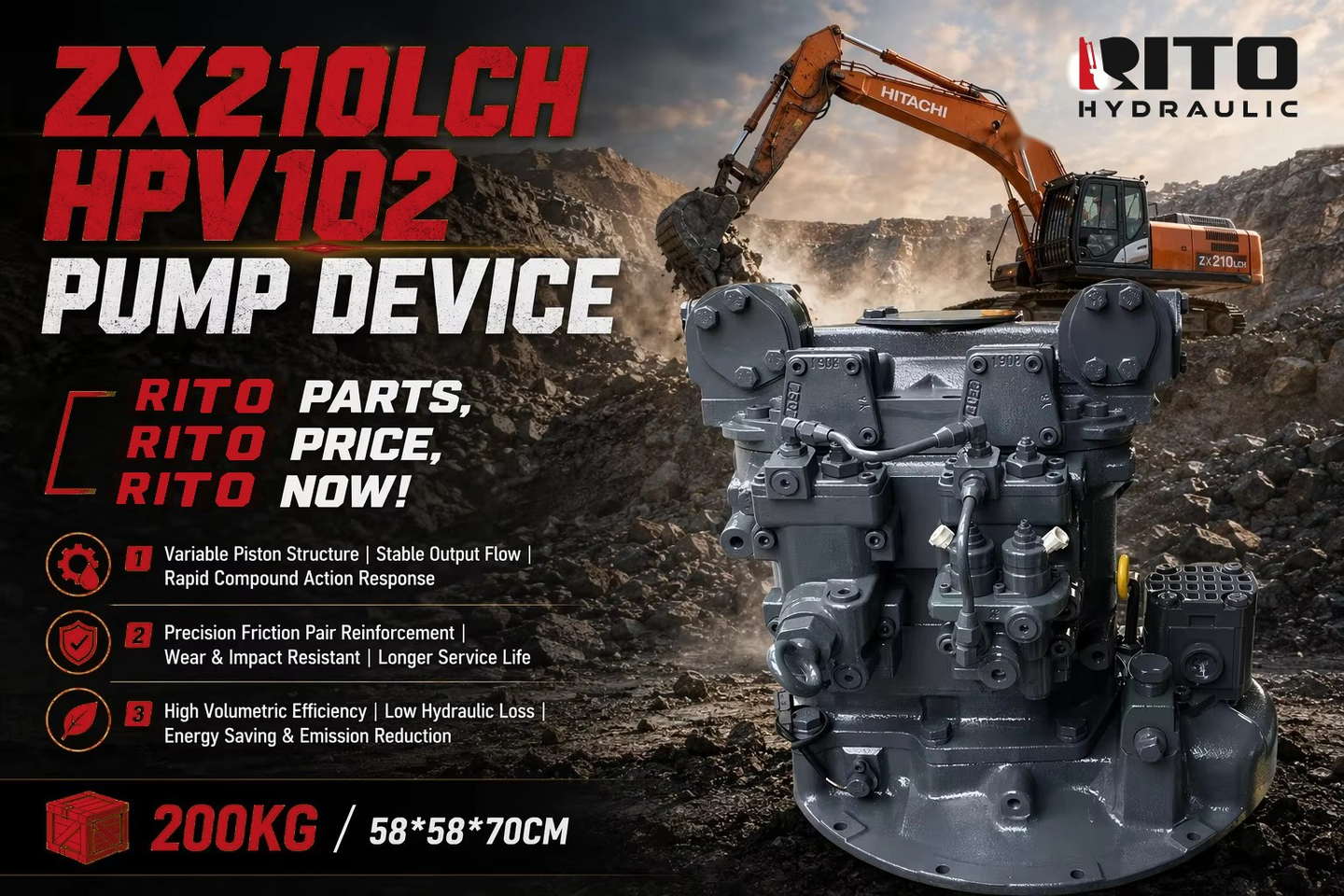
- Weight and packing matter for sourcing: about 200 kg, 58 × 58 × 70 cm.
- The cheapest unit is rarely the lowest-cost decision once downtime and repeat labour are counted.
Table of Contents
- 1. The Four Quality Tiers
- 2. What "Supply Chain" Means for HPV102
- 3. Application: ZX200 / ZX210 / ZX230 / ZX270
- 4. 10 Red Flags of a Low-End Reman
- 5. The Pre-Purchase Checklist
- 6. Why a Price Gap Is Never Just a Price Gap
- 7. Total Cost: The Maths That Changes the Decision
- 8. 8 Questions to Ask Any Supplier
- 9. Incoming Inspection on Arrival
- 10. FAQ
- 11. Get a Pump You Can Trust
1. The Four Quality Tiers
Most sourcing mistakes happen because buyers compare two products that are not in the same category. Here is the landscape:
| Tier | What it is | What to expect |
|---|---|---|
| 1. Genuine (OEM) | Built by the original manufacturer | Reference fit and life — at the highest cost |
| 2. Quality aftermarket | New assembly built to OEM dimensions and performance | Close to OEM behaviour; can be individually tested; real warranty |
| 3. Honest rebuild | A used core properly restored, with the wear parts genuinely replaced | Honest life if the work was done well — and stated openly |
| 4. Low-end reman | A used core cleaned up and re-sold as "new" or "refurbished" | Short life, repeat failures, and no real recourse |
Tiers 2 and 3 can both be good purchases. The problem is tier 4 sold as tier 1 or 2 — which is a marketing problem before it is a technical one. Complete, individually tested assemblies are listed with the wider excavator hydraulic parts range.
2. What "Supply Chain" Means for HPV102
Understanding where a pump comes from explains the price spread better than any specification sheet:
- Manufacturer-direct. A factory that makes the pump builds it, tests it, packs it, and ships it. Fewer hands on the product, more accountability.
- Trading layers. Each intermediary between the maker and you adds cost — and each one is a chance for the description to drift from the product.
- Core-based supply. Rebuilders need used pumps as cores. When core supply is short, the pressure to under-restore a unit rises, because the core cost is fixed but the sale price is not.
- Grading. The same warehouse may hold several grades side by side. What reaches you depends on what was ordered — and what was specified on the document.
That is the practical meaning of "supply chain" here: not a shipping term, but a question of how many times the product was graded, re-graded and re-described before it reached you. Regional sourcing dynamics matter too; our guide to sourcing hydraulic parts for African mining covers how that plays out across a long logistics chain.
3. Application: ZX200 / ZX210 / ZX230 / ZX270
The HPV102 main pump is used across a family of Hitachi machines — the ZX200, ZX210, ZX230 and ZX270 families, including long-undercarriage and other configurations. That breadth is exactly why the nameplate code and serial decide, not the model name:
| Machine family | Pump model | How to confirm |
|---|---|---|
| ZX200 family | HPV102 | Pump nameplate code + machine serial |
| ZX210 family | HPV102 | Pump nameplate code + machine serial |
| ZX230 family | HPV102 | Pump nameplate code + machine serial |
| ZX270 family | HPV102 | Pump nameplate code + machine serial |
The full range sits under Hitachi-series hydraulic parts. A pump that is "for a ZX210" is not automatically right for your ZX210 — the variant suffix on the plate is what settles it.
4. 10 Red Flags of a Low-End Reman
None of these alone is proof. Two or three together, though, is a clear signal.
| # | Red flag | Why it matters |
|---|---|---|
| 1 | No per-unit test report offered | Performance is claimed, not shown |
| 2 | Vague about what parts were replaced | Wear parts may be the old ones |
| 3 | Photos of a different unit each time | You are not seeing the pump you will receive |
| 4 | "New" used loosely for a rebuilt core | The core is used; only the description is new |
| 5 | No warranty in writing | Nothing to claim against when it fails |
| 6 | Price far below every other quote | Something inside is cheaper — usually the internals |
| 7 | Cannot answer questions about the regulator | The most critical, hardest-to-copy part |
| 8 | Refuses an on-site or video inspection | Confidence that does not survive being shown |
| 9 | Poor packing for a 200 kg part | Damage in transit, blamed on the carrier |
| 10 | Rushes you to pay | Time pressure replaces due diligence |
5. The Pre-Purchase Checklist
Ask for all six. A supplier who can provide them is in tier 1 or 2; one who cannot is not.
| Ask for | What good looks like |
|---|---|
| Per-unit test report | Flow and pressure results for this pump, with its identifier |
| Parts declaration | A clear statement of new vs reused components |
| Photos of the actual unit | Nameplate, ports, regulator — the pump you will receive |
| Written warranty | Duration and terms in writing, not "we will look after you" |
| Packing specification | How a 200 kg assembly is secured and protected for freight |
| Code confirmation | They verify your nameplate code and serial before shipping |
6. Why a Price Gap Is Never Just a Price Gap
When two quotes for "the same" HPV102 differ sharply, the difference is almost always in one of four places — and none of them are the casting:
- The internals. Friction pairs, bearings and seals are where cost lives. Cheaper internals are the easiest thing to hide and the fastest thing to fail.
- The regulator. The control is the most complex, most precision-dependent part of the pump. A "compatible" regulator that is not properly matched is the classic reason a cheap pump behaves badly.
- The testing. A pump that is individually tested costs more to produce than one that is merely assembled and boxed.
- The accountability. A written warranty is a cost the seller has accepted. No warranty means no cost — and no cover.
In other words: a low price is information, not a saving. It tells you where the money was removed.
7. Total Cost: The Maths That Changes the Decision
The purchase price is only one line in the calculation. The others are what turn a "cheap" pump into the expensive choice:
| Cost line | Why it belongs in the decision |
|---|---|
| Purchase price | The visible number |
| Installation labour | Paid once if the pump is right; twice if it is not |
| Downtime | Usually the largest cost of all on a working machine |
| Oil and filters | Repeated every time the system is opened and flushed |
| Contamination damage | A failing pump sends debris into the valve and motors |
| Freight, both ways | 200 kg is not inexpensive to move — especially twice |
A low-end reman does not eliminate cost; it moves cost from the invoice to the downtime. And when a replacement fails early, the debris it sheds can take the control valve assembly and travel motors with it — which is why repeat failures after a "new" pump is fitted are a recognised pattern, as our guide on why excavators still fail after a pump replacement explains.
8. 8 Questions to Ask Any Supplier
- Is this pump new, or a rebuilt core? (Ask for the answer in writing.)
- Can you send the test report for this specific unit?
- Which internal components are new, and which are reused?
- What is the warranty, in writing, and what does it cover?
- Can you send photos of the actual pump — nameplate, ports and regulator?
- Will you confirm my nameplate code and serial before shipping?
- How is a 200 kg assembly packed for international freight?
- If it fails, what is the claims process and who pays return freight?
A supplier who answers all eight comfortably is one you can work with. Hesitation on question 2 or 3 is the tell.
9. Incoming Inspection on Arrival
- Photograph the crate before opening — this is your evidence if there is transit damage.
- Match the nameplate code to your order before installing anything.
- Inspect the ports and mounting face for debris, corrosion or signs of use.
- Check the regulator matches what was described.
- Flush the system and renew filters before fitting — whatever the pump cost, contamination will cost more.
10. FAQ
Q1: Is an aftermarket Hitachi HPV102 pump as good as OEM?
A high-quality aftermarket pump is built to OEM dimensions and performance and can be a strong alternative. The catch is that "aftermarket" also covers low-end rebuilds, so the tier matters far more than the label.
Q2: How can I tell a quality aftermarket pump from a low-end reman?
Ask for evidence: a per-unit test report, a clear statement of new versus reused components, photos of the actual unit, a written warranty and a packing specification. A low-end reman usually cannot provide all five.
Q3: Which machines use the HPV102 pump?
The HPV102 main pump is used across the Hitachi ZX200, ZX210, ZX230 and ZX270 families, including long-undercarriage versions. Confirm the exact build from your pump nameplate and machine serial.
Q4: Why is one HPV102 so much cheaper than another?
Usually the internals, the regulator, whether the unit was individually tested, and whether a written warranty is included. A low price tells you where the cost was removed.
Q5: Is a rebuilt pump ever a good buy?
Yes — an honest rebuild with genuine wear parts replaced and the work declared openly can be good value. The problem is a low-end rebuild sold as new.
Q6: What does a proper test report show?
Flow and pressure results for that specific unit, identified by its serial or code, so you can see the performance rather than take it on trust.
Q7: How heavy is the HPV102, and how should it be packed?
About 200 kg, typically in a 58 × 58 × 70 cm case, secured against movement inside and protected for international freight.
Q8: What should I do if the pump fails early?
Stop using the machine, document the failure with photos and readings, and follow the written warranty claim process. Also flush the system — an early failure usually contaminates the oil.
Q9: Do I need to flush the system after fitting?
Yes, always. Flush and renew the return filter and suction strainer, and fill with fresh correct-grade oil.
Q10: What is the single most useful thing to check before paying?
Whether the supplier can provide a test report and a clear parts declaration for the exact unit you are buying. That one question filters out most low-end remans.
11. Get a Pump You Can Trust
Send us your machine model, serial number and the full pump code from the nameplate — plus a few clear photos — and our team will confirm the correct HPV102 build, send you a test-report sample and photos of the actual unit, and quote lead time the same day. RITO HYDRAULIC supplies complete, individually tested main pumps, control valves, travel motors and swing motors for Hitachi, Komatsu, Kobelco, Caterpillar, Hyundai, Doosan and Kawasaki-series machines — with export packing and a 6–12 month warranty.
Contact our team or learn more about RITO HYDRAULIC.
- CAT 330GC Final Drive — Which Part Number Fits and What Should You Check Before You Buy?
- Why Do Customers Need the TM40 Travel Assembly? When It Is Used, What It Does, and What It Changes
- Komatsu PC300-8 / PC350-8 Hydraulic Pump: Which 708-2G Number Fits, and Why PC300-7 Numbers Keep Appearing
- Why Does a CAT 320C / 320D Hydraulic Pump Lose Power Under Heavy Load?
- Why Does Your CAT 312C Need the SBS80 Hydraulic Pump?