

CAT 320GC Hydraulic Pump (A28VO130 / 655-8833): Classic Faults and the Money-Saving Fix


Author
JERY WANG
Guangzhou Rito Hydraulic Co.,Ltd., located in Guangzhou, China, is a leading manufacturer and distributor of hydraulic pumps, final drives, swing motors, and main control valves for earthmoving machinery. We supply genuine, OEM, and high-quality aftermarket parts.
We are committed to continuously sharing our expertise regarding construction machinery and excavator hydraulic systems. Our goal is to help you gain a deeper understanding of equipment principles and applications—enabling you to work more efficiently—while also showcasing our professional knowledge and capabilities. We invite you to learn more about us.
Choose us, and you will enjoy the best service, the most favorable prices, and the most reliable supplier!
Marie R. Winters


Quick Answer
Here is the money-saving principle in one line: on this machine, most "pump problems" are not pump problems. The 320GC uses an electronically controlled pump with intelligent power matching, which means output, speed and load are coordinated by the control system. That adds a whole category of faults that look like a failed pump and are fixed without buying one — a test, a calibration, a filter or a flush.
So the article is organised the way the diagnosis should be: the classic faults first, then the cheap correct response to each, then the expensive mistake to avoid.
Key Takeaways
- Five order numbers cover the same pump group — supersession is normal, and the plate decides which applies.
- The 320GC pump is electronically coordinated: weak or sluggish behaviour can be a control issue, not wear.
- Test pressure and flow before buying anything. It is the cheapest step and it removes the biggest risk.
- All functions weak points to the pump or its control; one or two weak functions point to the valve.
- Never fit a pump into an unflushed system — that is how "the new pump failed too" happens.
- The expensive mistakes on this machine are buying before testing, buying by lowest price, and skipping the flush.
Table of Contents
- 1. The Product at a Glance
- 2. Five Numbers, One Pump
- 3. What "Intelligent Power Matching" Means for You
- 4. Classic Faults and the Money-Saving Response
- 5. The Money-Saving Flow: 5 Steps
- 6. The Three Ways People Waste Money Here
- 7. How to Confirm the Right Number
- 8. FAQ
- 9. Get Your Pump Confirmed
1. The Product at a Glance
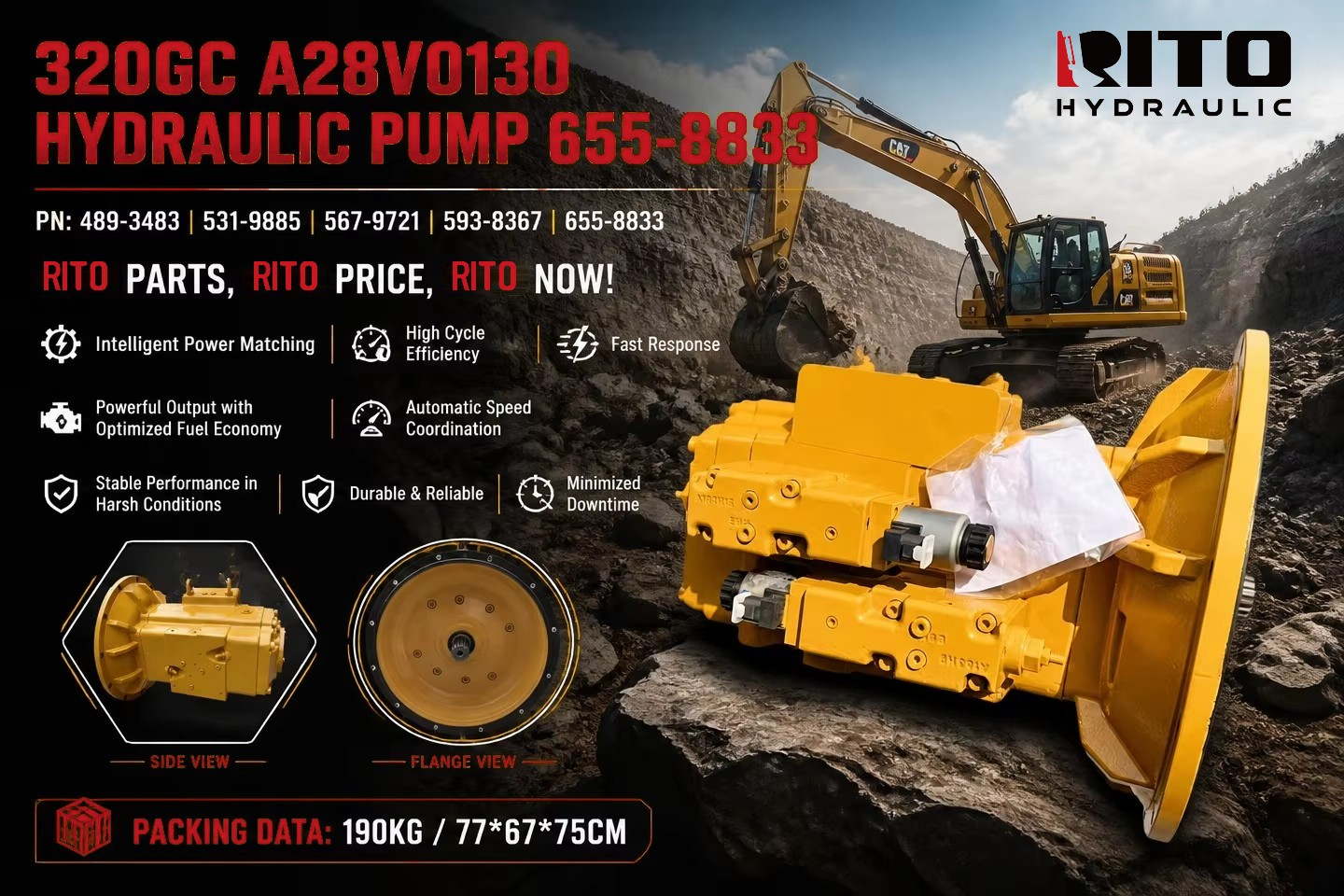
| Item | Detail |
|---|---|
| Application | CAT 320GC excavator |
| Pump model | A28VO130 (variable-displacement axial-piston pump) |
| Order numbers | 489-3483, 531-9885, 567-9721, 593-8367, 655-8833 |
| Weight | 190 kg |
| Packing | 77 × 67 × 75 cm |
| Feature points | Intelligent power matching; high cycle efficiency; fast response; powerful output with optimised fuel economy; automatic speed coordination; stable performance in harsh conditions; durable and reliable; minimised downtime |
Notice how much of that feature list is about coordination rather than raw output. That is not marketing padding — it describes how the machine is actually controlled, and it changes how you diagnose it. Complete units and the wider range are listed under Caterpillar-series hydraulic parts.
2. Five Numbers, One Pump
Five order numbers for one machine's pump group is normal Caterpillar behaviour, and it is worth understanding because it affects what you order:
| Why several numbers exist | What it means for you |
|---|---|
| Production revisions | A pump group can be revised during a model's life, so machines of different ages carry different numbers |
| Supersession | An earlier number may have been replaced by a later one; the older number still appears in listings |
| Alternative supply references | Replacement or remanufactured references sit alongside the original |
Two practical rules:
- 1. Do not choose a number by which one you saw first. Read your own pump plate, then have the number cross-checked for the current reference.
- 2. Two numbers being "listed together" does not make them interchangeable. Sellers group references they consider equivalent — that grouping is not the manufacturer's data.
This is one of the few places where five minutes of checking prevents an entire wrong shipment — and on a 190 kg item, the freight bill for a mistake is real.
3. What "Intelligent Power Matching" Means for You
The 320GC's pump does not simply pump. Its output is managed — the machine's control system coordinates hydraulic demand with engine output and travel or work speed. Three features on the product sheet describe exactly that:
| Feature | In plain language | Why it matters when something feels wrong |
|---|---|---|
| Intelligent power matching | Pump output is matched to what the work actually needs, rather than always running flat out | A weak-feeling machine may be under-delivering by control, not by wear |
| Automatic speed coordination | Engine and hydraulics are kept in step with each other | A coordination fault can look like a hydraulic fault — and vice versa |
| Optimised fuel economy | The same management reduces wasted flow and wasted fuel | Rising fuel consumption is an early symptom of the system losing its edge |
Two conclusions follow. First, electronic faults and hydraulic faults present almost the same way on a machine like this — so the diagnostic step you cannot skip is reading fault codes. Second, "the pump is worn" is a hypothesis to be tested, not a default explanation. On the 320GC's predecessor generations the same lesson showed up in a simpler form; our guide to power loss on the 329D works through it step by step.
4. Classic Faults and the Money-Saving Response
This is the core of the article: the complaints that come up most often on this machine, what usually causes them, the cheapest correct response — and the expensive mistake people make instead.
| Classic complaint | Likely cause | Money-saving response | Expensive mistake |
|---|---|---|---|
| All functions weak and slow | Pump output, control signal, suction restriction or relief setting | Pressure and flow test + read fault codes first | Ordering a pump before testing anything |
| Weak when hot, fine when cold | Oil thinning as temperature rises, exposing internal wear or a cooler problem | Check oil condition, cooler and filters; measure case-drain flow | Replacing the pump when the cooler or oil was the issue |
| Rising oil temperature | Internal leakage, blocked cooler, contamination, wrong relief setting | Clean the cooler, check the relief, test for internal leakage | Installing a new pump without finding out where the heat came from |
| Noise that follows pump speed | Suction starvation (filter, strainer, hose, level) or pump internals | Check suction side first — the cheapest and most common cause | Assuming noise always means a worn pump |
| Sluggish response, higher fuel burn | Power matching out of step — control or calibration, or engine side | Read codes, verify calibration and settings, check the engine | Buying a pump for what is a calibration or engine fault |
| Only one or two functions weak | The relevant section of the control valve, not the pump | Test pressure function by function — the pump serves everything | Replacing the pump when the valve needed attention |
| Pump replaced, still faulty | The original fault was elsewhere — supply, control or contamination | Go back to testing; flush the system and check the valve and motors | Buying a second pump — the most expensive outcome of all |
Read the table down the last column, and a pattern appears: almost every expensive mistake is a version of "bought before testing". The "new pump, same problem" scenario deserves particular attention, because it is the one that repeats money — our guide to why excavators still fail after a pump replacement explains the mechanism.
5. The Money-Saving Flow: 5 Steps
| Step | Do this | What it saves you |
|---|---|---|
| 1 | Test before buying — pressure, flow, case drain, fault codes | The cost of a pump you did not need |
| 2 | Clear the cheap causes — oil level and condition, suction strainer, return filter, cooler, relief settings, calibration | The most common causes of "pump symptoms" at a fraction of the cost |
| 3 | Match the number properly — plate code plus machine serial, cross-checked for supersession | A wrong 190 kg shipment and the downtime around it |
| 4 | Flush and renew filters before fitting anything | The second failure — the one contamination causes |
| 5 | Buy the right quality tier — new and tested, or an honest rebuild, stated openly | The cost of a cheap unit that fails early and takes the oil and filters with it |
Step 1 is the one people skip because it "takes time". Step 4 is the one people skip because the machine is needed. Those two skips account for most of the avoidable spend on this pump. If you want the full commissioning method — flushing, first start, settings — see our CAT main pump installation and care guide.
6. The Three Ways People Waste Money Here
| Waste | Why it happens | The fix |
|---|---|---|
| 1. Buying by lowest price | Two sellers quote the same number with very different products — one new and tested, one a low-end rebuild | Ask for a per-unit test report, a parts declaration and a written warranty |
| 2. Skipping the flush | The machine is needed urgently, so the system goes back together as-is | Treat flushing, filters and oil as part of the pump job, not as optional extras |
| 3. Refusing to test | A pressure and flow test feels like delay when a machine is down | Hours of testing is cheaper than weeks of a wrong repair — and it is the only way to know |
None of the three is a technical failure. All three are decisions made under time pressure — which is precisely why the flow above is worth having written down before the machine breaks. Replacement assemblies are listed under excavator hydraulic parts.
7. How to Confirm the Right Number
- Read the plate on the pump. Photograph the whole identification plate straight-on and in focus.
- Record the machine model and serial number. The serial is what tells a supplier which production revision applies.
- Ask which of the five numbers is current for your machine, and whether your original has been superseded.
- Photograph the pump from two or three angles, including the ports, regulator and flange — the product is supplied in side and flange views for exactly this reason.
- Include your test results and fault codes. They help confirm both the part and the diagnosis — and they tell a supplier you are not guessing.
8. FAQ
Q1: What hydraulic pump does the CAT 320GC use?
It uses the A28VO130 pump group, listed under Caterpillar order numbers 489-3483, 531-9885, 567-9721, 593-8367 and 655-8833. Confirm which applies to your machine from the pump plate and serial number.
Q2: Why are there five part numbers for one pump?
Because the pump group was revised during production and later numbers superseded earlier ones. All five references circulate in the market, which is why the plate and serial decide — not the first number you happen to see.
Q3: My 320GC is weak — is it the pump?
Not necessarily. Weakness in all functions points to the pump or its control system; weakness in only one or two functions usually points to the control valve. On this machine a control or calibration fault can feel exactly like a worn pump, so test before buying.
Q4: What is the cheapest first check?
Oil level and condition, the suction strainer and return filter, and any stored fault codes. Those cost almost nothing and account for a large share of "pump symptoms".
Q5: The machine is weak only when it is hot — why?
Hot oil is thinner, so internal leakage increases and wear becomes visible in performance. Check oil condition, the cooler and filters, and measure case-drain flow — that combination identifies whether it is a hydraulic fault or a heat problem.
Q6: I replaced the pump and it is still weak. What went wrong?
The original fault was probably not the pump. Suction restriction, a worn control valve, a calibration issue or contamination can all produce the same complaint and none is cured by a new pump.
Q7: What is intelligent power matching?
It means the machine's control system matches pump output to the work being done, coordinating with engine output and speed. It improves efficiency and fuel economy — and it means a fault can sit in the control system rather than in the pump itself.
Q8: How heavy is the 320GC pump?
About 190 kg, packed in a 77 × 67 × 75 cm case.
Q9: Do I have to flush the system when fitting a new pump?
Yes, always. Flush and renew the return filter and suction strainer, then fill with fresh correct-grade oil — otherwise debris from the old pump damages the new one.
Q10: What should I send to get a quotation?
Machine model, serial number, the pump plate code, two or three photos of the pump, and any pressure, flow or fault-code readings you have.
9. Get Your Pump Confirmed
Send us your machine model, serial number and the pump plate code — plus photos and any test readings — and our team will confirm which of the current numbers applies to your 320GC, flag any supersession, and quote lead time the same day. RITO HYDRAULIC supplies complete, individually tested main pumps, control valves, travel motors and swing motors for Caterpillar, Komatsu, Hitachi, Kobelco, Hyundai, Doosan and Kawasaki-series machines — with export packing and a 6–12 month warranty.
Contact our team or learn more about RITO HYDRAULIC.
Related reading: bent-axis vs swash-plate, explained on the 320B.
- CAT 330GC Final Drive — Which Part Number Fits and What Should You Check Before You Buy?
- Why Do Customers Need the TM40 Travel Assembly? When It Is Used, What It Does, and What It Changes
- Komatsu PC300-8 / PC350-8 Hydraulic Pump: Which 708-2G Number Fits, and Why PC300-7 Numbers Keep Appearing
- Why Does a CAT 320C / 320D Hydraulic Pump Lose Power Under Heavy Load?
- Why Does Your CAT 312C Need the SBS80 Hydraulic Pump?