
Travel Motor vs Swing Motor: What's the Difference on an Excavator? (Buyer's Guide 2026)


Author
JERY WANG
Guangzhou Rito Hydraulic Co.,Ltd., located in Guangzhou, China, is a leading manufacturer and distributor of hydraulic pumps, final drives, swing motors, and main control valves for earthmoving machinery. We supply genuine, OEM, and high-quality aftermarket parts.
We are committed to continuously sharing our expertise regarding construction machinery and excavator hydraulic systems. Our goal is to help you gain a deeper understanding of equipment principles and applications—enabling you to work more efficiently—while also showcasing our professional knowledge and capabilities. We invite you to learn more about us.
Choose us, and you will enjoy the best service, the most favorable prices, and the most reliable supplier!
Marie R. Winters


Quick Answer
Key Takeaways
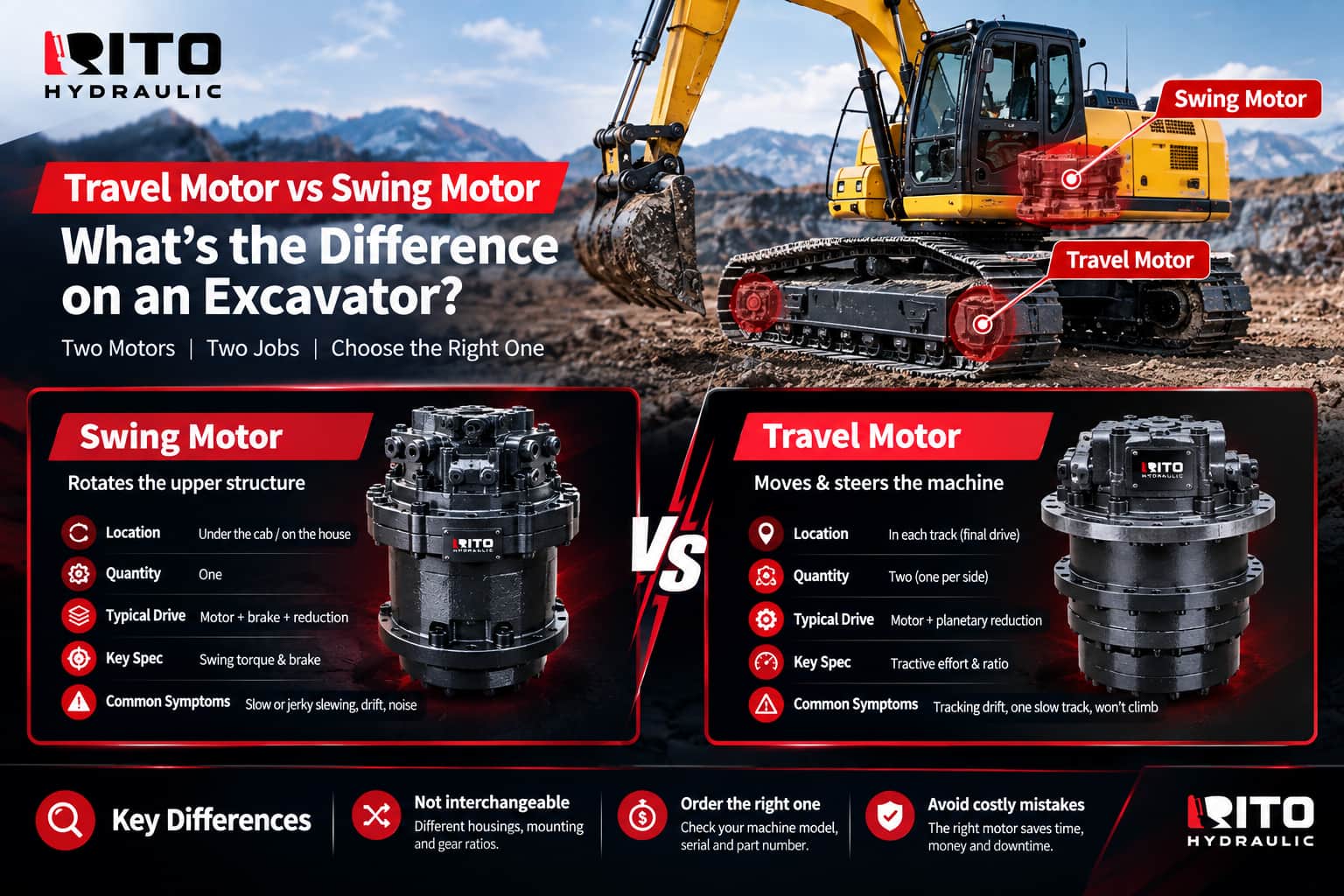
- Travel motor = moves and steers the machine. One per track (two in total).
- Swing motor = rotates the upper structure (cab and boom) 360°. One per machine.
- They are not interchangeable — different housings, mounting and gear ratios.
- Travel-motor faults show as tracking drift, one slow track or a machine that won't climb.
- Swing-motor faults show as slow or jerky slewing, drift when stopped, or noise under the cab.
- Many "motor" failures are actually leakage, contamination or a control issue — confirm before ordering.
Table of Contents
- 1. Two Motors, Two Jobs
- 2. Side-by-Side Comparison
- 3. The Swing Motor: Rotating the House
- 4. The Travel Motor: Driving the Tracks
- 5. Why People Confuse Them
- 6. How to Identify Which One You Need
- 7. Sourcing Tips: What to Send
- 8. FAQ
- 9. Get the Right Motor Today
1. Two Motors, Two Jobs
Look at an excavator and you will see two entirely different motions: the tracks move the machine, and the upper structure swings. Each motion is driven by its own hydraulic motor, and each lives in a different place with a different job.
Because both are called "the motor" on the job site, buyers constantly mix them up — and that mistake is expensive. This guide draws a clear line between them so you order the right unit the first time. If you are sourcing excavator hydraulic parts, this is the distinction that matters most.
2. Side-by-Side Comparison
| Point | Travel Motor | Swing Motor |
|---|---|---|
| Function | Moves & steers the machine | Rotates the upper structure |
| Location | In each track (final drive) | Under the cab / on the house |
| Quantity | Two (one per side) | One |
| Typical drive | Motor + planetary reduction | Motor + brake + reduction |
| Key spec | Tractive effort & ratio | Swing torque & brake |
| Interchangeable? | No — different housings, mounting and ratios | |
3. The Swing Motor: Rotating the House
The swing motor drives the upper structure — the cab, boom, arm and bucket — around the undercarriage. It works through a swing drive (gearbox + brake) and is controlled by the operator's left joystick.
Common symptoms when it wears:
- Slow or jerky slewing, especially when starting or stopping.
- Drift — the house keeps turning after you release the lever.
- Noise or vibration from under the cab.
- Loss of swing power on a slope.
Because the swing drive includes a brake and a gearbox, many "swing motor" faults are actually in the swing drive unit rather than the motor itself. Confirm before you order either.
4. The Travel Motor: Driving the Tracks
The travel motors are mounted inside the tracks (the final drives). Each drives one side independently, which is what lets the machine move and steer.
Common symptoms when one wears:
- The machine drifts or pulls to one side when tracking straight.
- One track moves slower than the other, or stops under load.
- Poor climbing or a loss of power on slopes.
- Noise, heat or oil leakage at the final drive.
Because a travel fault affects only one track, it is often mistaken for a track or idler problem — another reason to confirm the diagnosis first.
5. Why People Confuse Them
Three reasons, all avoidable:
- The word "motor" — on site, both are simply called "the motor". Be specific: travel or swing.
- Similar symptoms — slow, weak or noisy operation can come from either, or from the pump and control valve.
- Shared blame — a worn control valve or pump can make a healthy motor look tired.
The cost of confusing them is real: a wrong part, a wasted shipment, and more days of downtime.
6. How to Identify Which One You Need
- 1. Confirm the symptom: drift/pull = travel; slow or drifting swing = swing.
- 2. Locate the unit: inside the track = travel; under the cab = swing.
- 3. Read the nameplate on the old unit and photograph it.
- 4. Record the machine model and serial number.
- 5. Send all of it together for a confirmed match.
7. Sourcing Tips: What to Send
A verified supplier can match the right unit in one round if you send:
- Machine model and serial number.
- Whether it is the travel or swing motor (and which side for travel).
- The nameplate number and photos of the old unit.
- Whether you need the motor only or the complete assembly (with gearbox/brake).
- Shipping requirement — sea or air, destination and lead time.
RITO HYDRAULIC supplies both travel and swing assemblies (and the swing drives) for Komatsu swing motors and a wide range of brands — browse the range or ask for a specific model.
8. FAQ
Q1: What is the difference between a travel motor and a swing motor?
The travel motor moves and steers the machine (one in each track). The swing motor rotates the upper structure 360° (one per machine, under the cab). They are different parts and are not interchangeable.
Q2: Can I use a swing motor as a travel motor?
No. They differ in housing, mounting, gearing and braking. Always order the correct type for the application.
Q3: How many travel motors does an excavator have?
Two — one final drive in each track. Each drives its side independently, which is how the machine steers.
Q4: What are the symptoms of a bad travel motor?
The machine drifts or pulls to one side, one track runs slower or stalls under load, and climbing power drops. Noise, heat or leakage at the final drive are also signs.
Q5: What are the symptoms of a bad swing motor?
Slow or jerky slewing, drift after releasing the lever, noise or vibration under the cab, and loss of swing power on slopes.
Q6: How do I know it's the motor and not the pump or valve?
Travel-only or swing-only symptoms point to that circuit's motor or valve, while all-round weakness points to the pump or main relief. A pressure and flow test separates them.
Q7: Do I need the motor only or the complete assembly?
It depends on wear. If the gearbox, brake or bearings are also worn, a complete assembly is usually the better long-term choice. Confirm from the old unit's condition.
Q8: What information do you need to quote a motor?
The machine model and serial number, whether it is travel or swing (and which side), the nameplate number and photos of the old unit, and your shipping requirement.
Q9: Are the two travel motors the same?
On most machines the left and right travel motors are the same part, but installation orientation and plumbing can differ. Always confirm by side.
Q10: How can I be sure the replacement is good before it ships?
Ask for the per-unit test report — a verified supplier bench-tests flow, pressure and leakage before shipment and provides the data.
9. Get the Right Motor Today
Tell us whether you need a travel motor or a swing motor, along with your machine model and the nameplate number, and our team will confirm the correct fit, provide a test-report sample and quote lead time the same day. RITO HYDRAULIC supplies complete, individually tested main pumps, travel motors, swing motors and control valves for Komatsu, Hitachi, Caterpillar, Hyundai, Kobelco, Doosan and Kawasaki / Rexroth-series machines — with export packing and a 6–12 month warranty.
Contact our team or learn more about RITO HYDRAULIC.
Related reading: how to match the right travel motor to your machine and diagnosing a weak or noisy travel system.
- CAT 330GC Final Drive — Which Part Number Fits and What Should You Check Before You Buy?
- Why Do Customers Need the TM40 Travel Assembly? When It Is Used, What It Does, and What It Changes
- Komatsu PC300-8 / PC350-8 Hydraulic Pump: Which 708-2G Number Fits, and Why PC300-7 Numbers Keep Appearing
- Why Does a CAT 320C / 320D Hydraulic Pump Lose Power Under Heavy Load?
- Why Does Your CAT 312C Need the SBS80 Hydraulic Pump?