
Hitachi EX1200-6 Travel Weak or Noisy? Gearbox or Complete Travel Device — and Repair or Replace


Author
JERY WANG
Guangzhou Rito Hydraulic Co.,Ltd., located in Guangzhou, China, is a leading manufacturer and distributor of hydraulic pumps, final drives, swing motors, and main control valves for earthmoving machinery. We supply genuine, OEM, and high-quality aftermarket parts.
We are committed to continuously sharing our expertise regarding construction machinery and excavator hydraulic systems. Our goal is to help you gain a deeper understanding of equipment principles and applications—enabling you to work more efficiently—while also showcasing our professional knowledge and capabilities. We invite you to learn more about us.
Choose us, and you will enjoy the best service, the most favorable prices, and the most reliable supplier!
Marie R. Winters


Quick Answer
1. Separate hydraulic from mechanical. Is one track affected or both? Both points to the supply side — pumps, travel control, reliefs, centre joint. One points to that travel unit or its circuit.
2. Decide gearbox or complete device. The travel device (9270013-class assembly: 9270013 / 9301480) contains the motor, brake and reduction gear. The travel gearbox is the reduction alone (9301479). If the motor's case-drain and pressure test are within specification and the proof is mechanical — noise, binding, metal in the gear oil — the gearbox alone is the likely culprit.
3. Then decide repair or replace. On a 2,000 kg mining-class travel device, downtime usually outweighs the difference between overhauling and replacing.
Key Takeaways
- The travel device is the complete unit — motor, brake and planetary reduction in one assembly.
- The travel gearbox is the reduction portion; it can often be replaced on its own.
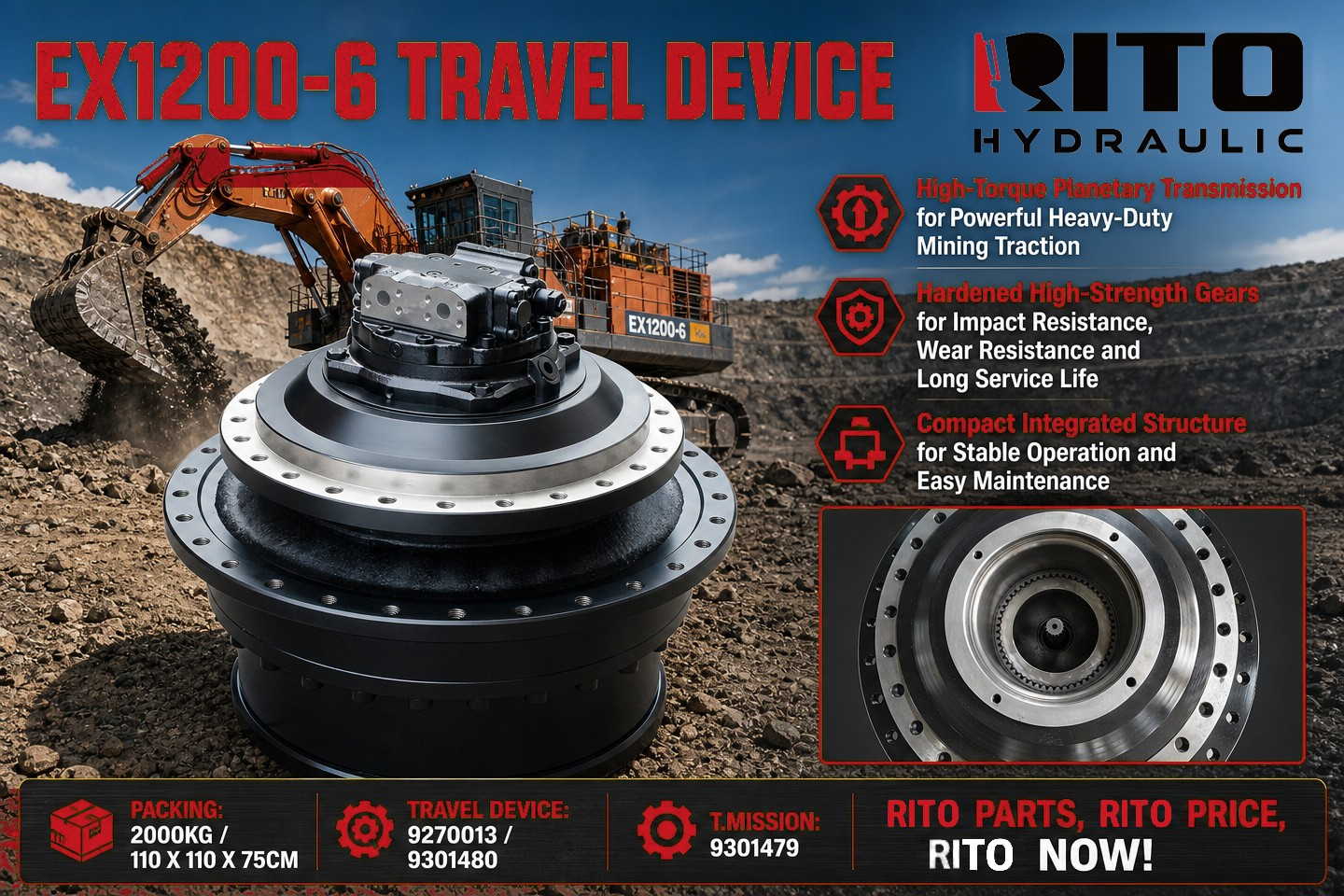
- Product numbers: travel device 9270013 / 9301480; travel gearbox (T.MISSION) 9301479.
- One track or both? Both suggests the hydraulic supply; one suggests that travel unit.
- Two tests carry most of the diagnosis: case-drain flow (motor wear) and gear oil inspection (gearbox wear).
- It is a 2,000 kg component — 110 × 110 × 75 cm — so lifting and freight are part of the decision.
Table of Contents
- 1. Two Parts, Two Numbers
- 2. What Each Part Actually Does
- 3. Stage 1: Separate Hydraulic from Mechanical
- 4. Stage 2: Gearbox or Complete Device?
- 5. Stage 3: Repair or Replace?
- 6. What This Component Has to Survive
- 7. Confirm the Right Unit
- 8. FAQ
- 9. Get Your Travel Unit Confirmed
1. Two Parts, Two Numbers
The first reason these jobs go wrong is that buyers order "the travel motor" when they need a gearbox — or the reverse. The two are sold separately, under separate numbers:
| Part | Number | What it is |
|---|---|---|
| Travel device | 9270013 / 9301480 | The complete assembly: hydraulic motor, parking brake and reduction gear in one unit |
| Travel gearbox (travel mission) | 9301479 | The planetary reduction on its own — no motor, no hydraulics |
Everything in this article follows from that split. If you order the wrong layer you either pay for a motor you did not need, or fit a gearbox to a worn motor and repeat the failure. Complete units are listed under Hitachi-series parts.
2. What Each Part Actually Does
| Section | Job | Typical failure signature |
|---|---|---|
| Hydraulic motor | Converts oil flow and pressure into rotation | Weak travel, high case-drain flow, heat, both speeds affected |
| Parking brake | Holds the machine when travel is not commanded | Will not release (no travel at all), drags, or slips on a slope |
| Planetary reduction | Turns fast, low-torque motor rotation into slow, very high torque at the sprocket | Noise, grinding, binding, metal in the gear oil, jerky travel |
Read that third column carefully — it is the shortest route to an answer. Hydraulic faults show up as weakness; mechanical faults show up as noise and debris. That distinction is what the next two stages refine.
3. Stage 1: Separate Hydraulic from Mechanical
Before removing a 2,000 kg component, establish whether the problem is even in it. Work in this order:
| # | Check | What it tells you |
|---|---|---|
| 1 | One track or both? | Both weak → look at the supply (pumps, travel control, reliefs, centre joint) before the units |
| 2 | Does it track straight on flat ground? | A machine that pulls to one side has one side weaker — consistent with that unit or its circuit |
| 3 | Pressure test at the travel circuit | Low pressure = supply or internal leakage; normal pressure with no movement = mechanical or brake |
| 4 | Measure case-drain flow | The classic motor-wear indicator. A high, rising flow condemns the motor, not the gearbox |
| 5 | Check brake release pressure | A brake that will not release stops the machine without anything being "worn out" |
| 6 | Drain and inspect the gear oil | Metal or glitter points straight at the reduction — the most direct gearbox evidence there is |
| 7 | Check track tension and sprocket condition | A worn sprocket or over-tight track loads the final drive and can feel like a failing unit |
Steps 4 and 6 do most of the work: one measures the motor, the other inspects the gearbox. If both come back clean and the machine is still weak, the fault is upstream — supply or control — and no amount of replacing travel hardware will fix it.
4. Stage 2: Gearbox or Complete Device?
Once you know the fault is mechanical — not supply — the question becomes which layer. Use the symptoms:
| What you observe | Most likely | Why |
|---|---|---|
| Noise that rises with speed, metal in the gear oil | Reduction (gearbox) | Gear and bearing damage announces itself audibly and in the oil |
| Weak on both speeds, hot, high case-drain flow | Motor | Internal leakage costs flow and produces heat |
| Lost one speed range only | Motor control / shift mechanism | Speed change is a motor-side function |
| Will not move, no noise | Brake not releasing, or no supply | A seized-on brake looks like a dead machine |
| Grinding plus weak travel | Both — plan a complete device | Debris from one side has damaged the other |
| Damaged housing or mounting | Assess case by case | Depends whether the damage is confined to the gear case |
Two rules decide most cases:
- 1. A gearbox-only replacement is right when the motor is proven good. That means the case-drain test is within specification, the pressures hold, the brake releases correctly and both speeds work. If those are true and the fault is noise, binding or debris in the gear oil, the reduction is the failing layer — and replacing it alone is both correct and far cheaper.
- 2. A complete device is right when the motor is also suspect, or when you cannot prove it isn't. Fitting a new gearbox onto a motor with rising case drain simply moves the failure a few months down the road — and the second failure is more expensive than the first. A comparable pattern on a smaller machine is described in our travel motor failure case study.
5. Stage 3: Repair or Replace?
On a mining-class machine, the comparison is not "overhaul invoice versus new-unit invoice". It has more lines than that.
| Cost line | Overhaul / repair | New or exchange unit |
|---|---|---|
| Component cost | Lower on paper | Higher on paper |
| Removal and refit | Required — and this is a 2,000 kg lift | Required, but once |
| Workshop time | Open-ended: strip, assess, order parts, rebuild | Predictable |
| Parts availability | The real risk — internal parts may be scarce and slow to obtain | Already assembled and tested |
| Certainty of outcome | Depends on the rebuild | Tested before shipping |
| Downtime on a working machine | Longest, and least predictable | Shortest |
| Risk of doing it twice | Real | Low |
Where an overhaul genuinely wins: when the unit is otherwise sound, the parts are available, and the machine has time off — for example a planned workshop stop rather than a mid-shift breakdown. Where replacement wins: a machine that is needed now, a fault that has spread, or internal parts with long lead times. And a general rule that applies either way: if the failure has produced debris, flush the travel circuit and check the rest of the hydraulic system — the same contamination logic that governs every hydraulic repair. Complete assemblies are listed under excavator hydraulic parts.
6. What This Component Has to Survive
It helps to appreciate what you are buying, because it explains the price and the weight:
| Design point | Why it matters on a mining machine |
|---|---|
| High-torque planetary transmission | The EX1200-6 is a very heavy machine; moving it up a grade or through soft ground demands enormous torque at the sprocket |
| Hardened high-strength gears | Mining travel is not steady — it is shock loading every time a track hits rock or a bucket bites |
| Compact integrated structure | Fewer external joints and a stable assembly, which also makes servicing more straightforward |
Two practical numbers follow from that duty: the assembly weighs about 2,000 kg and packs in a 110 × 110 × 75 cm case. Plan heavy lifting and heavy freight before you order — and allow for the fact that on a machine this size, the cost of the crate moving is itself a factor in the decision.
7. Confirm the Right Unit
- Read the identification on the existing unit. Photograph the plate or stamped number on the housing — straight-on and in focus.
- Record the machine model and serial. The serial range decides the build.
- Note which side of the machine it is, and whether both sides are the same specification.
- State which layer you need — the complete travel device (9270013 / 9301480) or the travel gearbox alone (9301479) — and ask for that to be verified against your serial.
- Include your test results — case-drain flow, pressures, and what you found in the gear oil. That evidence lets a supplier confirm both the part and the decision.
If you are still unsure which component you need, our travel motor fitment guide covers the matching process, and travel motor versus swing motor explains the two functions if you are diagnosing from scratch.
8. FAQ
Q1: Why is my EX1200-6 travel weak?
It is usually one of three things: the hydraulic supply (pumps, travel control, reliefs, centre joint), the travel motor (internal wear), or a brake that is not releasing. If both tracks are weak, suspect the supply first; if one is weak, suspect that travel unit.
Q2: What is the difference between the travel device and the travel gearbox?
The travel device is the complete assembly — motor, parking brake and reduction gear. The travel gearbox (listed as the travel mission) is the reduction alone. They carry different numbers: 9270013 / 9301480 for the device and 9301479 for the gearbox.
Q3: How do I know whether the gearbox or the whole assembly is at fault?
Test the motor side: case-drain flow and pressures. Inspect the gearbox side: drain the gear oil and look for metal, and listen for noise that rises with speed. If the motor tests good and the evidence is mechanical, the gearbox alone is likely the culprit.
Q4: Can I replace just the travel gearbox?
Often yes — provided the motor is proven good. Fitting a new gearbox onto a worn motor usually means repeating the job soon afterwards, so test the motor before deciding.
Q5: What causes noise in the travel system?
Most commonly gear and bearing damage in the reduction, which also shows up as metal in the gear oil. Other causes include motor internal damage, low lubricant level, and loose or worn mounting.
Q6: What is the most useful single test?
For the motor, case-drain flow measurement. For the gearbox, draining and inspecting the oil. Together they separate hydraulic wear from mechanical damage.
Q7: Should I repair or replace the travel device?
Overhaul makes sense if the unit is otherwise sound, parts are available and the machine has planned downtime. Replacement makes sense if the machine is needed now, the fault has spread, or internal parts have long lead times.
Q8: How heavy is this component?
About 2,000 kg, packed in a 110 × 110 × 75 cm case. Rated lifting equipment and heavy freight arrangements are essential.
Q9: Does the machine need flushing after a travel failure?
Yes. Flush the travel circuit, renew filters, and check for debris elsewhere in the system — contamination from a failed unit does not stay in one place.
Q10: What should I send to get the right unit?
Machine model and serial number, the identification from the existing travel unit, which side it is, which layer you need (device or gearbox), and any test results you have.
9. Get Your Travel Unit Confirmed
Send us your machine model, serial number and the identification from the travel unit — plus photos and any test readings — and our team will confirm whether you need the complete travel device (9270013 / 9301480) or the travel gearbox (9301479), check for supersession, and quote lead time the same day. RITO HYDRAULIC supplies complete, individually tested travel devices, travel gearboxes, main pumps, control valves and swing motors for Hitachi, Komatsu, Caterpillar, Kobelco, Hyundai, Doosan and Kawasaki-series machines — with export packing and a 6–12 month warranty.
Contact our team or learn more about RITO HYDRAULIC.
Related reading: the ZX850-3 / ZX870-3 travel device.
- CAT 330GC Final Drive — Which Part Number Fits and What Should You Check Before You Buy?
- Why Do Customers Need the TM40 Travel Assembly? When It Is Used, What It Does, and What It Changes
- Komatsu PC300-8 / PC350-8 Hydraulic Pump: Which 708-2G Number Fits, and Why PC300-7 Numbers Keep Appearing
- Why Does a CAT 320C / 320D Hydraulic Pump Lose Power Under Heavy Load?
- Why Does Your CAT 312C Need the SBS80 Hydraulic Pump?