
CAT 374D Main Pump Explained: What A20VLO260 Means & Three-Pump vs Double-Pump Systems


Author
JERY WANG
Guangzhou Rito Hydraulic Co.,Ltd., located in Guangzhou, China, is a leading manufacturer and distributor of hydraulic pumps, final drives, swing motors, and main control valves for earthmoving machinery. We supply genuine, OEM, and high-quality aftermarket parts.
We are committed to continuously sharing our expertise regarding construction machinery and excavator hydraulic systems. Our goal is to help you gain a deeper understanding of equipment principles and applications—enabling you to work more efficiently—while also showcasing our professional knowledge and capabilities. We invite you to learn more about us.
Choose us, and you will enjoy the best service, the most favorable prices, and the most reliable supplier!
Marie R. Winters


Quick Answer
2. Three-pump vs double-pump? A double pump has two pumping sections feeding the valve block: flow can be combined for speed or divided between functions. A three-pump system adds a third pump — normally because the machine needs more total flow than two sections can supply, or because one circuit deserves its own dedicated supply. More pumps mean more total flow, better flow sharing across big cylinders, and often better control — but also more parts to check when something goes wrong.
Key Takeaways
- 295-9676 is the Caterpillar main hydraulic pump group for the 374D / 374D L.
- 369-9676 is the field replacement for 295-9676 — the same function under a later number. Both are legitimate.
- An A20VLO260-style code tells you pump family, design and size class (~260 cc/rev) — not the exact build.
- Double pump = two sections; three-pump system = a third pump added for flow or dedicated duty.
- The more pumps a machine has, the more important it is to establish which one is faulty before buying.
- Order by the Caterpillar number from your machine, and confirm the configuration from its specification.
Table of Contents
- 1. The 374D Main Pump at a Glance
- 2. 295-9676 and 369-9676: Why Both Exist
- 3. What "A20VLO260" Tells You
- 4. Double Pump vs Three Pump
- 5. Why Big Machines Add a Third Pump
- 6. What This Means When You Buy
- 7. Confirm the Right Pump in Four Steps
- 8. FAQ
- 9. Get Your Pump Confirmed
1. The 374D Main Pump at a Glance
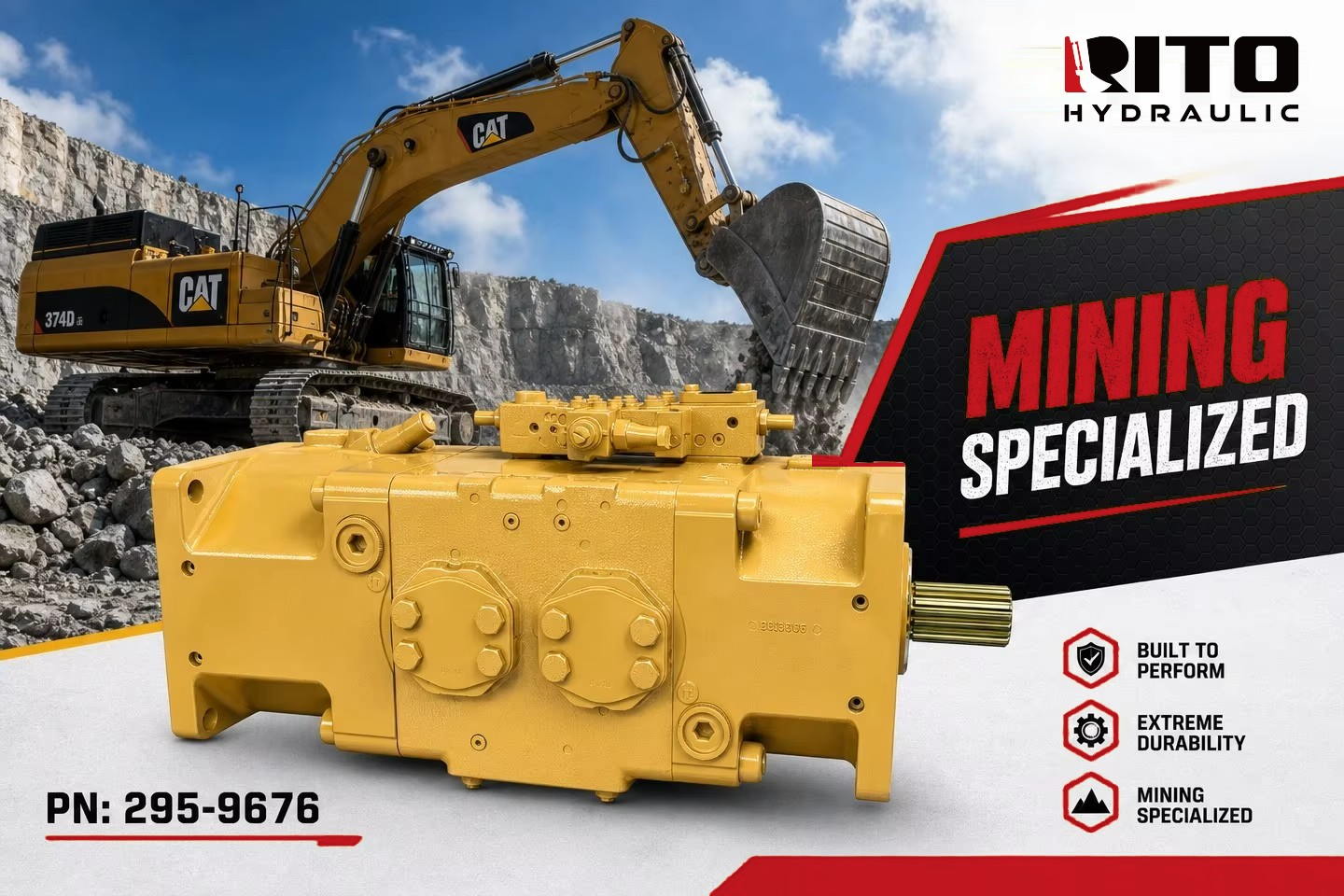
The Caterpillar 374D is a large mining-class excavator. Its main hydraulic pump group is listed under 295-9676, and the product is sold under the mining-duty description: mining specialised, built to perform, extreme durability.
All three of those phrases describe the same engineering reality. A mining excavator works long shifts at high pressure, with shock loads from bucket impacts and rock, in dust and heat. The pump is therefore built around heavy sections, large bearings and reinforced working surfaces — not around the packaging priorities of a smaller machine. That is also why a pump of this class is expensive and heavy, and why getting the number right matters so much.
Complete, individually tested assemblies are listed under Caterpillar-series hydraulic parts.
2. 295-9676 and 369-9676: Why Both Exist
This is a genuinely useful piece of Caterpillar numbering behaviour, and it explains a confusion that costs buyers time:
| Number | Role | What to do with it |
|---|---|---|
| 295-9676 | The main hydraulic pump group for the 374D / 374D L | A legitimate reference — still quoted on machines and listings |
| 369-9676 | The field replacement for 295-9676 (later production / service number) | Often the number a supplier will actually ship |
| 297-7684 | The wider pump and mounting group the pump sits inside | Useful context — not the pump itself |
Related numbers you may also meet for this machine include 295-9404, 369-9655, 295-9677, and remanufactured references such as 20R-0933.
The lesson: two different numbers can describe the same functional part, because manufacturers supersede numbers over a machine's life and introduce remanufactured equivalents. Neither number is "wrong" — but only one will be current, and the machine's serial range is what decides which applies to you. This is exactly why we ask for the plate and the serial rather than just a model name.
3. What "A20VLO260" Tells You
Codes of this family follow a common pattern across hydraulic pump manufacturers. Read it as three pieces of information:
| Part of the code | What it identifies |
|---|---|
| Series letter + number | The pump family and its design generation — here an axial-piston, variable-displacement type |
| Letters in the middle (e.g. V, L) | Design and variant markers — typically indicating a variable pump and a particular build or mounting arrangement |
| Trailing number (260) | The size class — roughly 260 cc/rev per pumping section |
Two honest cautions, because this is where buyers get caught:
- 1. Designations of this kind are the pump maker's language, not the machine maker's. The same physical pump can be referenced under a manufacturer-style code and a Caterpillar part number. You order by the CAT number; the design code tells you what you are dealing with.
- 2. Do not treat the code as the part number. Slight variations in these codes describe different builds — and different builds are not interchangeable. Read the identification on your own pump before ordering anything.
Think of it this way: the code tells you "a large variable axial-piston pump of about 260 cc". It does not tell you which exact assembly your machine needs. For the full picture of how these numbers behave, see our companion guide to the 374D pump: complete assembly or internal parts.
4. Double Pump vs Three Pump
Both arrangements do the same fundamental job — supply hydraulic flow to the machine — but they scale differently. Here is the comparison in plain terms:
| Aspect | Double pump (the standard layout) | Three-pump system |
|---|---|---|
| Pumping sections | Two, sharing one housing and drive | Three — either in one large assembly or as a main pump plus an additional pump |
| Total flow available | Sufficient for 20–40 tonne machines | Much higher — needed to drive the very large cylinders of a mining machine at usable speed |
| How flow is used | Combine or divide the two sections between functions | Flow can be shared across circuits, and a third pump can be dedicated to a specific duty |
| Control and smoothness | Good, but big cylinders can be starved when several functions run together | Better coordination of heavy, simultaneous functions |
| Complexity | Simpler, fewer lines, fewer failure points | More complex: more sections, more lines, more to diagnose |
| When something is wrong | One pump group to suspect | You must establish which pump — the whole machine can feel weak even if only one section has failed |
The core trade-off is easy to state: a third pump buys flow capacity and control, and costs complexity. On a 75-tonne mining excavator that is usually the right trade — the alternative is a machine that cannot move its own bucket fast enough to be productive.
5. Why Big Machines Add a Third Pump
Three reasons drive the decision, and in practice they overlap:
| Reason | Explanation |
|---|---|
| 1. Flow demand | Bigger cylinders have much larger volumes. To move them at a usable speed you need far more litres per minute than two sections can deliver. |
| 2. Flow sharing | With more sections, flow can be distributed so that using one function does not starve another — important when swinging a full bucket while raising the boom. |
| 3. Dedicated duty | A section can be assigned to a specific circuit, giving that circuit a guaranteed supply regardless of what else is running. |
Note that not every "extra pump" is a main pump. Large machines also carry small pilot and cooling pumps, and these are easy to confuse with a third main section when you are looking at a parts diagram. So the honest answer to "is my 374D a two-pump or three-pump machine?" is: check the machine's specification and the pump identification — the configuration is defined by the build, and builds change over a production run.
6. What This Means When You Buy
Once you know how many sections a machine has, the buying advice gets sharper:
| Situation | What to do |
|---|---|
| The whole machine is weak | Test pressures and flows, then identify which pump section is down before ordering |
| One circuit is weak but others are fine | It may be one section, or the valve section serving it — not necessarily the whole pump |
| You need one pump section only | Some sections are serviceable individually; others come only as a complete assembly — ask before assuming |
| You are replacing the assembly | Confirm the number and whether the current supply is the original or the field-replacement number |
| Metal has circulated | Plan a full system flush and check the control valve assembly and the travel and swing motors too |
The pattern in that table is the same one that governs every multi-pump machine: the more pumps there are, the more valuable a proper test is before you spend. A pressure and flow test costs a fraction of a mining-class pump, and it is the only way to know which section needs replacing. Complete, individually tested assemblies are listed under excavator hydraulic parts, and the machine-side method for isolating a pump fault is set out in our guide to troubleshooting a loss of power on a CAT excavator.
7. Confirm the Right Pump in Four Steps
- Record the machine model and serial number. The serial decides the build and therefore the number.
- Photograph the pump identification straight-on. Read the full code — not just the model family.
- Note how many sections the assembly has, and photograph the pump from two or three angles including the ports and regulator.
- Have the number cross-checked, including whether the original number has been replaced by a field-replacement or remanufactured reference.
Four items, one exchange — and a mining-class crate goes to the right machine.
8. FAQ
Q1: What is the CAT 374D main pump?
It is a large variable-displacement axial-piston pump assembly in roughly the 260 cc/rev class per section, listed by Caterpillar as pump group 295-9676 for the 374D / 374D L, with 369-9676 as its field replacement.
Q2: What does A20VLO260 mean?
It is a manufacturer-style designation: it identifies an axial-piston variable-displacement pump family and a displacement class of roughly 260 cc/rev. It describes the type and size of the pump, not the exact build your machine needs.
Q3: Are 295-9676 and 369-9676 the same part?
Functionally they refer to the same pump group: 295-9676 is the original number and 369-9676 is its field replacement. Suppliers may ship either reference, so confirm which applies to your serial range.
Q4: What is the difference between a three-pump and a double-pump system?
A double pump has two pumping sections; a three-pump system adds a third, giving more total flow so that large cylinders can be moved at speed and flow can be shared across circuits. The trade-off is greater complexity and more sections to diagnose.
Q5: Why do mining excavators need more pumping capacity?
Because their cylinders are far larger. Moving a big bucket at a productive speed requires a much higher flow rate than a 20-tonne machine needs — and heavy simultaneous functions need flow sharing to stay coordinated.
Q6: Does a third pump always mean a third main pump?
No. Large machines also carry small pilot and cooling pumps, which are easily confused with a main section on a parts diagram. Confirm the configuration from the machine specification.
Q7: How do I know which pump section is faulty?
By testing pressures and flows at the pump and by function, rather than by replacing parts on suspicion. On a multi-pump machine, a single failed section can make the whole machine feel weak.
Q8: Can I buy one pump section instead of the whole assembly?
Sometimes. Some sections are serviceable or supplyable individually while others are only available as a complete assembly. Ask specifically before assuming either way.
Q9: What else should I check after a pump failure?
The oil for metal, the filter and strainer, the control valve and the travel and swing motors. Contamination travels through the whole circuit, so a complete flush is part of the repair either way.
Q10: What should I send to get the right pump?
Machine model, machine serial number, the full identification from the pump, photos of the assembly including the ports, and any pressure and flow readings you have taken.
9. Get Your Pump Confirmed
Send us your machine model, serial number and the pump identification — plus photos and any test readings — and our team will confirm the correct assembly or section, tell you whether the original number has been superseded, and quote lead time the same day. RITO HYDRAULIC supplies complete, individually tested main pumps, pump sections, control valves, travel motors and swing motors for Caterpillar, Komatsu, Hitachi, Kobelco, Hyundai, Doosan and Kawasaki-series machines — with export packing and a 6–12 month warranty.
Contact our team or learn more about RITO HYDRAULIC.
Related reading: complete assembly or internal parts.
- CAT 330GC Final Drive — Which Part Number Fits and What Should You Check Before You Buy?
- Why Do Customers Need the TM40 Travel Assembly? When It Is Used, What It Does, and What It Changes
- Komatsu PC300-8 / PC350-8 Hydraulic Pump: Which 708-2G Number Fits, and Why PC300-7 Numbers Keep Appearing
- Why Does a CAT 320C / 320D Hydraulic Pump Lose Power Under Heavy Load?
- Why Does Your CAT 312C Need the SBS80 Hydraulic Pump?