
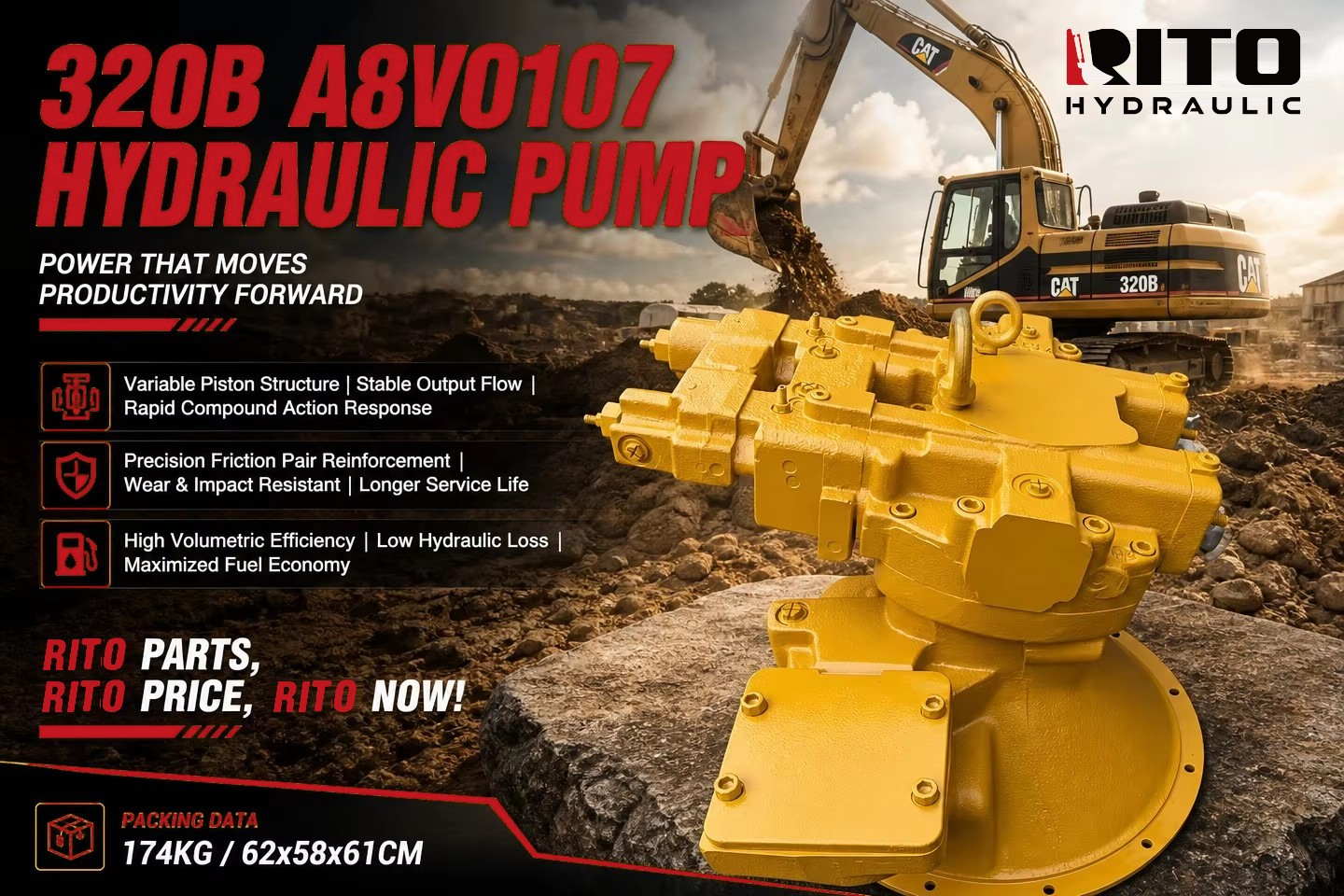
CAT 320B Hydraulic Pump A8VO107 Explained: Bent-Axis vs Swash-Plate, Fitment & 320B vs 320C


Author
JERY WANG
Guangzhou Rito Hydraulic Co.,Ltd., located in Guangzhou, China, is a leading manufacturer and distributor of hydraulic pumps, final drives, swing motors, and main control valves for earthmoving machinery. We supply genuine, OEM, and high-quality aftermarket parts.
We are committed to continuously sharing our expertise regarding construction machinery and excavator hydraulic systems. Our goal is to help you gain a deeper understanding of equipment principles and applications—enabling you to work more efficiently—while also showcasing our professional knowledge and capabilities. We invite you to learn more about us.
Choose us, and you will enjoy the best service, the most favorable prices, and the most reliable supplier!
Marie R. Winters


Quick Answer
1. What is the A8VO107? It is a Rexroth designation for a bent-axis, variable-displacement axial-piston double pump of roughly 107 cc/rev per section, fitted as the main pump on the CAT 320B. The "8" family is Rexroth's double (twin) bent-axis version.
2. Bent-axis vs swash-plate? In a bent-axis pump the cylinder block is tilted relative to the drive shaft; in a swash-plate pump the block is in line with the shaft and a tilted plate drives the pistons. Bent-axis favours high pressure and robustness; swash-plate favours compactness, speed and lower cost.
3. Which CAT machines? Don't stop at 320B — the A8VO107 is listed for 320B, 320BL, 320L and 322BL as well.
4. 320B vs 320C? The 320C moved to a different pump — the SBS120, which is a swash-plate type. So the change from 320B to 320C is not just a part-number change: it is a change of pump generation and design principle.
5. A8VO107 vs A8VO160? The trailing number is the displacement class — 107 vs 160 cc/rev per section. Same family, different size; they are not interchangeable.
Key Takeaways
- A8VO107 = Rexroth bent-axis variable double pump, ~107 cc/rev per section, used on CAT 320B.
- Bent-axis = cylinder block tilted to the shaft; swash-plate = block in line, plate tilted.
- Bent-axis trades compactness and speed for high pressure capability and shock resistance.
- Fitment extends beyond the 320B: 320BL, 320L, 322BL are commonly listed too.
- 320C uses the SBS120 — a swash-plate pump — so 320B and 320C pumps are different in kind, not just in number.
- OEM numbers commonly listed for 320B pumps include 123-2233, 200-3366, 123-2229 and 107-7070 — confirm on your plate. Assembly: about 174 kg, 62 × 58 × 61 cm.
Table of Contents
- 1. What the A8VO107 Is
- 2. Bent-Axis vs Swash-Plate: the Real Difference
- 3. Why a Designer Would Choose Bent-Axis
- 4. Which CAT Machines Use It
- 5. 320B vs 320C: What Actually Changed
- 6. A8VO107 vs A8VO160
- 7. The Part Numbers You Will Meet
- 8. How to Confirm the Right Pump
- 9. FAQ
- 10. Get Your Pump Confirmed
1. What the A8VO107 Is
| Item | Detail |
|---|---|
| Application | Caterpillar 320B class excavator |
| Pump model | Rexroth A8VO107 |
| Design | Bent-axis, variable-displacement axial-piston double pump |
| Size class | About 107 cc/rev per section |
| Weight | 174 kg |
| Packing | 62 × 58 × 61 cm |
| Design points | Variable piston structure with stable output flow and rapid compound-action response; reinforced precision friction pairs for wear and impact resistance; high volumetric efficiency and low hydraulic loss for fuel economy |
Read the model name in three parts. A8VO is Rexroth's bent-axis variable pump designation, and the "8" family is the double version — two pumping sections in one housing, which is what an excavator needs to run several functions at once. 107 is the displacement class. So the code tells you design, configuration and size — but not which exact build your machine has.
That last point is the reason this article exists: parts are ordered by the machine maker's part number, while the pump is described by its manufacturer's model. Complete assemblies are listed under Caterpillar-series hydraulic parts.
2. Bent-Axis vs Swash-Plate: the Real Difference
Both are axial-piston pumps: a ring of pistons runs in a cylinder block and each piston's stroke determines how much oil is moved. The difference — and the whole design philosophy — lies in what gets tilted.
| Aspect | Bent-axis (e.g. Rexroth A8VO107) | Swash-plate (e.g. SBS120, K3V, HPV) |
|---|---|---|
| What is tilted | The cylinder block sits at an angle to the drive shaft | The block is in line with the shaft; a tilted plate drives the pistons |
| How force is transmitted | Through connecting rods / piston-to-flange links | Piston shoes slide on the swash plate |
| Varying the output | Changing the block angle | Changing the plate angle |
| Pressure capability | High — the design suits heavy pressure duty | Good, but historically lower for a given size |
| Shock and impact | Robust — tolerant of heavy, abrupt loads | More dependent on the shoe-plate interface |
| Size and weight | Bulkier and heavier for the same displacement | Compact and lighter |
| Maximum speed | Generally lower | Higher |
| Construction and cost | More complex and more expensive to make | Simpler, easier to build in multi-section form, lower cost |
Neither is "better". They are answers to different questions — and you can see the trade-off in the two CAT generations described in section 5.
3. Why a Designer Would Choose Bent-Axis
A 20-tonne excavator's main pump lives a hard life: high working pressures, sudden shock loads when a bucket hits rock, and continuous duty in dust and heat. A bent-axis design is well suited to that combination:
- 1. Pressure and durability. The bent-axis geometry handles high pressure and shock loads comfortably — exactly what a 320B-class machine asks of it.
- 2. Efficiency under load. At high pressure the design can maintain good volumetric and mechanical efficiency, which is where "high volumetric efficiency, low hydraulic loss" on a product sheet comes from.
- 3. A different wear profile. The critical interfaces are the piston rods and the rotating group rather than a shoe sliding on a plate — which changes which components wear, and how servicing is approached.
And note what the machine owner experiences: a worn or mismatched pump does not announce itself. It shows up as heat, slower cycles, weaker digging and higher fuel burn — the slow tax of a pump that is no longer efficient. Maximising fuel economy, as the product sheet puts it, is really a statement about not wasting flow.
4. Which CAT Machines Use It
This is where most buyers stop too early. Searching "320B" finds one machine, but the A8VO107 is quoted across a wider group of Caterpillar excavators of that generation:
| Machine | Note |
|---|---|
| Caterpillar 320B | The best-known application |
| Caterpillar 320BL | Long-undercarriage variant of the same generation |
| Caterpillar 320L | Commonly listed with the same pump group |
| Caterpillar 322BL | The next size up in the same family — confirm by part number |
Why "confirm by part number" rather than "fits all four"? Because the listing is a starting point: the same pump family can be built in variants, and a machine can be revised during production. The pattern to remember is that Caterpillar's B-generation 20-tonne and 22-tonne machines share the A8VO107 pump family — which is exactly why an owner of a 322BL, not just a 320B, should be searching for this pump.
Complete, individually tested assemblies for this family are listed under excavator hydraulic parts.
5. 320B vs 320C: What Actually Changed
This is the most useful comparison in the whole B-generation story, and it is deeper than a part number.
| Aspect | 320B | 320C |
|---|---|---|
| Main pump | Rexroth A8VO107 | SBS120 |
| Design principle | Bent-axis | Swash-plate |
| What that means | High pressure capability, robust; bulkier | Compact and lighter, better suited to higher speed and tighter packaging |
| Interchangeable? | No. Different design family, different mounting and interfaces — a 320C pump is not a drop-in for a 320B | |
So when someone asks "is the 320C pump the same as the 320B pump?", the accurate answer is: no — the machine changed generation, and the pump changed design principle with it. That is why a 320B owner should search for A8VO107 specifically, and a 320C/320D owner should be looking at the swash-plate SBS family instead. Our guide to the CAT 329D and its SBS140 pump shows where that later generation led.
And the story keeps moving: newer machines such as the 320GC are listed with yet another Rexroth designation. The lesson is not "remember every number" — it is "never assume a neighbouring model or generation shares your pump".
6. A8VO107 vs A8VO160
These two are frequently confused because they share the whole family name and differ only in the final figure. Here is the simple, reliable way to tell them apart:
| Aspect | A8VO107 | A8VO160 |
|---|---|---|
| Family and design | Rexroth bent-axis, variable double pump | Same family and design |
| Displacement class | 107 cc/rev per section | 160 cc/rev per section |
| Machine class | 20-tonne-class machines such as the 320B | Larger machines that need more flow |
| Interchangeable? | No. A larger displacement class is a physically and hydraulically different pump | |
Three practical rules:
- 1. The number is the size, not the power. A bigger class means more flow capability per revolution — it does not by itself mean "more pressure".
- 2. Both figures exist in other Rexroth designations too. You will meet "107" and "160" in related series numbers, so never match on the number alone.
- 3. The machine's part number decides. Read your pump plate first; the model name confirms the family afterwards.
7. The Part Numbers You Will Meet
Alongside the pump model you will see Caterpillar order numbers quoted for this pump. Numbers commonly listed for the 320B main pump include:
| Order number | Commonly listed as | Confirm by |
|---|---|---|
| 123-2233 | 320B / 320BL main hydraulic pump | Machine plate + serial |
| 200-3366 | An A8VO107 pump assembly | Machine plate + serial |
| 123-2229 | Quoted alongside the 320B pump group | Machine plate + serial |
| 107-7070 | A8VO107 pump for 320B | Machine plate + serial |
Note the wording again: "commonly listed as". Order numbers get superseded, and sellers group numbers they consider interchangeable — which is not the same as the manufacturer's data for your serial range. Use this table as a map, not as a verdict.
8. How to Confirm the Right Pump
- Read the plate on the pump itself. Photograph the whole identification plate straight-on and in focus — not just the model name.
- Record your machine model and serial number. The serial is what tells a supplier which build your machine carries.
- Photograph the pump from two or three angles, including the ports, the regulator and the mounting flange.
- Have the numbers cross-checked by a supplier holding the parts data, who can also flag a supersession.
Before you buy, it is also worth confirming the pump is genuinely the fault. All-functions weakness points to the pump; one or two weak functions usually point to the control valve assembly — and a pressure and flow test settles it.
9. FAQ
Q1: What is an A8VO107 hydraulic pump?
It is a Rexroth bent-axis, variable-displacement axial-piston double pump of about 107 cc/rev per section, used as the main pump on the Caterpillar 320B and related machines.
Q2: What is the difference between bent-axis and swash-plate pumps?
In a bent-axis pump the cylinder block is tilted relative to the drive shaft; in a swash-plate pump the block is in line with the shaft and a tilted plate drives the pistons. Bent-axis favours high pressure and shock resistance; swash-plate favours compactness, speed and lower cost.
Q3: Which CAT machines use the A8VO107?
It is commonly listed for the 320B, 320BL, 320L and 322BL. Other machines of that generation may share the family — confirm with the machine's part number and serial.
Q4: Is the 320C pump the same as the 320B pump?
No. The 320C uses the SBS120, a swash-plate pump, while the 320B uses the bent-axis A8VO107. They are different designs and are not interchangeable.
Q5: How do I tell an A8VO107 from an A8VO160?
By the displacement class: 107 versus 160 cc/rev per section. Same family and design, different size — and not interchangeable. The number on your pump plate is what settles it.
Q6: Is A8VO107 a part number I can order by?
It is the pump model and size class. The order number is the Caterpillar number on the machine, confirmed against your serial.
Q7: What are 123-2233, 200-3366, 123-2229 and 107-7070?
Caterpillar order numbers commonly listed for the 320B main pump group. Which one applies to your machine depends on its build — verify before ordering.
Q8: How heavy is the A8VO107 assembly?
About 174 kg, packed in a 62 × 58 × 61 cm case. Plan rated lifting equipment and heavy freight.
Q9: What are the signs of a failing 320B main pump?
All functions weak and slow together, rising oil temperature, metal in the filter, noise that follows pump speed, weaker digging and higher fuel consumption. A single weak function usually points to the control valve instead.
Q10: What should I send to get the right pump?
Machine model, machine serial number, the full identification from the pump plate, and two or three photos of the pump including the ports.
10. Get Your Pump Confirmed
Send us your machine model, serial number and the full identification from the pump plate — plus a few clear photos — and our team will confirm the correct A8VO107 build, flag any supersession, and quote lead time the same day. RITO HYDRAULIC supplies complete, individually tested main pumps, control valves, travel motors and swing motors for Caterpillar, Komatsu, Hitachi, Kobelco, Hyundai, Doosan and Kawasaki-series machines — with export packing and a 6–12 month warranty.
Contact our team or learn more about RITO HYDRAULIC.
Related reading: classic faults on the newer CAT 320GC pump.
- CAT 330GC Final Drive — Which Part Number Fits and What Should You Check Before You Buy?
- Why Do Customers Need the TM40 Travel Assembly? When It Is Used, What It Does, and What It Changes
- Komatsu PC300-8 / PC350-8 Hydraulic Pump: Which 708-2G Number Fits, and Why PC300-7 Numbers Keep Appearing
- Why Does a CAT 320C / 320D Hydraulic Pump Lose Power Under Heavy Load?
- Why Does Your CAT 312C Need the SBS80 Hydraulic Pump?