
Komatsu PC300-7 Main Pump (HPV140): How to Match the Right Pump — Model, Variant & Cross-Reference Guide


Author
JERY WANG
Guangzhou Rito Hydraulic Co.,Ltd., located in Guangzhou, China, is a leading manufacturer and distributor of hydraulic pumps, final drives, swing motors, and main control valves for earthmoving machinery. We supply genuine, OEM, and high-quality aftermarket parts.
We are committed to continuously sharing our expertise regarding construction machinery and excavator hydraulic systems. Our goal is to help you gain a deeper understanding of equipment principles and applications—enabling you to work more efficiently—while also showcasing our professional knowledge and capabilities. We invite you to learn more about us.
Choose us, and you will enjoy the best service, the most favorable prices, and the most reliable supplier!
Marie R. Winters


Quick Answer
Key Takeaways
- Application: Komatsu PC300-7 (30-tonne class); pump model HPV140.
- "HPV140" gives you the model and size class — not the full part number.
- Match on four points: machine & serial, pump code, control variant, mounting/shaft/ports.
- The control (regulator) variant is the single most common reason an HPV140 "fits but runs wrong".
- Never substitute by appearance — neighbouring size classes look similar and do not interchange.
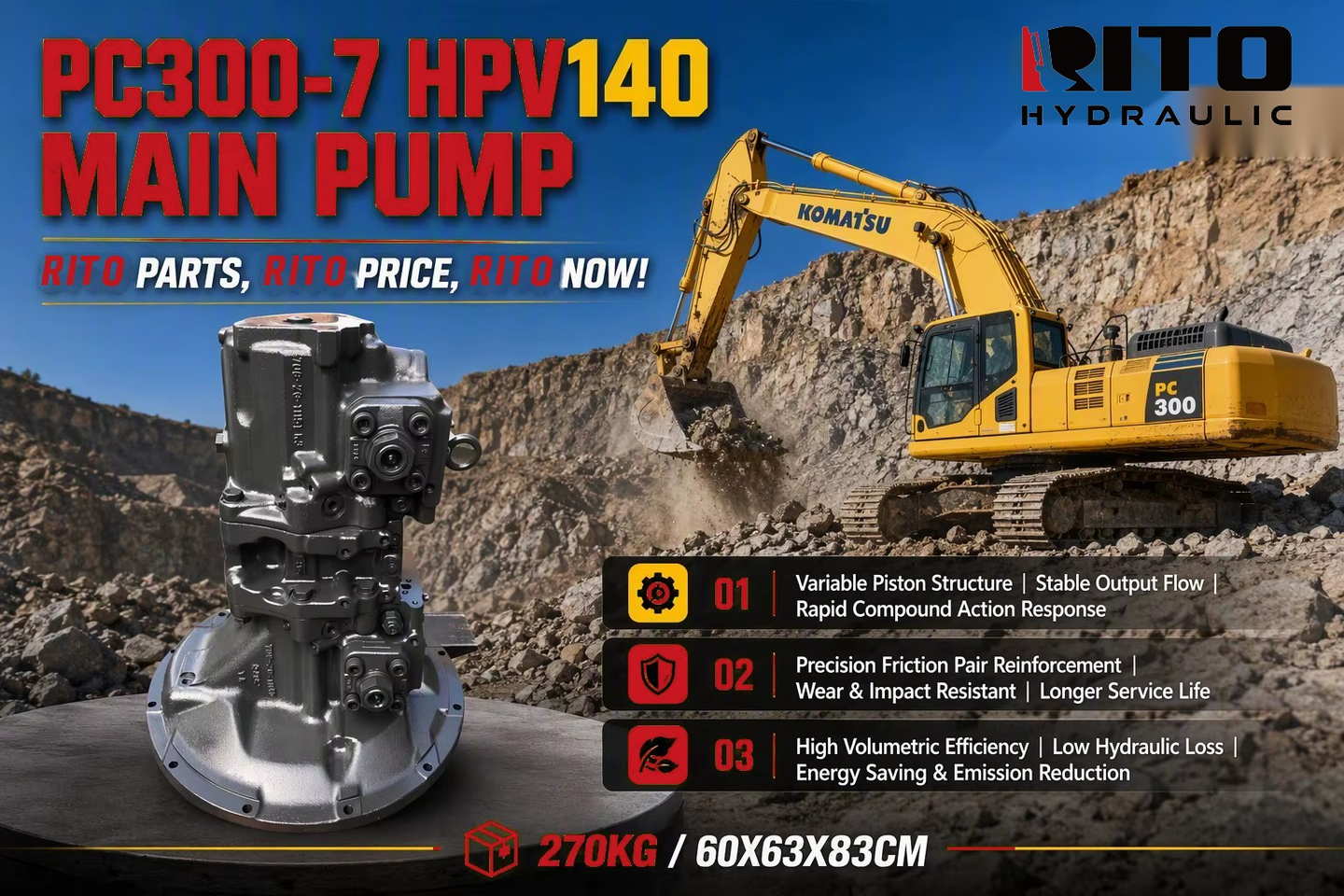
- Weight and size matter for selection too: about 270 kg, packed 60 × 63 × 83 cm.
Table of Contents
- 1. Start With the Machine, Not the Pump
- 2. What "HPV140" Tells You
- 3. Match Point 1: Machine Model & Serial
- 4. Match Point 2: The Pump Code
- 5. Match Point 3: Control Type & Regulator
- 6. Match Point 4: Mounting, Shaft & Ports
- 7. Confirming HPV140 on Your Machine
- 8. The Matching Checklist
- 9. Wrong-Pump Mistakes and What They Cost
- 10. FAQ
- 11. Get Your Pump Matched
1. Start With the Machine, Not the Pump
The most common selection error is starting from a pump number someone quoted, and working backwards. Do it the other way round: identify the machine first.
The PC300-7 is a 30-tonne class excavator, and machines in this class are typically sold in more than one configuration — the standard undercarriage and the LC (long undercarriage) version, for example. Those differences, plus the serial range, decide which pump build left the factory. Complete assemblies and the rest of the range are listed under Komatsu-series hydraulic parts.
2. What "HPV140" Tells You
Komatsu's main pumps carry a model designation, and the PC300-7's is HPV140. Read it as two pieces of information:
| Part of the name | What it means |
|---|---|
| HPV | Komatsu's variable-displacement piston pump family |
| 140 | The size class of the pump — the "how big" part of the answer |
The important distinction: HPV140 is a model, not an order number. Within one model there are variants built for different machines and control systems. That is why the next three match points matter as much as this one. If you want the background on how the pump itself works, see our explainer on how a variable-displacement piston pump works.
3. Match Point 1: Machine Model & Serial
Record three things from the machine itself:
- 1. Model — exactly as marked (for example PC300-7 vs PC300LC-7).
- 2. Serial number — from the machine's serial plate on the frame.
- 3. Configuration — standard or long undercarriage, and any local-market variant.
The serial is not a formality. Manufacturers change pump specifications mid-production, and the serial range is how a supplier knows whether your machine falls before or after that change. A pump that suits one production batch may not suit the next.
4. Match Point 2: The Pump Code
Now go to the pump itself. Every main pump carries a nameplate with the model and the full code for that specific build. Two rules:
- The nameplate beats the model name. "HPV140" narrows the search; the full code on the plate identifies the exact unit.
- Photograph it straight-on and in focus. A blurry photo is the single most common reason a quotation takes a week instead of a day.
Also photograph the whole pump from two or three angles — the photos show details (ports, adjusters, mounting face) that no code can fully convey.
5. Match Point 3: Control Type & Regulator
This is where most "it fits but runs wrong" stories begin. The regulator (also called the control) is the part of the pump that decides how much oil to produce at any moment, and it is tailored to the machine's control system.
| If this differs… | …the machine behaves like this |
|---|---|
| Regulator / control variant | Pump output does not track demand — sluggish, weak or over-loaded |
| Pressure / relief settings | Too low = weak functions; too high = stress and heat |
| Flow-setting arrangement | Compound movements feel slow or jerky |
Because the regulator communicates with the rest of the hydraulic system — including the control valve assembly — a mismatch shows up as a behaviour problem, not a fitting problem. The pump will bolt up perfectly and still feel wrong. This is the strongest argument for matching by code and serial rather than by appearance.
6. Match Point 4: Mounting, Shaft & Ports
The final points are physical. They are easy to check and impossible to argue with:
| Check | Why |
|---|---|
| Mounting flange & bolt pattern | Must bolt to the bell housing without adapters |
| Spline / shaft type | Must engage the coupling correctly |
| Port positions & sizes | Lines must route without re-plumbing |
| Direction of rotation | Wrong rotation means the pump cannot work |
| Weight & envelope | About 270 kg; packed 60 × 63 × 83 cm — plan lifting and freight |
7. Confirming HPV140 on Your Machine
Rather than assuming, confirm. Three reliable sources tell you which pump your machine uses:
- 1. The pump nameplate — the model and full code, as fitted. This is the primary source.
- 2. The machine's parts manual — listed by machine serial range, so it reflects what your build actually uses.
- 3. A supplier's confirmation — send the serial and plate photos and have the match verified before you order.
A caution worth repeating: do not substitute by size or appearance alone. Neighbouring pump size classes look similar in photographs and share many external features, but they are not interchangeable between machine classes. The full, individually tested assemblies in this range are listed with the wider excavator hydraulic parts catalogue.
8. The Matching Checklist
Copy this before you order. If you can answer all five lines, a supplier can confirm your pump the same day.
| # | Item | Where to get it |
|---|---|---|
| 1 | Machine model | Decal / manual |
| 2 | Machine serial number | Serial plate on the frame |
| 3 | Pump model + full code | Pump nameplate (photo it straight-on) |
| 4 | Control / regulator variant | Nameplate suffix + machine manual |
| 5 | Photos of the pump | Two or three angles, including ports |
If you are matching a pump for a different machine, the same logic applies in a brand-agnostic form — see our 3-minute pump selection guide for Komatsu and Hitachi.
9. Wrong-Pump Mistakes and What They Cost
- Ordering by model name only ("HPV140") — variants differ, so this is not enough.
- Skipping the serial number — mid-production pump changes are real, and the serial is how they are tracked.
- Ignoring the control variant — the top cause of a pump that fits but performs badly.
- Judging by a photo — neighbouring size classes look alike and do not interchange.
- Not flushing before fitting — contamination from the old pump shortens the life of the new one.
- Underestimating freight — at about 270 kg and 60 × 63 × 83 cm, this is heavy freight; plan crating and lifting.
10. FAQ
Q1: What pump does the Komatsu PC300-7 use?
The PC300-7 uses the HPV140 main pump — a variable-displacement piston pump. Confirm the exact build from the pump nameplate and your machine serial.
Q2: Is "HPV140" enough to order the right pump?
No. HPV140 identifies the model and size class, but the model is built in several variants. The full code on the nameplate, plus the machine serial, is what confirms the correct unit.
Q3: Why does the control variant matter so much?
The regulator sets how much oil the pump produces and how it communicates with the rest of the system. The wrong variant bolts up but makes the machine feel sluggish, weak or over-loaded.
Q4: What information should I send to get a quote?
Machine model, machine serial number, the full pump code from the nameplate, and two or three clear photos of the pump including the ports.
Q5: How heavy is the PC300-7 main pump?
About 270 kg as a complete assembly, packed in a 60 × 63 × 83 cm case.
Q6: Can a pump from a nearby model fit?
Do not assume it. Similar-looking pumps from neighbouring machine classes usually differ in size class, control variant or mounting. Confirm by code and serial.
Q7: How do I find the pump code on my machine?
It is on the nameplate attached to the pump body. Photograph it straight-on and in focus, and also photograph the pump from two or three angles.
Q8: Does the serial number really change the pump?
It can. Manufacturers revise specifications during a model's production run, so the serial range indicates which build your machine was fitted with.
Q9: What should I do after fitting a new pump?
Flush the system, renew the return filter and suction strainer, fill with fresh correct-grade oil, and check pressures and settings against the machine specification before returning to full load.
Q10: How can I be sure before it ships?
Ask for a per-unit test report, a 6–12 month warranty, and confirmation that the pump is a new, complete assembly matched to your exact code — not a rebuild sold as new.
11. Get Your Pump Matched
Send us your machine model, serial number and the full pump code from the nameplate — plus a few clear photos — and our team will confirm the correct HPV140 build, provide a test-report sample and quote lead time the same day. RITO HYDRAULIC supplies complete, individually tested main pumps, control valves, travel motors and swing motors for Komatsu, Hitachi, Kobelco, Caterpillar, Hyundai, Doosan and Kawasaki-series machines — with export packing and a 6–12 month warranty.
Contact our team or learn more about RITO HYDRAULIC.
- CAT 330GC Final Drive — Which Part Number Fits and What Should You Check Before You Buy?
- Why Do Customers Need the TM40 Travel Assembly? When It Is Used, What It Does, and What It Changes
- Komatsu PC300-8 / PC350-8 Hydraulic Pump: Which 708-2G Number Fits, and Why PC300-7 Numbers Keep Appearing
- Why Does a CAT 320C / 320D Hydraulic Pump Lose Power Under Heavy Load?
- Why Does Your CAT 312C Need the SBS80 Hydraulic Pump?