
Komatsu PC200-8 Main Pump Explained: How a Variable Displacement Piston Pump Works


Author
JERY WANG
Guangzhou Rito Hydraulic Co.,Ltd., located in Guangzhou, China, is a leading manufacturer and distributor of hydraulic pumps, final drives, swing motors, and main control valves for earthmoving machinery. We supply genuine, OEM, and high-quality aftermarket parts.
We are committed to continuously sharing our expertise regarding construction machinery and excavator hydraulic systems. Our goal is to help you gain a deeper understanding of equipment principles and applications—enabling you to work more efficiently—while also showcasing our professional knowledge and capabilities. We invite you to learn more about us.
Choose us, and you will enjoy the best service, the most favorable prices, and the most reliable supplier!
Marie R. Winters


Quick Answer
Key Takeaways
- The main pump converts engine power into hydraulic power — flow and pressure that drive every function.
- Variable displacement means the pump's output is adjustable, not fixed; it matches demand instead of dumping excess oil.
- On the PC200-8 the assembly is a twin (tandem) unit — two pump sections, one housing, one drive shaft.
- Four words unlock every spec sheet: displacement, flow, pressure, efficiency.
- Most pump failures trace back to contamination, heat or cavitation — not to the pump's design.
- The nameplate number is what makes a pump correct for a given machine; "same model" is not enough.
Table of Contents
- 1. What the Main Pump Actually Does
- 2. Why "Variable Displacement" Is the Whole Story
- 3. Inside the Pump: the Main Parts
- 4. How It Works: a Simple Walk-Through
- 5. Two Pumps in One: the Tandem Design
- 6. Key Terms, in Plain Words
- 7. What Wears Out, and Why
- 8. PC200-8 Pump at a Glance
- 9. FAQ
- 10. Get Help Choosing Your Pump
1. What the Main Pump Actually Does
An excavator's engine turns a shaft. That shaft spins the main pump. Inside, the pump pushes hydraulic oil into a pressurised circuit, and that oil does the real work — lifting a boom, curling a bucket, swinging the house, driving the tracks.
Think of the pump as a translator: mechanical power in, hydraulic power out. Everything downstream — the control valve, the cylinders, the travel and swing motors — only works because the pump keeps supplying the right amount of oil at the right pressure. The PC200-8 is a mid-size 20-tonne class machine, so its pump sits right at the centre of every job it does. You can browse the wider Komatsu-series range to see how this family scales across models.
2. Why "Variable Displacement" Is the Whole Story
There are two ways to build a hydraulic pump. A fixed-displacement pump always moves the same volume of oil per revolution — simple, but wasteful, because when the machine needs less oil the excess has to go somewhere. A variable-displacement pump can change its output on the fly.
That difference is the reason modern excavators feel so refined:
| Situation | Fixed-displacement pump | Variable-displacement pump (PC200-8 type) |
|---|---|---|
| Operator idles the machine | Keeps pumping the same volume | Reduces output to save energy |
| Slow, precise digging | Excess oil heats the system | Matches flow to the joystick |
| Heavy digging, multiple functions | Limited by fixed output | Increases output for power and speed |
| Fuel consumption | Higher — wasted energy becomes heat | Lower — output follows demand |
In short: a variable pump only makes the oil you actually need. That is what "high efficiency and energy saving" means on a product sheet — it is not marketing, it is the direct consequence of the design.
3. Inside the Pump: the Main Parts
You do not need to be a technician to understand the layout. A variable-displacement axial-piston pump is built around a handful of key parts:
- 1. Drive shaft — takes power from the engine and spins the rotating group.
- 2. Cylinder barrel + pistons — a ring of pistons rides in a barrel; as the barrel turns, each piston rises and falls to draw in and push out oil.
- 3. Swash plate — an angled face the pistons run against. Change its angle, and you change how far each piston travels — which changes the output. This is the heart of "variable displacement".
- 4. Regulator / control — the brain. It reads what the machine is doing and tilts the swash plate to the right angle.
- 5. Valve plate + ports — the inlet and outlet that time the oil in and out of the barrel.
- 6. Housing and bearings — hold everything in alignment under high pressure and load.
On the PC200-8, the manufacturer's emphasis on "precision friction pairs" refers to these closely fitted working surfaces — barrels, pistons, shoe plates — where millionths of a millimetre of clearance decide whether the pump is efficient or worn out. That is why the quality of these surfaces, not the casting, is what separates a good pump from a cheap one. Complete assemblies are listed with the wider excavator hydraulic parts range.
4. How It Works: a Simple Walk-Through
Follow the oil from tank to work and back — this is the entire loop, in five steps:
- 1. Suction. Oil is drawn from the hydraulic tank into the pump. If the suction filter or line is restricted, the pump starves — and starvation damages it quickly.
- 2. Pressurisation. The spinning pistons push the oil into a much smaller volume, raising its pressure.
- 3. Control. The regulator angles the swash plate so the pump produces only the flow the machine needs right now.
- 4. Distribution. Pressurised oil leaves the pump and is routed by the control valve to the cylinder or motor that is working.
- 5. Return. After doing its job, the oil returns to the tank, passes through the return filter, and cools before going around again.
Once you see the loop, the symptoms start to make sense: a restricted suction line causes noise and damage (cavitation), a dirty return filter lets contamination circulate, and hot oil thins out and accelerates wear everywhere. For the full machine-wide picture, see our companion explainer on how an excavator hydraulic system works.
5. Two Pumps in One: the Tandem Design
Look at a PC200-8 main pump and you will notice it looks like two pump bodies bolted together — because it is. Most machines in this class use a tandem (twin) pump: two variable-displacement pump sections sharing one housing and one drive shaft.
Why two? Because an excavator has to run several functions at once. Splitting the output lets the machine:
- Combine flows when the operator needs maximum speed on a single function.
- Divide flows when two or more functions work together — for example, swinging while lifting the boom.
- Keep pressure where it is needed, instead of one pump being pulled in several directions at once.
That is also why the pump is matched to the machine so precisely: the two sections are tuned to the flow and pressure the excavator's circuits expect. Our companion PC200-7 / PC220LC-7 pump reference shows how the same family carries different numbers for different builds.
6. Key Terms, in Plain Words
Spec sheets are full of short words with big meanings. Here is what each one is really telling you:
| Term | Plain-language meaning |
|---|---|
| Displacement | How much oil the pump moves in one revolution — its "size" |
| Variable displacement | That "size" can be changed while running, to match demand |
| Flow | How much oil the pump delivers per minute — flow sets speed of movement |
| Pressure | The "push" behind the oil — pressure sets force (lifting and digging power) |
| Regulator / control | The part that decides how much oil to produce at any moment |
| Volumetric efficiency | How much of the oil the pump "should" move actually reaches the circuit, instead of leaking past worn parts |
| Case drain | The small leakage line back to the tank — a rise here is an early wear signal |
| Cavitation | Vacuum bubbles forming and collapsing in the oil — they erode metal surfaces |
| Contamination | Particles in the oil — the single biggest cause of hydraulic wear |
Two of these are worth remembering above the rest: flow controls how fast the machine moves, and pressure controls how hard it pushes. Almost every "the machine feels wrong" complaint is really a flow or pressure story.
7. What Wears Out, and Why
Pumps rarely fail because their design is weak. They fail because something in the oil or the environment attacks them over time. The usual culprits:
| Cause | What it does | How to prevent it |
|---|---|---|
| Contamination | Particles grind the precision fits, so oil leaks internally | Clean oil, fresh filters, careful filling |
| Heat | Thins the oil and speeds up wear; overheated oil loses its protective film | Keep the cooler working; don't run hot |
| Cavitation | Bubbles collapse against metal and pit it | Keep the suction filter and line clear |
| Oil starvation | Pump runs without enough oil and seizes or scores | Correct oil level; fix leaks early |
| Sustained overload | Constant maximum pressure shortens component life | Correct relief settings; sensible operation |
Notice the pattern: almost every cause is controllable. That is the most useful thing a machine owner can take from a "how it works" explainer — the pump is usually the victim, not the culprit.
8. PC200-8 Pump at a Glance
| Item | Detail |
|---|---|
| Application | Komatsu PC200-8 |
| Type | Variable-displacement piston pump, twin (tandem) assembly |
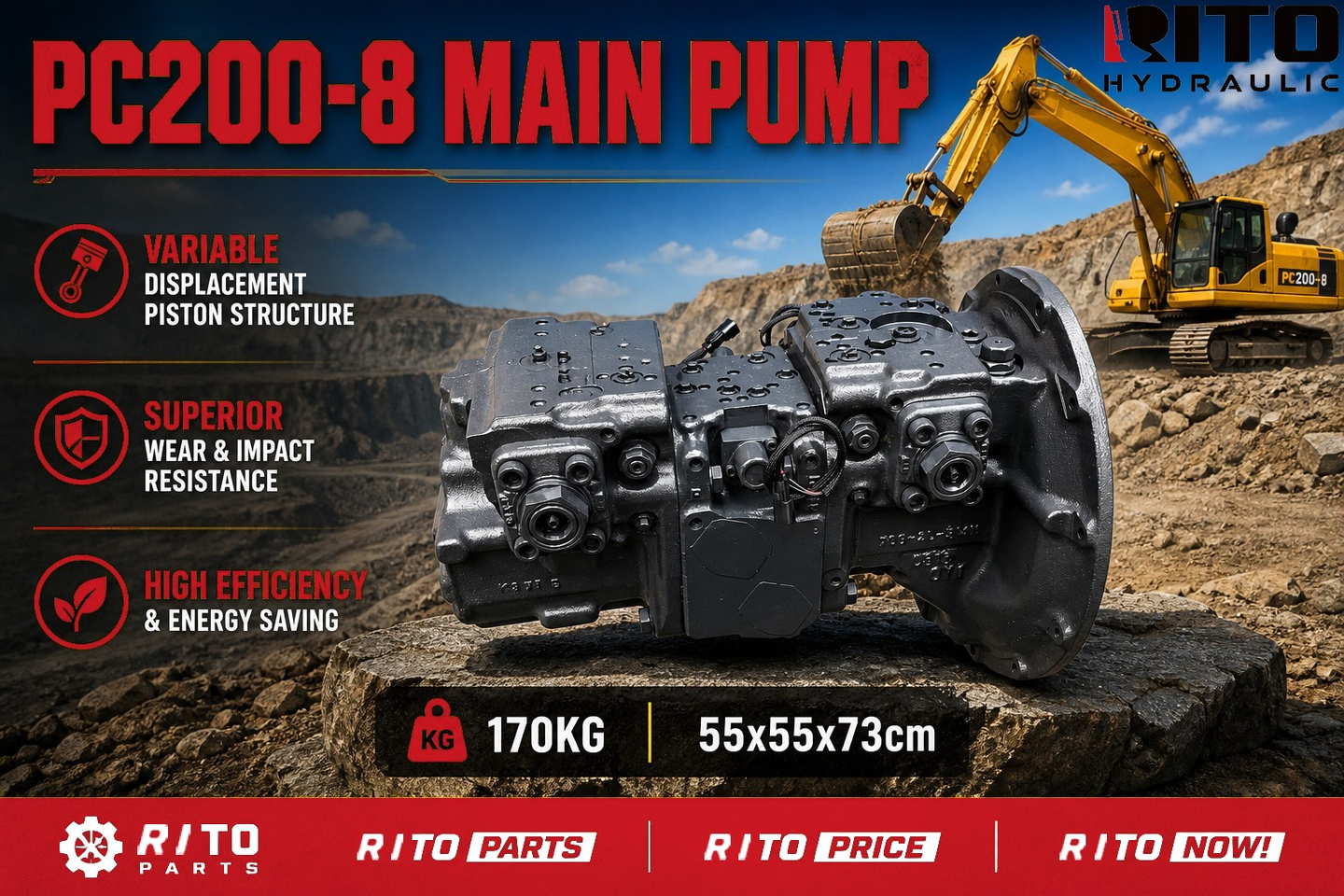
| Weight | 170 kg |
| Packing | 55 × 55 × 73 cm |
| Design highlights | Variable-displacement piston structure; superior wear and impact resistance on the working surfaces; high efficiency and energy saving |
| Confirm with | The nameplate number on your own pump + machine serial |
Rated displacement, pressure and flow figures vary by build, so always confirm them against your machine's specification and the pump nameplate rather than assuming they are the same across the model.
9. FAQ
Q1: What does the main pump do on a PC200-8?
It converts engine power into hydraulic power — pressurised oil flow that drives the boom, arm, bucket, swing and travel functions.
Q2: What does "variable displacement" mean?
The pump can change how much oil it moves per revolution, so it produces only the flow the machine needs instead of always pumping a fixed amount. That is what makes the machine smooth and fuel-efficient.
Q3: Why does an excavator pump have two sections?
A tandem design lets the machine combine flows for maximum speed on one function or divide them when several functions work together.
Q4: What is the difference between flow and pressure?
Flow is how much oil moves per minute and sets how fast a function moves. Pressure is the push behind the oil and sets how much force it can produce.
Q5: What usually causes a main pump to fail?
Contamination, heat, cavitation, oil starvation or sustained overload — not the basic design. All of these are largely preventable with clean oil and correct maintenance.
Q6: What is "volumetric efficiency"?
How much of the oil the pump should move actually reaches the circuit, rather than leaking past worn parts. Lower efficiency means the pump is losing performance even if it still turns.
Q7: How heavy is the PC200-8 main pump?
Around 170 kg as a complete assembly, packed in a 55 × 55 × 73 cm case — so plan lifting equipment and freight accordingly.
Q8: Can I use any pump that fits a PC200-8?
No. Build variants can use different pump numbers. Always match the nameplate number and machine serial, not just the model name.
Q9: Does the pump or the valve cause weak functions?
Weakness in all functions together points to the pump; weakness in one or two functions points to the relevant control valve section.
Q10: What maintenance keeps a main pump healthy?
Clean, correct-grade oil; regular filter changes; a working cooler; correct relief settings; and prompt attention to any noise or heat change.
10. Get Help Choosing Your Pump
If you are replacing a pump rather than studying one, the safest route is to let us confirm it for you. Send your machine model, serial number and the full number from the pump nameplate, plus a few clear photos, and our team will confirm the correct assembly and quote lead time. RITO HYDRAULIC supplies complete, individually tested main pumps, control valves, travel motors and swing motors for Komatsu, Hitachi, Kobelco, Caterpillar, Hyundai, Doosan and Kawasaki-series machines — with export packing and a 6–12 month warranty.
Contact our team or learn more about RITO HYDRAULIC.
- CAT 330GC Final Drive — Which Part Number Fits and What Should You Check Before You Buy?
- Why Do Customers Need the TM40 Travel Assembly? When It Is Used, What It Does, and What It Changes
- Komatsu PC300-8 / PC350-8 Hydraulic Pump: Which 708-2G Number Fits, and Why PC300-7 Numbers Keep Appearing
- Why Does a CAT 320C / 320D Hydraulic Pump Lose Power Under Heavy Load?
- Why Does Your CAT 312C Need the SBS80 Hydraulic Pump?