
Caterpillar 320D3 Swing Motor Assembly: Complete Fitment and Buying Guide


Author
JERY WANG
Guangzhou Rito Hydraulic Co.,Ltd., located in Guangzhou, China, is a leading manufacturer and distributor of hydraulic pumps, final drives, swing motors, and main control valves for earthmoving machinery. We supply genuine, OEM, and high-quality aftermarket parts.
We are committed to continuously sharing our expertise regarding construction machinery and excavator hydraulic systems. Our goal is to help you gain a deeper understanding of equipment principles and applications—enabling you to work more efficiently—while also showcasing our professional knowledge and capabilities. We invite you to learn more about us.
Choose us, and you will enjoy the best service, the most favorable prices, and the most reliable supplier!
Marie R. Winters


Quick Answer
Key Takeaways
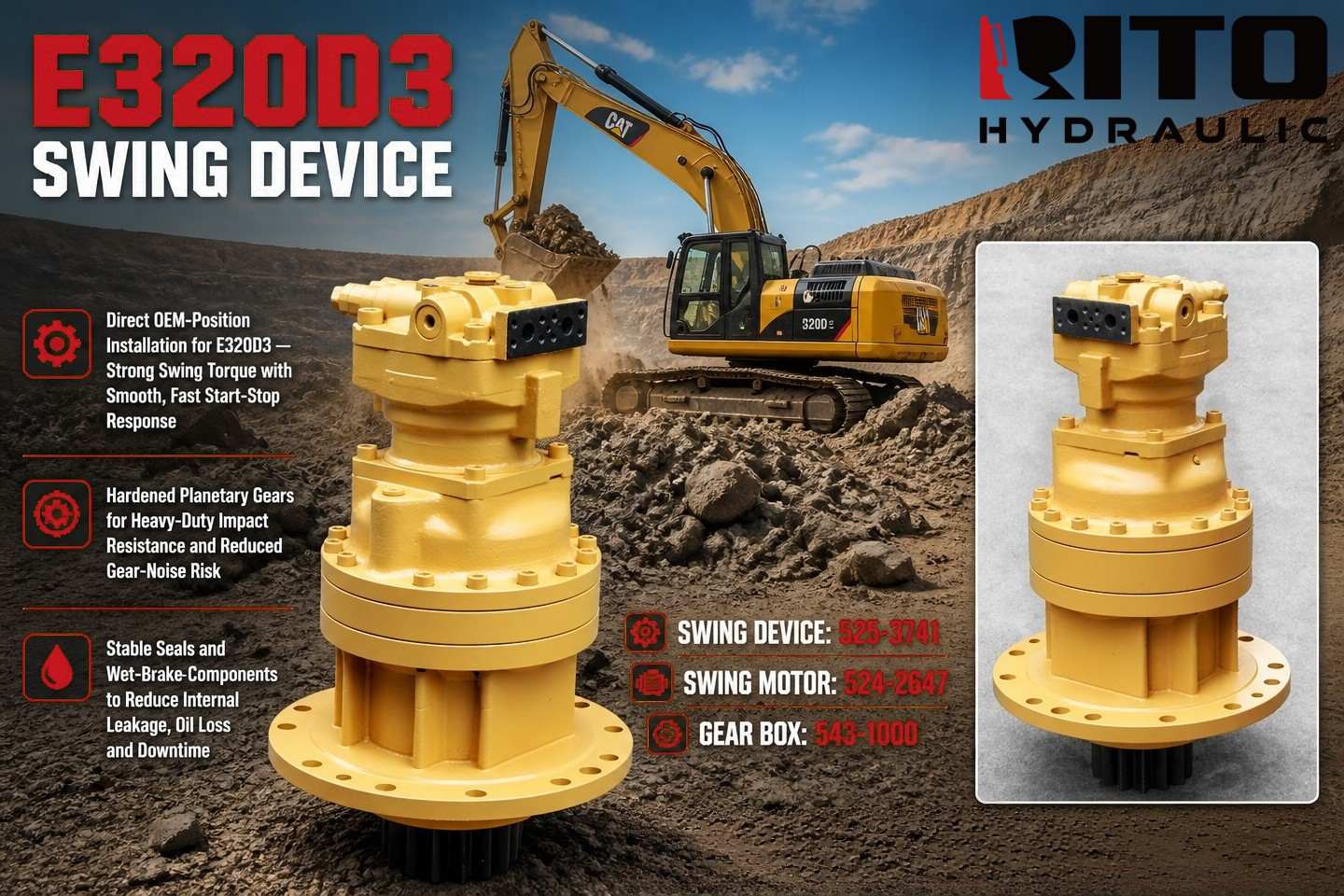
- The 320D3 swing drive has three orderable levels: complete device (525-3741), motor (524-2647) and gearbox (543-1000).
- 543-1000 is the gearbox without the motor — it is a component of the complete 525-3741 device, not a rival part number.
- Choose the level first (what has failed), then the number (what your machine carries).
- Buying the complete assembly is not automatically right — and buying motor-only is not automatically cheap.
- Listings disagree about which 320D / 323D generations this drive covers, so the machine serial decides, not the listing.
- Swing runs on almost every working cycle, which is why a worn swing drive shows up as lost production long before it fails outright.
Table of Contents
- 1. Why the Swing Drive Stops the Whole Machine
- 2. Three Numbers, Three Levels
- 3. Which Level Do You Actually Need?
- 4. What "Direct OEM-Position Installation" Requires
- 5. Cross-Generation Fitment: 320D, 320D2, 320D3
- 6. Failure Signals You Can Catch Early
- 7. Confirm Before You Order
- 8. FAQ
- 9. Get Your Swing Assembly Confirmed
1. Why the Swing Drive Stops the Whole Machine
Travel is occasional. Swing is constant. On a 20-tonne class machine like the CAT 320D3, the operator swings the upper structure to dig, to dump and to reposition — many times an hour, every shift. No other hydraulic function is worked as hard, and none is as closely tied to output.
That is what makes the swing drive different from most parts you order. A tired travel motor slows the machine down; a failed swing drive stops the machine working at all. The machine can still dig, but it cannot put the bucket anywhere useful, so the job simply stops.
The swing drive is a matched pair: a hydraulic swing motor converts oil flow into rotation, and a planetary reduction gearbox multiplies that into the torque that turns the upper structure on the swing bearing. There is also a brake in the assembly, which is what holds the cab steady on a slope and stops it drifting. Three jobs, one bolted assembly.
Worth clearing up before anything else, because it is a common mix-up: a swing motor and a travel motor look alike in photos and do completely different work. Our guide to travel motor versus swing motor settles the identification; the rest of this article assumes you are looking at the swing side. The wider Caterpillar-series hydraulic parts range shows where this assembly sits in the line-up.
2. Three Numbers, Three Levels
The single most useful thing to understand about this drive is that it is sold in layers. Confusing the layers is how people buy the wrong thing — and how they end up paying for a complete unit when a gearbox would have done, or fitting a motor onto a gearbox that was already dying.
| Part number | Level | What it is |
|---|---|---|
| 525-3741 | Complete | The whole swing device — motor, reduction gearbox and brake together, ready to bolt on |
| 524-2647 | Motor | The hydraulic swing motor on its own — the part that turns oil pressure into rotation |
| 543-1000 | Gearbox | The swing reduction gearbox on its own — and it is quoted as without motor, because it is a component of the complete 525-3741 |
Read that last row again, because it is the detail most buyers miss: 543-1000 is not a competing device — it lives inside 525-3741. When someone quotes you a "cheap 543-1000", they are quoting a gearbox, and you still need the motor side accounted for. Knowing which layer a number belongs to stops that conversation going wrong.
You will also meet other numbers in the same listings — for example 549-3964 is commonly quoted alongside the 525-3741 device, and numbers such as 550-5488 and 550-5494 appear in swing motor assembly listings for the 320D2 / 320D3 pair. Treat every one of those as a lead to verify against your own plate. A seller's grouping is a commercial convenience, not a statement from the manufacturer that the parts interchange.
The same layered logic applies to travel devices, which is why our breakdown of the ZX200 travel motor assembly follows the identical pattern: decide the level first, then the number.
3. Which Level Do You Actually Need?
Now the practical question. The right level follows from what is actually wrong — not from price, and not from what happens to be in stock. Use the symptom column, then test before you buy.
| What the machine does | Where it usually sits | Level to consider |
|---|---|---|
| Slow or weak swing, hot oil, no unusual noise | Internal leakage in the motor or a system-side pressure issue | Test first — motor (524-2647) only if the motor is proven at fault |
| Grinding, knocking or a new whine when swinging | Gears, bearings or oil condition inside the reduction | Gearbox side (543-1000) — but inspect the motor too before deciding |
| Upper structure drifts or creeps on a slope | Brake pack wear or brake circuit pressure | Usually a brake or seal-level repair, not a whole device |
| Oil leaking at the motor flange or top cover | Seals and O-rings, before damage spreads inward | Seal kit now — replacement device later if ignored |
| Wear across both the motor and the reduction | A drive that has reached the end of its service life | Complete device (525-3741) — one job, one warranty |
Two honest warnings about how this usually goes wrong in practice.
First, "buy the complete assembly" is not automatically the answer. It is the lowest-risk route when wear genuinely spans both halves — but if the gearbox is sound and only the motor has failed, a motor-level repair is a legitimate decision, provided the rest of the unit has actually been inspected. Anyone telling you to skip that inspection has a sales interest, not a diagnosis.
Second, "motor only" is not automatically the cheap option. Once you add seals, plates, bearings and labour to a unit that is half-worn, the difference often narrows sharply — and you have taken on more risk than a tested assembly would have carried. The test, not the price tag, should make this decision.
Note also what the table implies about the brake. Drifting on a slope is one of the most common complaints on this class of machine, and it is frequently a brake or seal issue rather than a failed motor. That distinction is worth money, because it is the difference between a repair and an assembly. Replacement swing devices and the wider spare range are grouped under excavator hydraulic parts.
4. What "Direct OEM-Position Installation" Requires
The phrase "direct OEM-position installation" describes a specific promise on this drive: the unit is built so it goes back where the original sat, with no fabrication. In practice that means five things must line up at once:
| # | Must match | Why it decides the fit |
|---|---|---|
| 1 | Mounting flange and bolt pattern | The device bolts to the upper structure — a different pattern cannot be made to fit |
| 2 | Output pinion and gear ratio | The pinion drives the swing bearing; the wrong ratio changes swing speed and torque |
| 3 | Port positions and sizes | Hoses must reconnect without re-plumbing; wrong ports invite leaks |
| 4 | Brake type and release pressure | The brake must release cleanly and hold firmly; a mismatch drags, heats or fails to hold |
| 5 | Overall height and shaft engagement | Affects clearance, spline engagement and the load path into the bearing |
Inside the assembly, the parts that carry the load are the ones worth asking about when you buy: hardened planetary gears, which give the reduction its impact resistance against shock loading in rock and demolition work, and the seals and brake components, which decide whether oil stays where it belongs. Those are also the first things a low-cost rebuild quietly leaves out — the gearbox housing gets cleaned and painted, and the internals go back with worn plates and tired seals.
5. Cross-Generation Fitment: 320D, 320D2, 320D3
This is where listings get genuinely confusing, and it is worth being blunt about why. Because Caterpillar shares upper-structure architecture across the 320D family, a swing device from one generation can look like it will fit the next. In the market, you will see the same numbers attached to different model lists — some listings tie 525-3741 and 543-1000 to the 320D3 alone, while others also list them for the 323D3.
That disagreement is not an accident, and it is not something you can settle from a listing:
- Mounting may be shared while the internals are not. A device can bolt up correctly and still carry the wrong gear ratio or brake specification.
- Porting and brake pressure can change between generations. These are the differences that make a physically-fitted unit behave badly.
- Machine serial, not model name, is the discriminator. The serial is what identifies the build and therefore the correct configuration.
So the rule is simple: treat every cross-generation claim as unverified until it is checked against your serial. If you are sourcing second-hand or cross-generation to save money, that check is not optional — it is the whole purchase.
The same discipline pays on the pump side of the same class of machine. A machine that has lost its edge usually gets blamed on one component, and our guide to classic faults on the 320GC main pump shows how often the real cost hides a step away from the obvious suspect.
6. Failure Signals You Can Catch Early
Swing drives rarely fail without warning. They give notice for weeks — and the notice is always cheaper than the repair.
| Signal | What is usually happening | Sensible response |
|---|---|---|
| Drift on a slope | The brake pack or brake circuit is no longer holding fully | Check the brake circuit and plates — this is often a repair, not a replacement |
| Slower swing under load | Falling efficiency through internal leakage | Pressure and flow test — and check oil temperature at the same time |
| New noise when swinging | Gear or bearing wear, or oil that has stopped doing its job | Sample the oil and look for metal before it becomes a knock |
| Oil at the flange or top cover | Seals and O-rings have reached the end of their life | Replace seals early; a small leak lets dust and water in |
| Jerky or uneven swing | Contaminated oil, or a control-side problem rather than the device | Clean the circuit and verify oil condition before condemning the assembly |
Four habits prevent most of the above, and none of them is expensive:
- Keep the gearbox oil right. The reduction is an oil-lubricated unit; the wrong grade or a low level is the fastest route to gear and bearing damage. Check the level, and find the leak rather than topping up forever.
- Sample the oil. Metal in the oil tells you about wear long before you can hear it. It is the cheapest diagnostic you have.
- Treat seals as a service item. Replacing a seal at the first sign of weeping keeps water and grit out of a precision assembly.
- Do not slam the swing against its end stops. Every hard end-stop is a shock load straight into the planetary gears and brake pack.
One caution that saves real money: not every swing fault is a swing-drive fault. Weak swing can come from the pump or the control valve setting, and jerky swing can come from a control signal. Test the circuit before you order an assembly — otherwise you replace a good swing drive and keep the original fault.
7. Confirm Before You Order
Everything above reduces to a short list. Done once, this turns the purchase into a single round instead of a freight argument:
- 1. Machine model and serial number. The serial decides the build — not the badge on the counterweight.
- 2. Which level you need. Complete device, motor only or gearbox only — decided from a test, not a guess.
- 3. The number on your old unit. Read the plate and record it exactly; do not transcribe from memory or from a listing photo.
- 4. What the machine does wrong, and when. In every swing, only under load, only when hot, only on slopes — the timing narrows the cause.
- 5. Photographs. The plate straight-on and in focus, plus the whole assembly from two or three angles including the port face.
- 6. Any oil sample or test result you have. Metal in the oil or a measured pressure drop shortens the conversation considerably.
Sent together, those six items let a supplier verify the drive against your machine. Sent as "one 320D3 swing motor", they become a guess on a heavy, expensive part.
8. FAQ
Q1: What is the swing motor assembly part number for a CAT 320D3?
The complete swing device is 525-3741. It contains the 524-2647 swing motor and the 543-1000 swing reduction gearbox. Which of the three you order depends on which level has failed, so read the plate on your own unit before quoting.
Q2: What is the difference between 525-3741 and 524-2647?
525-3741 is the complete swing device — motor, reduction gearbox and brake as one bolt-on assembly. 524-2647 is only the hydraulic swing motor. Buying the motor does not give you the gearbox, and buying the device includes everything.
Q3: Is 543-1000 the same as 525-3741?
No. 543-1000 is the swing reduction gearbox without the motor, and it is a component of the complete 525-3741 device — not a competing part number. If you replace only the gearbox, the motor side still has to be inspected and accounted for.
Q4: Can I buy just the swing motor without the gearbox?
Yes, where the motor alone is proven at fault and the reduction has genuinely been inspected. It is a legitimate route — but do not choose it purely on price, because a new motor fitted to a worn gearbox is how machines end up with a second failure soon after.
Q5: Will a swing device from another 320D generation fit my 320D3?
It may bolt on, but mounting being shared does not mean the internals are. Gear ratio, porting and brake specification can differ between generations, and market listings disagree about which models share these numbers. Confirm against your machine serial before buying cross-generation.
Q6: Which machines is the 525-3741 swing device used on?
It is listed for the CAT 320D3 / E320D3 platform. Other machines in the 320D family are sometimes listed alongside it, and the same reduction is quoted against the 323D3 by some suppliers — which is exactly why serial-level confirmation is required rather than a model-name match.
Q7: Why does my excavator drift when parked on a slope?
Drift almost always points at the brake side — a worn brake pack or low brake circuit pressure — rather than at the motor. Check the brake circuit and friction plates before ordering any assembly; it is frequently a much smaller repair than it feels like.
Q8: What are the early signs of a failing swing drive?
Drift on slopes, slower swing under load, a new noise when swinging, oil weeping at the flange or top cover, and jerky or uneven swing. Each one has a different likely cause, which is why early diagnosis changes what you buy.
Q9: Should I buy a complete assembly or repair the existing one?
Buy the level that matches the actual damage. If wear spans the motor and the reduction, a complete tested device is the lower-risk route. If the fault is confined to seals or the brake, a repair is reasonable. The decision should follow a test, not a quote.
Q10: How can I be sure the replacement is good before it ships?
Ask for a per-unit test report, a written warranty, and a clear statement of whether the unit is new or rebuilt. A verified supplier bench-tests the assembly and provides that data before packing — and can tell you which level your symptoms actually justify.
9. Get Your Swing Assembly Confirmed
Send us your machine model and serial number, the number from your old swing drive, the level you believe you need, and a few clear photos — plus any oil sample or pressure test result — and our team will tell you which of the three levels your machine actually justifies, confirm the correct assembly for your 320D3, and quote lead time the same day. RITO HYDRAULIC supplies complete, individually tested swing devices, swing motors, travel motors, main pumps and control valves for Caterpillar, Komatsu, Hitachi, Kobelco, Hyundai, Doosan and SANY machines — with export packing and a 6–12 month warranty.
Contact our team or learn more about RITO HYDRAULIC.
- CAT 330GC Final Drive — Which Part Number Fits and What Should You Check Before You Buy?
- Why Do Customers Need the TM40 Travel Assembly? When It Is Used, What It Does, and What It Changes
- Komatsu PC300-8 / PC350-8 Hydraulic Pump: Which 708-2G Number Fits, and Why PC300-7 Numbers Keep Appearing
- Why Does a CAT 320C / 320D Hydraulic Pump Lose Power Under Heavy Load?
- Why Does Your CAT 312C Need the SBS80 Hydraulic Pump?