
Excavator Hydraulic Control Valve Assembly: When Must You Replace It & How to Choose the Right Model (2026)


Author
JERY WANG
Guangzhou Rito Hydraulic Co.,Ltd., located in Guangzhou, China, is a leading manufacturer and distributor of hydraulic pumps, final drives, swing motors, and main control valves for earthmoving machinery. We supply genuine, OEM, and high-quality aftermarket parts.
We are committed to continuously sharing our expertise regarding construction machinery and excavator hydraulic systems. Our goal is to help you gain a deeper understanding of equipment principles and applications—enabling you to work more efficiently—while also showcasing our professional knowledge and capabilities. We invite you to learn more about us.
Choose us, and you will enjoy the best service, the most favorable prices, and the most reliable supplier!
Marie R. Winters


Quick Answer
Key Takeaways
- The control valve distributes flow to every function — a fault here can feel like a pump fault.
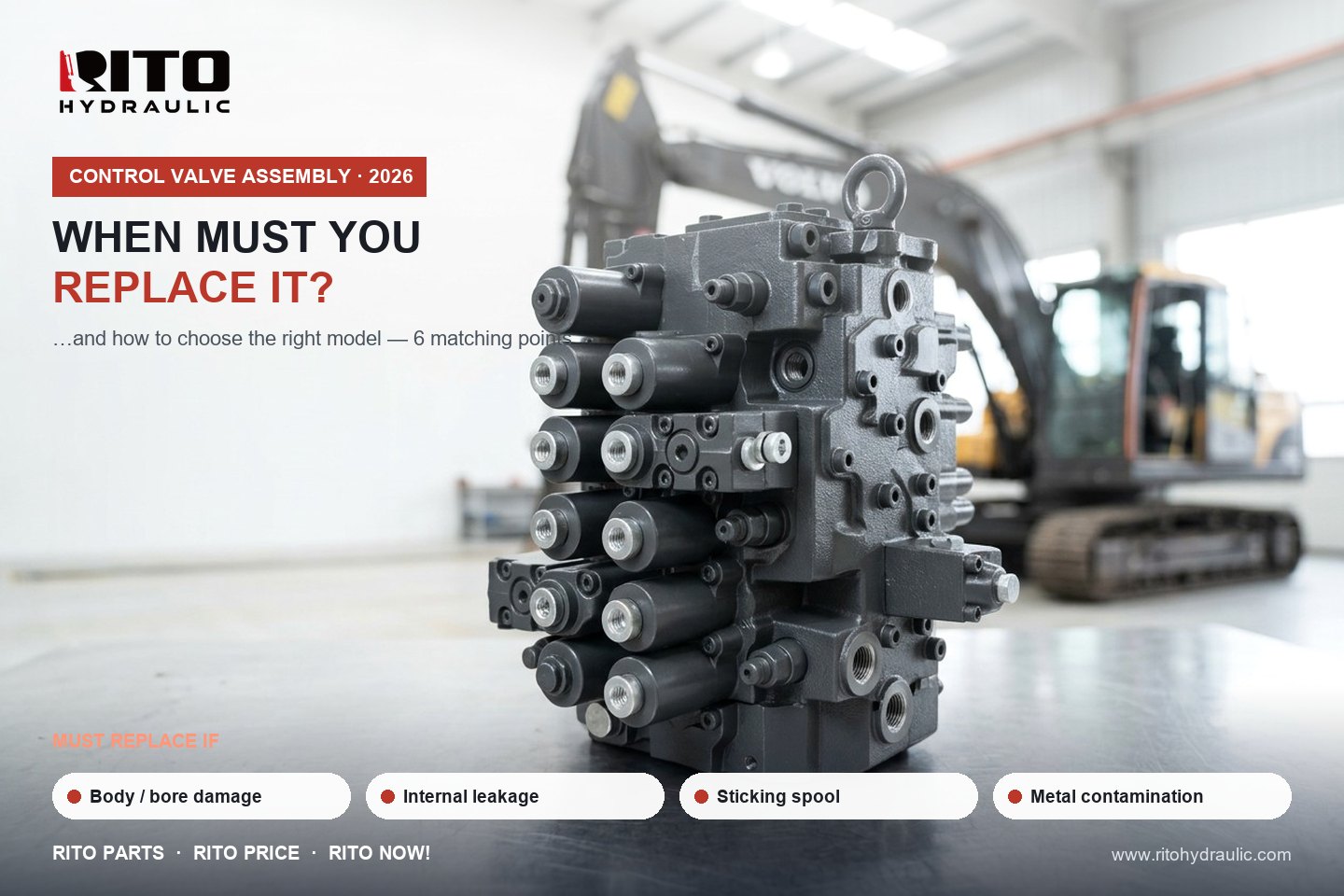
- Replace on damaged body/bore, unrecoverable spool wear, internal leakage, scored bores or contamination.
- Repair only when the fault is confined to seals or a single serviceable section.
- Match six points: model & serial, section count, control type, ports, spools, mounting.
- The control type (load-sensing / negative control, etc.) is the most common mismatch.
- After replacement, flush the system — a dirty circuit will damage the new valve.
Table of Contents
- 1. Why the Control Valve Matters
- 2. When You MUST Replace It
- 3. Repair vs Replace
- 4. How to Choose the Right Model
- 5. Identify Your Valve: Read the Plate
- 6. Mistakes That Cause the Wrong Valve
- 7. After Replacement
- 8. FAQ
- 9. Get the Right Control Valve
1. Why the Control Valve Matters
The control valve assembly takes the single flow from the main pump and delivers it, on demand, to the boom, arm, bucket, swing and travel circuits. It also sets priorities, limits pressure and, on modern machines, tells the pump how much flow to produce.
That makes it the most "connected" component on the machine. When a valve section leaks or sticks, the operator feels weak, slow or drifting functions — symptoms that are easily mistaken for a failing pump. Before you spend on a pump, the valve deserves a hard look.
2. When You MUST Replace It
Some valve faults are serviceable. Others are not. These are the hard signals that point to replacement:
| # | Hard signal | Why it means replacement |
|---|---|---|
| 1 | Cracked or damaged body | A casting fault cannot be repaired safely |
| 2 | Scored or worn spool bores | Clearances are lost; new spools will not seal |
| 3 | Unrecoverable internal leakage | Functions drift and weaken even after sealing |
| 4 | Sticking / jammed spool | A safety issue — functions can stick on |
| 5 | Metal contamination / scoring | Particles from a failed pump have damaged the valve |
| 6 | Multiple sections faulty | Repairing section by section costs more than replacing |
| 7 | A previous rebuild has failed | A second rebuild rarely restores the original performance |
If two or more of these apply, plan for a complete replacement assembly rather than a repair.
3. Repair vs Replace
| Situation | Better route |
|---|---|
| A seal or a single serviceable section leaking | Repair may be viable |
| Body or bore damage; multiple sections faulty | Replace |
| Contamination from a failed pump | Replace + full system flush |
| Production machine, needs to work now | Verified complete assembly |
For production machines, a verified complete assembly is usually the lower total-cost option once downtime is counted. Browse the full excavator hydraulic parts range to plan the repair in one order.
4. How to Choose the Right Model
Six points must match. Miss any one and the valve can be wrong even if it "looks identical":
| # | Must match | Note |
|---|---|---|
| 1 | Machine model & serial | Serial range can change the fitted valve |
| 2 | Number of sections | Each function has its own section |
| 3 | Control type | Load-sensing / negative control etc. |
| 4 | Port layout | Must connect without re-plumbing |
| 5 | Spool configuration | Controls how each function behaves |
| 6 | Mounting & fittings | Bolt pattern and accessory fittings |
On many machines the same valve family is used across several models — so a supplier can often match by nameplate number + machine serial rather than by model name alone.
5. Identify Your Valve: Read the Plate
- 1. Find the nameplate on the valve body and record the model/part number.
- 2. Photograph the plate straight-on and in focus.
- 3. Photograph the whole valve from two or three angles (ports, sections, mounting face).
- 4. Note the machine model and serial number.
- 5. Note the control type if you know it, and which functions are faulty.
6. Mistakes That Cause the Wrong Valve
- Ordering by model name only — build variants use different valves.
- Ignoring the section count — a valve that fits but lacks a function will not work.
- Skipping the control type — the most common and most damaging mismatch.
- Judging by an outside photo — two valves can look alike and behave differently.
- Fitting a new valve without flushing — contamination destroys the new unit.
7. After Replacement
- Flush the system and replace the return filter and suction strainer.
- Fill with fresh, correct-grade oil — never the drained oil from the failed system.
- Check pressure adjustments (relief and control settings) against the machine specification.
- Run light functions first, then return to full load while watching temperature and behaviour.
8. FAQ
Q1: When does an excavator control valve need replacing?
When the body or bore is damaged, a spool sticks or leaks internally beyond repair, bores are scored by contamination, multiple sections are faulty, or a previous rebuild has already failed.
Q2: Can a control valve be repaired instead of replaced?
Sometimes — if the fault is confined to a seal or a single serviceable section and the body and bores are sound. Body/bore damage or multiple faults mean replacement.
Q3: What are the symptoms of a faulty control valve?
One or more functions that are weak, slow, drift when held, jerk, or stick. All-function weakness usually points upstream to the pump instead.
Q4: How do I choose the right control valve model?
Match machine model and serial, the number of sections, the control type, the port layout, the spool configuration and the mounting — and confirm the nameplate number.
Q5: Why does the control type matter so much?
It determines how the valve and pump communicate (for example load-sensing vs negative control). The wrong control type makes the machine respond badly even though the valve physically fits.
Q6: How do I find my valve's part number?
Read the nameplate on the valve body, and check the machine manual. Photograph the nameplate and send it with your machine model and serial number.
Q7: Do I need to replace the pump as well?
Not automatically. But if a pump has failed and shed metal, the valve may also be contaminated — inspect both, and flush the system regardless.
Q8: Should I flush the system after fitting a new valve?
Yes. Flush and replace the return filter and suction strainer, then fill with fresh correct-grade oil — otherwise debris will damage the new valve.
Q9: Can the same valve fit several excavator models?
Yes — valve families are often shared across models, but the section count, control type and settings can differ. Always confirm by nameplate and serial.
Q10: How can I be sure the replacement is good before it ships?
Ask for a per-unit test report, a 6–12 month warranty, and confirmation that it is a new, complete assembly — not a rebuild sold as new.
9. Get the Right Control Valve
Send us your machine model, serial number and the nameplate number from the valve — plus a few clear photos — and our team will confirm the correct assembly, provide a test-report sample and quote lead time the same day. RITO HYDRAULIC supplies complete, individually tested control valves, main pumps, travel motors and swing motors for Komatsu, Hitachi, Caterpillar, Hyundai, Kobelco, Doosan and Kawasaki / Rexroth-series machines — with export packing and a 6–12 month warranty.
Contact our team or learn more about RITO HYDRAULIC.
- CAT 330GC Final Drive — Which Part Number Fits and What Should You Check Before You Buy?
- Why Do Customers Need the TM40 Travel Assembly? When It Is Used, What It Does, and What It Changes
- Komatsu PC300-8 / PC350-8 Hydraulic Pump: Which 708-2G Number Fits, and Why PC300-7 Numbers Keep Appearing
- Why Does a CAT 320C / 320D Hydraulic Pump Lose Power Under Heavy Load?
- Why Does Your CAT 312C Need the SBS80 Hydraulic Pump?