
CAT 374D Hydraulic Pump Failure: Complete Assembly or Internal Parts? (369-9676 / 217-5472)


Author
JERY WANG
Guangzhou Rito Hydraulic Co.,Ltd., located in Guangzhou, China, is a leading manufacturer and distributor of hydraulic pumps, final drives, swing motors, and main control valves for earthmoving machinery. We supply genuine, OEM, and high-quality aftermarket parts.
We are committed to continuously sharing our expertise regarding construction machinery and excavator hydraulic systems. Our goal is to help you gain a deeper understanding of equipment principles and applications—enabling you to work more efficiently—while also showcasing our professional knowledge and capabilities. We invite you to learn more about us.
Choose us, and you will enjoy the best service, the most favorable prices, and the most reliable supplier!
Marie R. Winters


Quick Answer
Internal parts make sense when the damage is confined: a seal weeping, one identifiable item worn, and the rest of the pump still measuring within specification.
A complete assembly makes sense when the damage is widespread or unknown: metal has circulated, several working surfaces are worn, the machine is a mining-class workhorse (the CAT 374D is exactly that), or you simply cannot inspect properly before the next shift.
On a machine this size, the tie-breaker is almost never the parts price. It is downtime and the risk of doing the job twice — which is why a complete, individually tested assembly is often the cheaper decision even when its invoice is larger.
Key Takeaways
- Decide by failure type, not by budget: confined damage suits parts; widespread damage suits an assembly.
- The 374D is a mining-class machine — its duty punishes extended downtime more than most.
- Metal circulating in the oil is the single strongest argument for a complete assembly.
- Parts-and-repair only works if the whole pump is measured afterwards, not just the failed item.
- Whichever route you take, flush the system and renew filters — or the repaired pump will fail again.
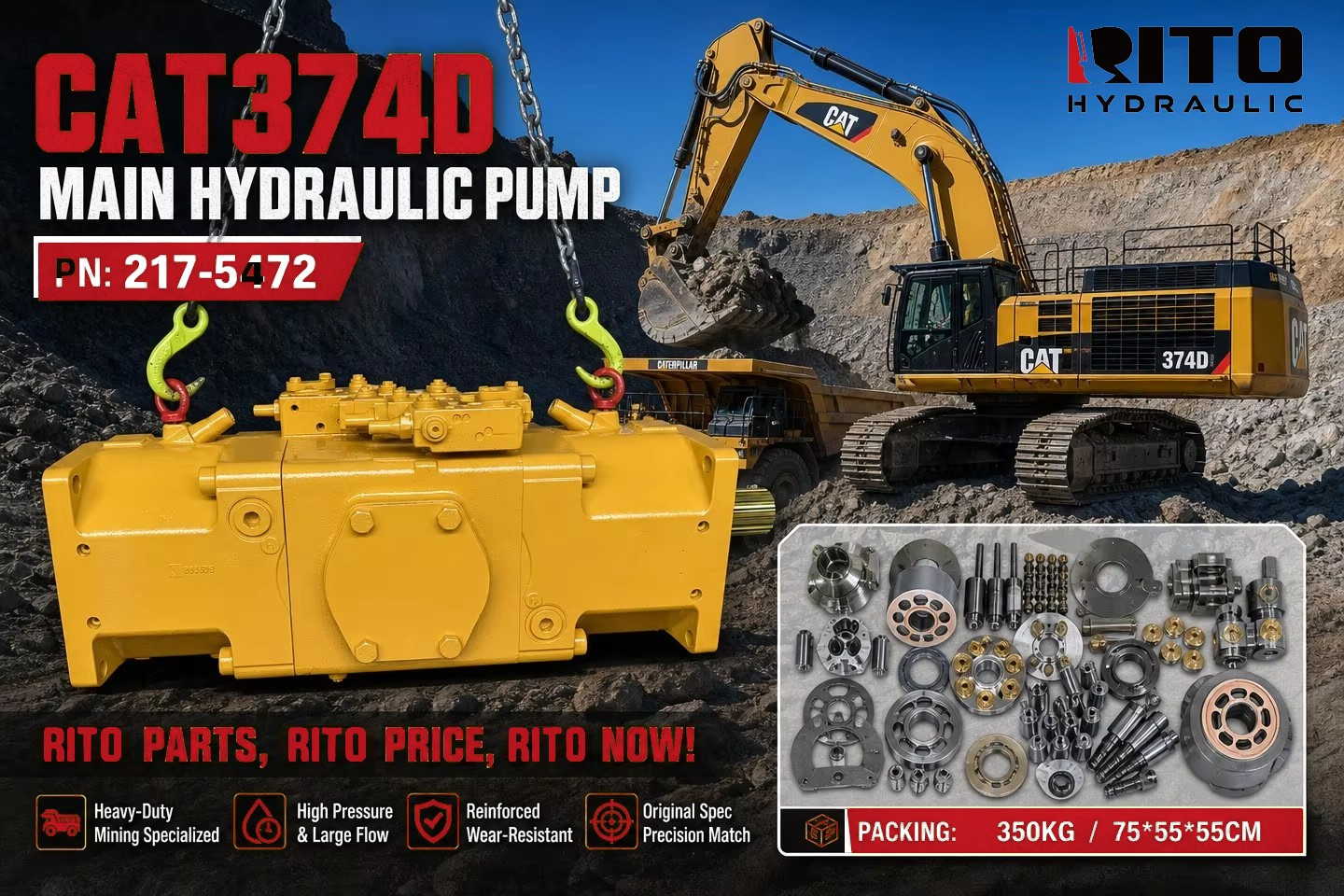
- Our 374D pump listing carries PN 217-5472; you may also meet 369-9676. Assembly and components sit at different numbering layers — the plate decides.
Table of Contents
- 1. The Product at a Glance
- 2. Two Numbers, Two Different Layers
- 3. First Question: What Kind of Failure Is It?
- 4. When Internal Parts Make Sense
- 5. When a Complete Assembly Makes Sense
- 6. The Comparison People Get Wrong
- 7. What "Internal Parts" Actually Includes
- 8. The Rule That Applies Either Way
- 9. The Five-Step Decision
- 10. FAQ
- 11. Get the Right Decision, and the Right Part
1. The Product at a Glance
| Item | Detail |
|---|---|
| Application | Caterpillar 374D — a mining-class excavator |
| Part number (our listing) | 217-5472 |
| Type | Variable-displacement piston pump assembly |
| Weight | 350 kg |
| Packing | 75 × 55 × 55 cm |
| Specification points | Heavy-duty, mining-specialised build; high pressure and large flow; reinforced, wear-resistant working surfaces; original-specification precision match |
Two of those points matter directly to the decision you are making. "Mining-specialised, heavy-duty" means this pump works in the harshest duty cycle there is — long shifts, high pressures, shock loads and dust. "Original-specification precision match" is the quiet one: it means the internal clearances are exact, which is precisely what a parts-and-repair job has to reproduce to be worthwhile.
Complete, individually tested assemblies are listed under Caterpillar-series hydraulic parts.
2. Two Numbers, Two Different Layers
You will meet two numbers around this pump, and understanding why they are different is the key to the whole article.
| Number | What it refers to | Confirm by |
|---|---|---|
| 217-5472 | The main hydraulic pump number carried on our 374D pump listing | Machine plate + serial |
| 369-9676 | Also referenced for the 374D main pump | Machine plate + serial |
Here is the honest, useful way to think about it:
- 1. A pump assembly and its internal components live at different numbering layers. The assembly has one number; the cylinder block, pistons, shoes, valve plates, bearings and seals each have their own. That layering is exactly why "assembly versus parts" is a real decision rather than a figure of speech.
- 2. An assembly can carry more than one number over its life. Original fitment, replacement and supersession often mean two numbers exist for what is functionally the same unit. Which one applies to your machine is settled by the plate and the serial.
- 3. Do not choose a number by which one you were told first. Read your own pump plate, then have the number cross-checked.
That last point sounds obvious, but it is the single most common cause of wrong orders on mining-class parts.
3. First Question: What Kind of Failure Is It?
Before any price is discussed, classify the failure. Five patterns cover almost every case:
| Failure pattern | What it looks like | Usual route |
|---|---|---|
| External leak / seal | Oil weeping at a joint or shaft seal; performance still normal | Targeted repair |
| Single worn item | One function degraded; the rest measures within specification | Possible parts route — if fully measured |
| Rotating-group wear | Gradually rising temperature, slower cycles, declining flow on test | Assembly — multiple surfaces are worn together |
| Contamination damage | Metal in the filter, scored surfaces, several components affected | Assembly — plus a full system flush |
| Catastrophic | Sudden noise and loss of function; debris throughout the circuit | Assembly — and check the valve and motors too |
Notice the shape of that table: the further down you go, the less the "parts" route makes sense. That is not a coincidence. Pumps do not usually wear one item at a time — the same oil, heat and duty that wore one surface have been acting on all of them.
4. When Internal Parts Make Sense
The parts route is legitimate — under specific conditions. All of these should be true:
- 1. The damage is confined. One identifiable item is out of specification, and the surfaces around it are not.
- 2. The pump can be properly measured. Clearances are checked across the whole unit, not just at the failed part. A repair based on visual inspection alone is a gamble.
- 3. The oil is clean. No metal has circulated. If debris has moved through the circuit, the premise of a "confined" repair no longer holds.
- 4. You have the facilities. Clean assembly area, correct tooling, measured clearances, correct torque — and someone who does this regularly.
- 5. Downtime allows it. A careful repair takes time. If the machine is needed tomorrow, that constraint usually decides the matter by itself.
If any of the five fails, the savings from the parts route are paper savings. Complete assemblies — and the excavator hydraulic parts range they sit in — exist precisely to remove that risk.
5. When a Complete Assembly Makes Sense
Reach for the assembly when any of these is true:
| Situation | Why |
|---|---|
| Metal has circulated | You cannot clean or inspect your way out of contamination; the wear is everywhere |
| Several working surfaces are worn | Replacing one worn item alongside others that are marginal just moves the failure date |
| It is a mining machine | Downtime on a 374D is measured in production lost, not hours wasted |
| You cannot measure properly | An unmeasured repair is a guess with a warranty risk attached |
| The pump owes you nothing | If it has already given long service, overhauling it is false economy |
| You need it back in service fast | A tested assembly is a swap, not a workshop project |
The strongest single argument is the first one. Once metal has circulated, a "partly repaired" pump is a countdown timer.
6. The Comparison People Get Wrong
Most buyers compare two things: the parts invoice and the assembly invoice. That comparison is incomplete, and it is why the "cheaper" route so often ends up the expensive one.
| Cost line | Parts route | Assembly route |
|---|---|---|
| Component / assembly cost | Lower on paper | Higher on paper |
| Labour hours | High and variable | Lower — it is a swap |
| Measurement and machining | Needed, and often underestimated | Already done and verified |
| Outcome certainty | Depends entirely on the repair | Tested before it ships |
| Risk of doing it twice | Real — this is the hidden line | Low |
| Downtime | Longer, and open-ended | Predictable |
| Oil and filters | Required anyway | Required anyway |
The "risk of doing it twice" line is the one that decides most mining jobs. A repaired pump that fails again does not cost you the repair — it costs you the repair, the second repair, the replaced oil, the filters, and another stretch of lost production. That is the pattern our guide on why excavators still fail after a pump replacement describes — and it almost always starts with contamination that was never removed.
7. What "Internal Parts" Actually Includes
If you do go the parts route, it helps to know what you are actually choosing between. A complete pump is assembled from items such as:
| Group | Typical items |
|---|---|
| Rotating group | Cylinder block, pistons, piston shoes, retainer plate, drive shaft |
| Control surfaces | Valve plates, swash plate, shoe plate |
| Bearings and seals | Shaft bearings, seal kits, O-rings |
| Control and regulation | Regulator components, control pistons, adjusters |
| Fasteners and small parts | Screws, pins, plugs, springs |
Two things follow. First, a "parts repair" is rarely one part — it is usually a set, because a worn rotating group wears as a group. Second, the precision interfaces between these items are the whole point of the pump — which is why the product sheet says "original-specification precision match". Assembling a mix of new and marginal items reproduces the appearance of a pump without reproducing its performance.
8. The Rule That Applies Either Way
This is not advice; it is the mechanism by which most repeat failures happen. A failed pump has already distributed debris through the circuit. Put a repaired or new pump into that circuit without cleaning it, and the debris does the same damage again — often faster, because fresh precision surfaces are less tolerant of contamination than worn ones.
On a mining-class machine it is worth going further: check the tank, clean or replace breather and filter elements, and inspect the control valve and travel and swing motors for signs that debris has passed through them. Contamination does not respect component boundaries.
9. The Five-Step Decision
- Classify the failure using the table in section 3 — is it confined, or widespread?
- Check the oil for metal. If debris has circulated, the decision is effectively made: go to a complete assembly and plan a full flush.
- Measure, do not look. Clearances across the whole pump tell you whether a parts route is honest. Visual inspection cannot.
- Put downtime on the scales. On a 374D, lost production usually outweighs any invoice difference.
- Confirm the part number from your own plate, then have it cross-checked — including whether the number has been superseded.
Steps 1 to 3 decide which route; steps 4 and 5 decide how much it really costs. For the machine-side view of CAT pump diagnosis, see our guide to why a CAT excavator loses power and how to test the pump.
10. FAQ
Q1: Should I buy a complete pump assembly or replace internal parts?
It depends on the failure. If the damage is confined, the oil is clean and the whole pump can be measured, the parts route can work. If metal has circulated, several surfaces are worn, or you cannot measure properly, a complete assembly is the safer and usually cheaper decision.
Q2: What are 217-5472 and 369-9676?
Both are numbers you will meet around the 374D main pump. Our listing carries 217-5472; 369-9676 is also referenced for this pump. Which one applies to your machine is settled by the pump plate and machine serial.
Q3: Why is a parts repair sometimes a false economy?
Because pumps rarely wear one item at a time. The same oil, heat and duty that damaged one surface have acted on the others. Replacing a single item beside marginal ones often just moves the failure date — and the second failure costs more than the first.
Q4: How do I know if metal has circulated?
Check the filter and magnetic plug for debris, inspect drained oil, and look for scoring on pump and valve surfaces. Metal in the oil changes the whole strategy: complete assembly plus a full system flush.
Q5: Can I fit a repair kit and keep the same pump?
Sometimes — but only if the pump is fully measured, the damage is confined and the assembly is done to specification in a clean environment. A kit fitted to a worn body does not restore precision.
Q6: Do I need to flush the system if I fit a new assembly?
Yes, always. Flush and renew the return filter and suction strainer, then fill with fresh correct-grade oil. Skipping this is the most common reason a new pump has a short life.
Q7: How heavy is the 374D main pump?
About 350 kg, packed in a 75 × 55 × 55 cm case. Plan rated lifting equipment at both ends of the shipment.
Q8: What is included in a complete assembly?
A complete, tested unit — rotating group, control surfaces, bearings, seals, regulator and hardware — assembled and matched to the original specification, rather than a set of loose components.
Q9: Should I also check the valve and motors?
Yes, particularly after a contamination failure. Debris passes through the whole circuit, so the control valve and travel and swing motors should be inspected before the machine returns to work.
Q10: What should I send to get a quotation?
Machine model, machine serial number, the full identification from the pump plate, photos of the pump, and — for a parts enquiry — clear photos and measurements of the components you need.
11. Get the Right Decision, and the Right Part
Send us your machine model, serial number and the pump identification, plus photos and any test readings you have, and our team will help you weigh the two routes — and, if the answer is a complete assembly, confirm the correct build and quote lead time the same day. RITO HYDRAULIC supplies complete, individually tested main pumps, pump components, control valves, travel motors and swing motors for Caterpillar, Komatsu, Hitachi, Kobelco, Hyundai, Doosan and Kawasaki-series machines — with export packing and a 6–12 month warranty.
Contact our team or learn more about RITO HYDRAULIC.
Related reading: what A20VLO260 means, and three-pump vs double-pump systems.
- CAT 330GC Final Drive — Which Part Number Fits and What Should You Check Before You Buy?
- Why Do Customers Need the TM40 Travel Assembly? When It Is Used, What It Does, and What It Changes
- Komatsu PC300-8 / PC350-8 Hydraulic Pump: Which 708-2G Number Fits, and Why PC300-7 Numbers Keep Appearing
- Why Does a CAT 320C / 320D Hydraulic Pump Lose Power Under Heavy Load?
- Why Does Your CAT 312C Need the SBS80 Hydraulic Pump?