

Komatsu PC300-8 Control Valve Explained: What It Is, Which Machines It Fits & CLSS vs a Conventional Valve


Author
JERY WANG
Guangzhou Rito Hydraulic Co.,Ltd., located in Guangzhou, China, is a leading manufacturer and distributor of hydraulic pumps, final drives, swing motors, and main control valves for earthmoving machinery. We supply genuine, OEM, and high-quality aftermarket parts.
We are committed to continuously sharing our expertise regarding construction machinery and excavator hydraulic systems. Our goal is to help you gain a deeper understanding of equipment principles and applications—enabling you to work more efficiently—while also showcasing our professional knowledge and capabilities. We invite you to learn more about us.
Choose us, and you will enjoy the best service, the most favorable prices, and the most reliable supplier!
Marie R. Winters


Quick Answer
2. What does it fit? Primarily the PC300-8 / PC300LC-8 class, and neighbouring machines of the same generation that share the valve family — but the part number on the machine decides, never the model name alone.
3. CLSS versus a conventional valve? CLSS stands for Closed-Centre Load Sensing System — the architecture behind Komatsu's HydrauMind. In plain words: the valve supplies oil only when a function asks for it, at just the pressure the load needs. A conventional (open-centre) valve keeps circulating oil through a central bypass and builds pressure when a function is used. That single difference changes heat, fuel use and how smoothly the machine responds.
Key Takeaways
- The control valve is the distribution centre of the hydraulic system: it routes, prioritises, limits and signals.
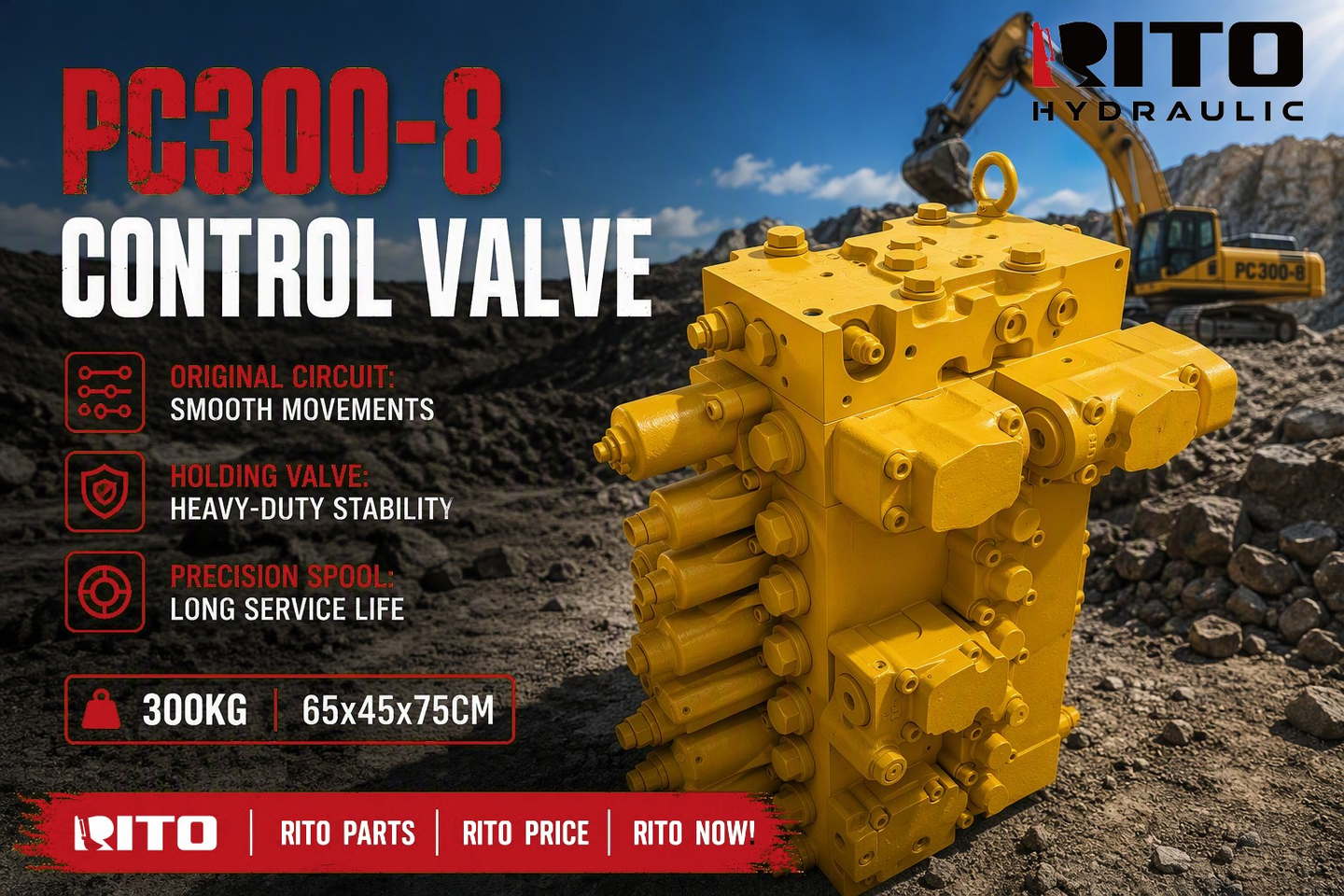
- The PC300-8 assembly weighs about 300 kg and is packed 65 × 45 × 75 cm — a heavy-lift job.
- CLSS = Closed-Centre Load Sensing System; Komatsu's earlier generation used OLSS (Open-Centre Load Sensing).
- CLSS delivers flow on demand — less heat, less fuel, smoother compound operations.
- An open-centre (conventional) valve circulates oil continuously and builds pressure when a function is selected.
- Because CLSS is a matched system, the valve and pump must speak the same language — which makes correct matching stricter, not looser.
Table of Contents
- 1. What the Control Valve Actually Does
- 2. The PC300-8 Part at a Glance
- 3. What CLSS Means in Plain Words
- 4. CLSS vs a Conventional Valve
- 5. What CLSS Changes on Site
- 6. Why CLSS Makes Matching Stricter
- 7. Which Machines It Suits
- 8. How to Confirm the Right Valve
- 9. FAQ
- 10. Get Your Valve Confirmed
1. What the Control Valve Actually Does
If the main pump is the heart of an excavator, the control valve assembly is the nervous system. It performs four jobs at once:
| Job | What it means in practice |
|---|---|
| Route | Sends pump flow to whichever function the operator selects — boom, arm, bucket, swing, travel |
| Prioritise | Decides who gets oil first when several functions are asked for at once |
| Limit | Sets and caps pressure so the system is protected and the machine behaves predictably |
| Signal | Tells the pump how much oil to produce — the piece that makes CLSS work |
"Distribution valve" is a fair nickname: it distributes. But the fourth job is the one that separates a modern Komatsu from an older machine, and it is the subject of sections 3 to 5.
2. The PC300-8 Part at a Glance
| Item | Detail |
|---|---|
| Application | Komatsu PC300-8 class (30-tonne, Dash-8 generation) |
| Type | Multi-section main control valve assembly |
| Weight | 300 kg |
| Packing | 65 × 45 × 75 cm |
| Design points | Original circuit for smooth movements; holding valve for heavy-duty stability; precision spool for long service life |
Those three design points are worth reading carefully, because each maps to a real behaviour: original circuit means the internal flow path matches the machine's intended control characteristics; holding valve means the function can hold its position under load instead of creeping; precision spool means the closely fitted sliding element that meters the oil — the part that decides whether the machine feels crisp or sloppy.
3. What CLSS Means in Plain Words
CLSS stands for Closed-Centre Load Sensing System. Unpack the three words:
| Word | What it means |
|---|---|
| Closed-centre | With no function selected, the valve does not provide a free path for oil to circulate. The pump stands by at low pressure instead of pumping continuously. |
| Load sensing | The valve sends a signal — the sense line — telling the pump the pressure the heaviest working function needs. |
| System | Valve and pump are designed together. The pump's regulator, the valve's spools and the sense lines form one control loop. |
The result: the pump produces only the flow the machine actually needs, at slightly more pressure than the load requires. Nothing is wasted circulating back to the tank when the operator is not working — which is why Komatsu's CLSS is credited with reduced heat, lower fuel use and smooth compound operation.
It also has a family history. Komatsu's earlier generation used OLSS — Open-Centre Load Sensing System. CLSS is the later architecture, and it is the basis of Komatsu's HydrauMind control. Knowing which one your machine has matters when you order parts, because the two architectures do not share the same behavioural logic.
4. CLSS vs a Conventional Valve
This is the comparison that answers the question most people are really asking. "Conventional" here means an open-centre valve — the classic layout still found on older and simpler machines.
| Aspect | Conventional (open-centre) valve | CLSS (closed-centre load sensing) |
|---|---|---|
| When no function is used | Oil keeps circulating through the centre bypass back to tank | No circulating flow; pump stands by at low pressure |
| When a function is used | The bypass closes, pressure builds, flow is diverted to the function | The valve signals demand; the pump delivers just that much flow |
| Pump output | Effectively fixed while running | Continuously matched to demand |
| Heat generated | Higher — unused flow becomes heat | Lower — less wasted flow |
| Fuel use (idle / light work) | Higher, because the pump keeps working | Lower |
| Compound operations | Functions compete; movement can be affected by other functions | Smooth, coordinated — flow and pressure are managed together |
| Control feel | Functional, less precise | Proportional and predictable regardless of load |
| Complexity | Simpler, fewer lines | More complex — sense lines and a pump regulator that listens to them |
Three practical consequences follow from that table, and they are the reasons CLSS is worth understanding rather than just quoting:
- Efficiency is architectural, not a tuning option. CLSS saves fuel because of how it is built, not because of a setting.
- Smoothness comes from sensing. The valve knows what the load needs, so the machine moves the same way whether the bucket is empty or full.
- But it is also less forgiving of mismatched parts. That is the next section.
5. What CLSS Changes on Site
| On site | What CLSS changes |
|---|---|
| Fuel and heat | Less oil circulated for nothing, so less energy converted into heat — kinder to oil life and to the cooler |
| Precision work | Fine joystick movements give fine machine movements, because flow follows demand closely |
| Compound movements | Swinging while lifting, or arm-and-bucket together, stays coordinated rather than one function starving the other |
| Diagnosis | Faults can sit in the valve, the pump regulator or the sense-signal path — so testing is a process, not a guess |
That last row matters commercially. On a CLSS machine, "the valve is faulty" is a hypothesis, not a conclusion. A blocked or leaking sense line, a tired pump regulator, or a spool problem can produce similar complaints — which is why a pressure and flow test comes before a purchase.
6. Why CLSS Makes Matching Stricter
Here is the counter-intuitive lesson about a "smarter" system: the more closely a valve and pump are designed to work together, the less tolerant the machine is of a mismatch.
With CLSS, the valve and the pump's regulator form a closed control loop. Fit a valve whose internal settings, spool arrangement or signal characteristics do not correspond to the machine, and the loop is broken. The symptoms are not dramatic — the machine still runs — but it feels wrong:
- Sluggish or over-eager response, especially when several functions are used together
- Functions that do not hold smoothly, or that move faster in one direction than the other
- Higher oil temperature than the machine used to run
- Poor fine control, which operators describe as "the machine has lost its feel"
This is why a control valve replacement should be matched by the machine's own part number and not by "it looks the same". General guidance on the replace-or-repair decision is in our guide on when a control valve must be replaced and how to choose the right model. Complete, individually tested assemblies are listed under excavator hydraulic parts.
7. Which Machines It Suits
The primary application is the Komatsu PC300-8 and its PC300LC-8 long-undercarriage counterpart — the 30-tonne class of the Dash-8 generation.
Other machines of the same generation may use the same valve family, but three things prevent a simple list:
- 1. Section count. The number of valve sections is matched to the machine's functions; a different count is a different valve.
- 2. Control architecture. A CLSS machine and an OLSS machine cannot be served by the same valve logic.
- 3. Build level and serial. Komatsu revises valve specifications across a production run, and the serial range indicates which build your machine carries.
So the honest answer to "which machines does it fit" is: the PC300-8 class, confirmed by part number and serial. The wider generation range is listed under Komatsu-series hydraulic parts. The same logic applies to other brands' valves — our SK200–SK260 control valve guide walks through it for a different make.
8. How to Confirm the Right Valve
- Read the valve's identification. Photograph the nameplate and any stamped numbers on the body — straight-on and in focus.
- Count and photograph the sections. A clear photo of the full block shows the section arrangement and the end covers.
- Record the machine model and serial number. The serial decides which build your machine carries.
- Have it cross-checked by a supplier holding the parts data, who can also confirm whether the correct part has been superseded.
Four items, one exchange, and a 300 kg crate goes to the right machine. Without them, the cost of being wrong is measured in freight, downtime and re-work.
9. FAQ
Q1: What is the PC300-8 control valve assembly?
It is the multi-section main control valve (distribution valve) that routes pump flow to every function, sets priorities and pressure limits, and signals the pump. It weighs about 300 kg and packs in a 65 × 45 × 75 cm case.
Q2: What does CLSS stand for?
Closed-Centre Load Sensing System — Komatsu's hydraulic architecture and the basis of HydrauMind. It supplies only the flow the machine needs, at the pressure the load requires.
Q3: What is the difference between CLSS and a conventional valve?
A conventional open-centre valve circulates oil continuously and builds pressure when a function is selected. A CLSS valve is closed-centre: with nothing selected the pump stands by at low pressure, and when a function is used the valve signals the exact demand. CLSS therefore runs cooler, uses less fuel and gives smoother compound control.
Q4: What is OLSS?
Open-Centre Load Sensing System — Komatsu's earlier load-sensing architecture. It predates CLSS, and the two are not interchangeable in behaviour or parts.
Q5: Which machines does this valve fit?
Primarily the PC300-8 and PC300LC-8 (30-tonne Dash-8 class). Other machines of the same generation may share the valve family, but the part number and machine serial decide.
Q6: Can I use a valve from a similar Komatsu model?
Do not assume it. Section count, control architecture and build level can all differ. Confirm against your machine's part number.
Q7: How heavy is it, and how is it packed?
About 300 kg, packed in a 65 × 45 × 75 cm case. Plan rated lifting equipment and heavy freight.
Q8: What happens if the wrong valve is fitted?
The machine usually still runs, but it feels wrong: sluggish or over-eager response, functions that do not hold smoothly, poor fine control and higher oil temperature.
Q9: Does CLSS affect how I diagnose a fault?
Yes. On a CLSS machine the fault can lie in the valve, the pump regulator or the sense-signal path, so a pressure and flow test should come before any purchase.
Q10: What should I send to get the right valve?
The valve identification, photos of the full block showing the sections, your machine model and serial number, and any previous repair history. That is enough for a same-day confirmation.
10. Get Your Valve Confirmed
Send us your machine model, serial number and the identification from the valve — plus photos of the full block — and our team will confirm the correct assembly, flag any supersession, and quote lead time the same day. RITO HYDRAULIC supplies complete, individually tested control valves, main pumps, travel motors and swing motors for Komatsu, Hitachi, Kobelco, Caterpillar, Hyundai, Doosan and Kawasaki-series machines — with export packing and a 6–12 month warranty.
Contact our team or learn more about RITO HYDRAULIC.
- CAT 330GC Final Drive — Which Part Number Fits and What Should You Check Before You Buy?
- Why Do Customers Need the TM40 Travel Assembly? When It Is Used, What It Does, and What It Changes
- Komatsu PC300-8 / PC350-8 Hydraulic Pump: Which 708-2G Number Fits, and Why PC300-7 Numbers Keep Appearing
- Why Does a CAT 320C / 320D Hydraulic Pump Lose Power Under Heavy Load?
- Why Does Your CAT 312C Need the SBS80 Hydraulic Pump?