
Why Does a SANY SY500 Travel Slowly on One Side? A Final Drive Diagnosis Guide


Author
JERY WANG
Guangzhou Rito Hydraulic Co.,Ltd., located in Guangzhou, China, is a leading manufacturer and distributor of hydraulic pumps, final drives, swing motors, and main control valves for earthmoving machinery. We supply genuine, OEM, and high-quality aftermarket parts.
We are committed to continuously sharing our expertise regarding construction machinery and excavator hydraulic systems. Our goal is to help you gain a deeper understanding of equipment principles and applications—enabling you to work more efficiently—while also showcasing our professional knowledge and capabilities. We invite you to learn more about us.
Choose us, and you will enjoy the best service, the most favorable prices, and the most reliable supplier!
Marie R. Winters


Quick Answer
Key Takeaways
- One-sided slow travel is a narrowing symptom. Anything shared by both tracks — pump output, main relief, control signal — is unlikely to be the cause.
- Swap the travel hoses. This single test separates a hydraulic fault from a mechanical one before any money is spent.
- Check the cheap things first: oil level and condition, track tension, sprocket and bolt condition, and whether the high-speed range still works.
- Contamination is the quiet killer of travel devices — dirty oil wears the motor and the reduction from the inside.
- If the fault stays with the track, the unit is B229900005472 (SANY 60307469, designation FTM85) for the SY485 / SY500 / SY500C / SY500H.
- Repair, reducer-only or a complete device is a level decision — make it after the test, not before.
Table of Contents
- 1. The Symptom: One Track Slower Than the Other
- 2. Rule Out the Cheap Causes First
- 3. The Decisive Test: Does the Fault Follow the Hoses?
- 4. Reading the Result
- 5. Where a Travel Device Actually Fails
- 6. Repair or Replace — and at Which Level?
- 7. What to Order for a SANY SY500
- 8. FAQ
- 9. Get Your Travel Device Confirmed
1. The Symptom: One Track Slower Than the Other
A travel device is a compact package doing three jobs: a hydraulic motor turns oil pressure into rotation, a planetary reduction multiplies that into track-pulling torque, and a brake holds the machine when the levers are released. On a 50-tonne machine like the SY500, that package on each side moves a very heavy structure, all day, usually on poor ground.
When the machine tracks straight but one side is slow, or it steers itself as you travel, operators often assume the final drive is finished. Sometimes it is. Often it is not — and the difference is worth a great deal of money, because a final drive for this class of machine is a heavy, expensive item.
What matters first is understanding what the symptom has already told you. Tracks travel from a shared source — the main pump supplies the whole machine, and the main relief protects the whole system. A fault in anything shared would slow both tracks. So when only one side is slow, the cause is almost certainly confined to:
| Confined to one side | What lives there |
|---|---|
| The hydraulic circuit for that track | That side's control valve section, its travel relief or cross-line relief, and the hoses feeding it |
| The travel device itself | Motor internals, the reduction gears and bearings, brake, and seals |
| The track and its interface | Track tension, sprocket wear, and the mounting bolts that hold the device to the frame |
That is a short list, and it is testable — which is why the correct response to this symptom is a sequence of cheap checks, not an order form. If you want the background on how travel devices are put together and what else shares this family, our guide to the ZX200 travel motor assembly covers the construction in detail.
2. Rule Out the Cheap Causes First
Four checks cost almost nothing and each one eliminates a whole class of cause. Do them in this order.
| # | Check | What it tells you |
|---|---|---|
| 1 | High-speed range — does it engage on the slow side? | If only high speed fails on that side, suspect the two-speed control or pilot circuit rather than the device's internals |
| 2 | Oil level and oil condition in that travel device | Low oil means a leak and imminent damage. Metal, milkiness or a burnt smell means the damage has already started |
| 3 | Track tension on both sides | A badly unequal track tension makes a machine steer and drag, and it is entirely free to correct |
| 4 | Sprocket, bolts and mounting | A worn sprocket or loose mounting bolts change how the load reaches the final drive and can mimic a weak drive |
Two of those deserve emphasis. The first is oil. Inside a travel device the planetary gears and bearings run in an oil bath; low oil or contaminated oil turns a serviceable unit into scrap faster than any other single factor. Contamination is the quiet killer of final drives — grit does not need to be large to open up wear in a precision gear train. Our notes on the ZX870-3 travel device and its oil care apply to this machine word for word.
The second is how the machine is used. Slopes and muddy ground put the highest torque demand on this assembly; that is exactly the duty the SY500 is bought for, and it is the duty that punishes a unit with marginal oil or worn bearings. Sealing quality — keeping dust out and oil in — is what protects the unit in those conditions, and it is one of the first things a cheap rebuild leaves out.
3. The Decisive Test: Does the Fault Follow the Hoses?
If the cheap checks do not resolve it, this is the test that decides the whole purchase — and it requires no instruments.
The idea is to feed each travel motor from the other side's circuit. When you swap the travel hoses left to right, one of two things must happen:
| Result after swapping hoses | What it proves |
|---|---|
| The slow side changes to the other track | The fault is hydraulic and upstream — the relief, the control valve section or the supply to that line. The travel device is likely innocent |
| The same track is still slow | The fault is mechanical, inside that travel device or its track interface — the circuit is proven capable of driving the other side |
Two things to do this safely and usefully. First, work clean — every time you break into a hydraulic circuit you risk introducing the contamination that causes the next failure; cap and plug the lines, and use clean fittings. Second, record what you actually saw: which side was slow, at what engine speed, on the flat or on a slope, with or without a load. A short video of the machine tracking is genuinely useful evidence when you talk to a supplier.
If the fault is upstream and it is the valve rather than the travel device, the same machine's control valve is the next place to look — our guide to the SANY SY500 control valve covers how that unit is identified and how its sections work.
4. Reading the Result
With the hose test done, the remaining tests narrow the answer further. These are the ones worth doing before you order.
| Test | How to read it |
|---|---|
| Compare pressures left and right | A clear difference at the same operating point points at that side's relief setting or circuit restrictions, not the device |
| Compare case drain flow between the two sides | A travel device that leaks much more internally than its twin is worn — this is the same logic as reading case drain flow on a main pump. Measure at the same oil temperature and conditions on both sides |
| Listen while travelling | Grinding or a rhythmic knock suggests gear or bearing damage; a uniform whine that changes with load is more often hydraulic |
| Drain and inspect the oil | Metal on the magnetic plug or silver sheen in the oil means the unit has already worn internally — a photograph of it is evidence, not an opinion |
| Check for brake drag | If one device runs noticeably hotter than the other after travelling, the brake may not be releasing fully — that both slows the track and cooks the oil |
Add these together and you get one of three answers: a circuit fault (cheap), a brake or seal problem (a repair), or genuine internal wear in the travel device (a replacement). Only the third one means buying a final drive.
5. Where a Travel Device Actually Fails
When the fault really is inside the unit, it is almost always one of a small number of wear modes — and knowing which one is present tells you how much of the assembly needs to be replaced.
| Wear mode | Typical evidence | Effect on the machine |
|---|---|---|
| Motor internal leakage | High case drain flow compared with the other side; heat | Slow, weak travel under load — worst on slopes |
| Gear and bearing wear | Metal in the oil, silver sheen, grinding or knocking | Noise that worsens, then loss of drive and possible seizure |
| Seal failure | Oil weeping at the flange or shaft; water or dust ingress | Oil loss, contamination, and accelerated wear of everything inside |
| Brake not releasing | One device hotter than the other after travel | Drag, heat, slower tracking and burnt oil |
| Parking brake wear | Machine creeps or drifts when parked on a slope | A safety problem as well as a wear problem |
Three of these — motor leakage, gear and bearing wear, and brake or seal problems — look identical from the cab. That is precisely why the sequence in this article exists: it separates them with tests rather than assumptions.
It is also worth saying plainly what prevents most of them. Keeping the oil clean and at the right level, replacing seals before they admit water or dust, and not treating hard end-stops and slope work as routine punishment all extend the life of a unit that is expensive to replace. A travel device that is properly fed rarely fails suddenly.
6. Repair or Replace — and at Which Level?
Once internal wear is confirmed, the question becomes what to buy. On this machine the assembly is supplied across several levels, and the decision should follow the damage rather than the price tag.
| Situation | Sensible route |
|---|---|
| Brake or seal fault, internals sound | Repair — the cheapest correct answer, and the one most often skipped |
| Damage confined to the reduction, motor healthy | Reducer / gearbox level — provided the motor is genuinely inspected, not assumed good |
| Wear across motor and reduction, or metal already circulating | Complete travel device — one job, one warranty, and no half-worn components left to fail |
| A production machine, down and losing money now | A tested complete unit, because downtime costs more than the difference in price |
Two cautions that save money. First, if metal has already been circulating, the job does not end at the travel device — flush the circuit, replace filters and inspect the oil, or the new unit inherits the debris that killed the old one. Second, mixing a new component with a worn one invites a second failure: a new reducer bolted to a tired motor is a short-lived repair.
The general decision logic — how to tell whether the gearbox failed or the whole device did, and when a complete unit beats a repair — is worked through in our guide to the EX1200-6 travel device. The reasoning carries across to the SY500; only the numbers change. Replacement units and the wider spare range are grouped under excavator hydraulic parts.
7. What to Order for a SANY SY500
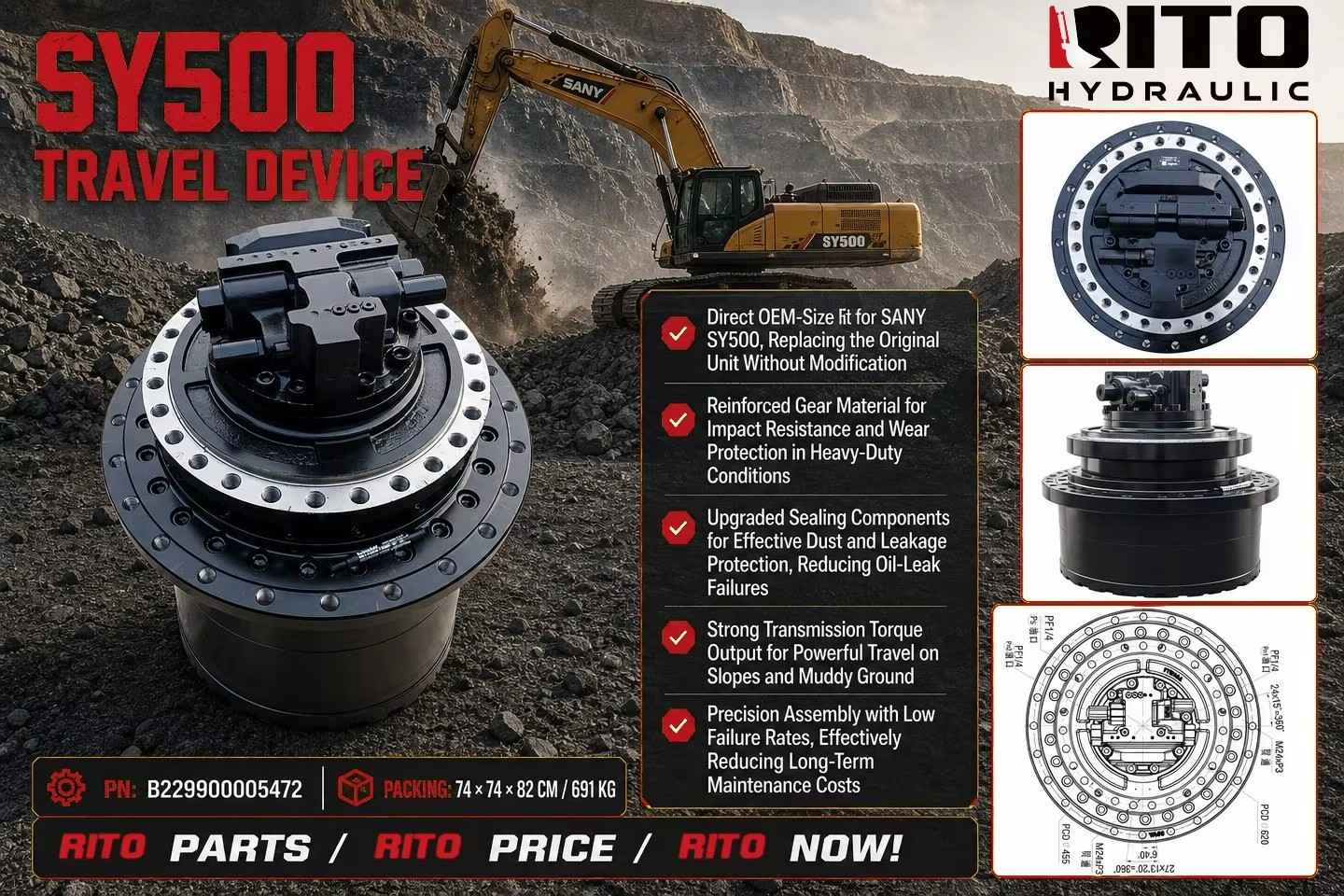
If the diagnosis ends in replacement, this is the identification you need. The travel device for this machine is supplied under SANY number B229900005472, also listed under SANY part 60307469 and the designation FTM85, and it covers the SY485, SY500, SY500C and SY500H.
| Item | Detail |
|---|---|
| Part number | B229900005472 |
| SANY part reference | 60307469 |
| Designation | FTM85 travel device |
| Listed applications | SY485 / SY500 / SY500C / SY500H |
| Packing | 74 x 74 x 82 cm, 691 kg |
One honest caution about levels. Listings describe this number in several ways — travel motor gearbox, travel reduction gearbox, final drive — and SANY's own parts book lists B229900005472 as the reducer assembly within the travel device. So before you order, be clear whether you need the reducer on its own or the complete travel device that includes the motor. Which one you need is answered by the diagnosis, not by the catalogue.
And note the weight: at roughly 691 kg packed, this is a two-man-and-machine job, and a wrong unit is expensive to ship back. Five minutes with the machine's plate and serial number is the cheapest insurance in the whole process.
8. FAQ
Q1: Why does my SANY SY500 travel slowly on one side?
Because the fault is confined to that track's circuit or that track's travel device. Anything shared by both tracks — pump output, main relief — would slow both. Narrow it with a hose swap: if the slow side changes, the cause is hydraulic; if it stays with the track, it is inside the device.
Q2: Is one-sided slow travel always a failed final drive?
No — and that assumption is expensive. Relief settings, the control valve section for that track, brake drag, unequal track tension and simple oil loss all produce the same symptom. Only testing separates them.
Q3: What is the quickest useful test?
Swap the travel hoses left to right. If the slow side moves to the other track, the problem is hydraulic and upstream. If the same track is still slow, the problem is mechanical, inside that travel device.
Q4: What should I check before that?
Four free or cheap things: whether the high-speed range engages on the slow side, the oil level and condition in the travel device, track tension on both sides, and the condition of the sprocket and mounting bolts.
Q5: What part number is the SY500 travel device?
It is supplied under SANY number B229900005472, also listed as SANY part 60307469 and designation FTM85, covering the SY485, SY500, SY500C and SY500H. Confirm against your own machine's plate and serial before ordering.
Q6: Should I buy the reducer or the complete travel device?
It depends on the damage. If the motor is healthy and the fault is confined to the reduction, the reducer level can be correct — provided the motor is genuinely inspected. If wear spans both, or metal has circulated, a complete device is the lower-risk choice.
Q7: The oil in the travel device is milky or metallic. What does that mean?
Milky oil means water has entered, usually through a failed seal. Metal or a silver sheen means internal wear has already begun. Either way, drain and inspect before travelling further — continuing to run will accelerate the damage.
Q8: Why does the machine drift when parked on a slope?
That is the parking brake, not the travel function. A worn brake pack or a brake that does not hold is a safety issue as well as a wear issue, and it is usually a smaller repair than replacing the whole assembly.
Q9: How do I avoid this happening again?
Keep the oil clean and at the correct level, replace seals before water and dust get in, and be realistic about how hard slope and mud work loads the assembly. Contamination is the most common cause of premature final drive failure.
Q10: What should I send to get a quotation?
The machine model and serial number, the plate number from the old unit, which side it is, whether the machine is two-speed, photographs of the unit and the ports, and the results of any tests you have done — plus a description of exactly when the fault appears.
9. Get Your Travel Device Confirmed
Send us your machine model, serial number, which side is affected and the number from your old unit — plus a few clear photos and any test results — and our team will help you decide whether the reducer or the complete device is the right level, confirm the correct assembly for your SY500, and quote lead time the same day. RITO HYDRAULIC supplies complete, individually tested travel devices, final drives, main pumps, swing devices and control valves for SANY, Komatsu, Hitachi, Caterpillar, Kobelco, Hyundai, Doosan and Kawasaki machines — with export packing and a 6–12 month warranty.
Contact our team or learn more about RITO HYDRAULIC.
- CAT 330GC Final Drive — Which Part Number Fits and What Should You Check Before You Buy?
- Why Do Customers Need the TM40 Travel Assembly? When It Is Used, What It Does, and What It Changes
- Komatsu PC300-8 / PC350-8 Hydraulic Pump: Which 708-2G Number Fits, and Why PC300-7 Numbers Keep Appearing
- Why Does a CAT 320C / 320D Hydraulic Pump Lose Power Under Heavy Load?
- Why Does Your CAT 312C Need the SBS80 Hydraulic Pump?