
PC600-6 Hydraulic Pump Wear: How Case Drain Flow Reveals Internal Damage


Author
JERY WANG
Guangzhou Rito Hydraulic Co.,Ltd., located in Guangzhou, China, is a leading manufacturer and distributor of hydraulic pumps, final drives, swing motors, and main control valves for earthmoving machinery. We supply genuine, OEM, and high-quality aftermarket parts.
We are committed to continuously sharing our expertise regarding construction machinery and excavator hydraulic systems. Our goal is to help you gain a deeper understanding of equipment principles and applications—enabling you to work more efficiently—while also showcasing our professional knowledge and capabilities. We invite you to learn more about us.
Choose us, and you will enjoy the best service, the most favorable prices, and the most reliable supplier!
Marie R. Winters


Quick Answer
Key Takeaways
- Case drain flow is internal leakage. The more the pump wears, the more oil bypasses the actuators and returns through the drain line.
- It rises before the operator notices weakness — which makes it the earliest practical wear signal.
- Measure it at operating temperature, at a defined operating point, and compare against the machine's specification and your own past readings.
- Trend beats single reading. One number tells you little; the same number six months later tells you almost everything.
- The test has limits: not all internal leakage appears as case drain flow, so it supports a diagnosis rather than replacing one.
- The PC600-6 pump assembly is ordered as 708-2L-00710 or 708-2L-00731 — confirm against your own plate.
Table of Contents
- 1. What Case Drain Is — and Why It Exists
- 2. Why Case Drain Flow Is the Earliest Wear Signal
- 3. How to Measure It Properly
- 4. Reading the Result
- 5. The Limits of the Test
- 6. From Reading to Decision
- 7. Which Pump Number Fits Your PC600-6
- 8. FAQ
- 9. Get Your Pump Confirmed
1. What Case Drain Is — and Why It Exists
Inside a piston pump, the pistons run in a cylinder block and are pushed by a swashplate; the oil they displace is delivered at high pressure to the machine. But no piston-to-bore fit is perfectly tight, and no valve plate seals perfectly. A small amount of oil always slips past these clearances into the pump's housing.
That oil cannot be allowed to build up pressure inside the case, so every pump has a case drain line: a low-pressure return that takes leakage oil from the housing back to the hydraulic tank. On a PC600-6 that line is part of the installation, and it is doing two jobs at once — protecting the pump's shaft seal from case pressure, and quietly reporting the condition of everything inside.
| Where the oil goes | What it does | What it tells you |
|---|---|---|
| Delivered to the circuits | Moves the boom, arm, bucket, swing and travel | Useful work — should be the overwhelming majority of the flow |
| Leaks back internally | Bypasses the actuators and returns through the case drain | Wear. The size of this stream is what we are going to measure |
If you want the internal mechanism in more depth — how the pistons, bores and valve plate work together and where clearances open up — that is covered in our explainer on how a variable-displacement piston pump works. The wider Komatsu-series hydraulic parts range shows what else shares this family.
2. Why Case Drain Flow Is the Earliest Wear Signal
Here is the reason this test deserves to be routine rather than exotic. Pump wear develops gradually: surfaces begin to score, clearances open by fractions of a millimetre, and leakage increases. But a machine does not feel that immediately, because the pump compensates. It strokes further to maintain output, so the operator keeps working and does not notice.
What the pump cannot compensate for is the oil that is now circulating through the drain instead of doing work. That oil becomes heat. So the sequence on a wearing PC600-6 usually runs like this:
| Stage | What is happening | What is observable |
|---|---|---|
| 1. Early wear | Clearances open; leakage begins to rise | Case drain flow rises. Nothing else is obvious yet |
| 2. Compensating | Pump strokes further to hold output | Oil temperature creeps up; fuel burn rises for the same work |
| 3. Losing ground | Leakage outruns the pump's ability to compensate | Slower cycles across every function; heat under load; harder to feather |
| 4. Failure | Surfaces break down; debris enters the system | Noise, metal in the oil, loss of function — and damage to valves downstream |
Stage 1 is the only one where you have real choice. Catch the pump there and you are planning a replacement; catch it at stage 3 and you are planning it while the machine is unproductive; catch it at stage 4 and you are also cleaning a contaminated system, which is where the real money goes.
The same signal exists on other components in the circuit — travel devices and swing motors also leak internally and also have drain lines. If you are not sure which assembly you are looking at, our breakdown of the ZX200 travel motor assembly shows how those drain lines are arranged and what they mean in practice.
3. How to Measure It Properly
The test itself is simple; the discipline is in the conditions. There are two accepted methods, and either will work if you control the variables.
| Method | How it works | Best for |
|---|---|---|
| Inline flow meter | A flow meter is plumbed into the case drain line and read live | Workshops and repeat testing — fast, and easy to compare readings over time |
| Timed manual collection | Disconnect the drain line, direct it into a container for a measured time, then convert to flow | Field use, where no flow meter is available |
Whichever you use, these conditions decide whether the number is worth anything:
- Oil at operating temperature. Cold, thick oil under-reports leakage; hot, thin oil over-reports it. Compare readings taken at the same temperature, always.
- A defined operating point. Note the engine speed and the function being worked, and repeat the test under the same conditions each time. Leakage rises with pressure, so an unrecorded test is an uncomparable test.
- The drain line must be free. A partly blocked or undersized drain line corrupts the reading and can also raise case pressure — check the line first.
- One component at a time. If several units share a drain path, isolate the pump you are testing or you are measuring a mixture.
- Cleanliness. Any time you break into the hydraulic system, work clean and seal up afterwards. A contaminated system will undo whatever the test told you.
4. Reading the Result
Case drain flow is judged in two ways, and serious operators use both.
| Way of judging | What it means |
|---|---|
| Against the specification | The machine's own service data gives the acceptable drain flow. This is the authority — always use it where it exists. As a widely used rule of thumb in the industry, drain flow beyond roughly a tenth of the pump's theoretical output is treated as excessive internal leakage, but that is a general guide and does not replace your machine's figure. |
| Against your own history | The same test, same conditions, recorded over months. A reading that had held steady for a year and has now climbed by half again is telling you something no single figure can. |
This is why a logbook matters more than a tolerance. If you record one drain-flow reading at every service, you own a wear curve for that pump. When the curve starts to bend upward, you can plan a replacement during a scheduled stop instead of an unplanned one — and on a machine of this size, one avoided unplanned stop typically pays for the test routine many times over.
5. The Limits of the Test
Case drain flow is powerful, but it is not a complete diagnosis, and treating it as one is how good pumps get replaced. Three honest limitations:
- Not all internal leakage appears as case drain flow. Some leakage paths return internally without passing through the drain, so the test can under-report total wear. It is a window, not a window on everything.
- Other things change the reading. Oil viscosity, temperature, engine speed, drain-line restriction and even the function being operated all move the number. A reading taken without recording conditions proves nothing.
- The pump is not the only source in the system. Weakness can come from relief settings, the control signal reaching the pump, or a worn valve sliding in the control valve. Only if leakage is genuinely high, and the rest of the circuit tests sound, does the pump become the prime suspect.
Used correctly, the test does something specific and valuable: it separates a machine that has lost hydraulic performance because the pump is leaking internally from one that has lost it for another reason — before anyone spends money. That is precisely the question a 60-tonne machine operator needs answered fastest.
6. From Reading to Decision
Once the pump is confirmed as the source, the decision is about level of repair rather than whether to act.
| Situation | Sensible route |
|---|---|
| Leakage modestly above spec, machine still productive | Plan a replacement; re-test at the next service interval |
| Leakage clearly high, functions slowing | Order a tested replacement before the machine stops earning |
| Leakage high plus noise, heat or metal in the oil | Replace, then flush the system — the oil, filters and downstream valves must be dealt with too |
| An older machine you intend to keep working | A verified replacement is often better economics than repeated partial repairs |
Whatever you choose, ask for a test report and a clear statement of whether the unit is new or remanufactured. Replacement pumps and the wider spare range are grouped under excavator hydraulic parts. If you are keeping an older machine in service, the same economics we set out for reviving a PC128UU-1 apply here, just at a larger scale.
7. Which Pump Number Fits Your PC600-6
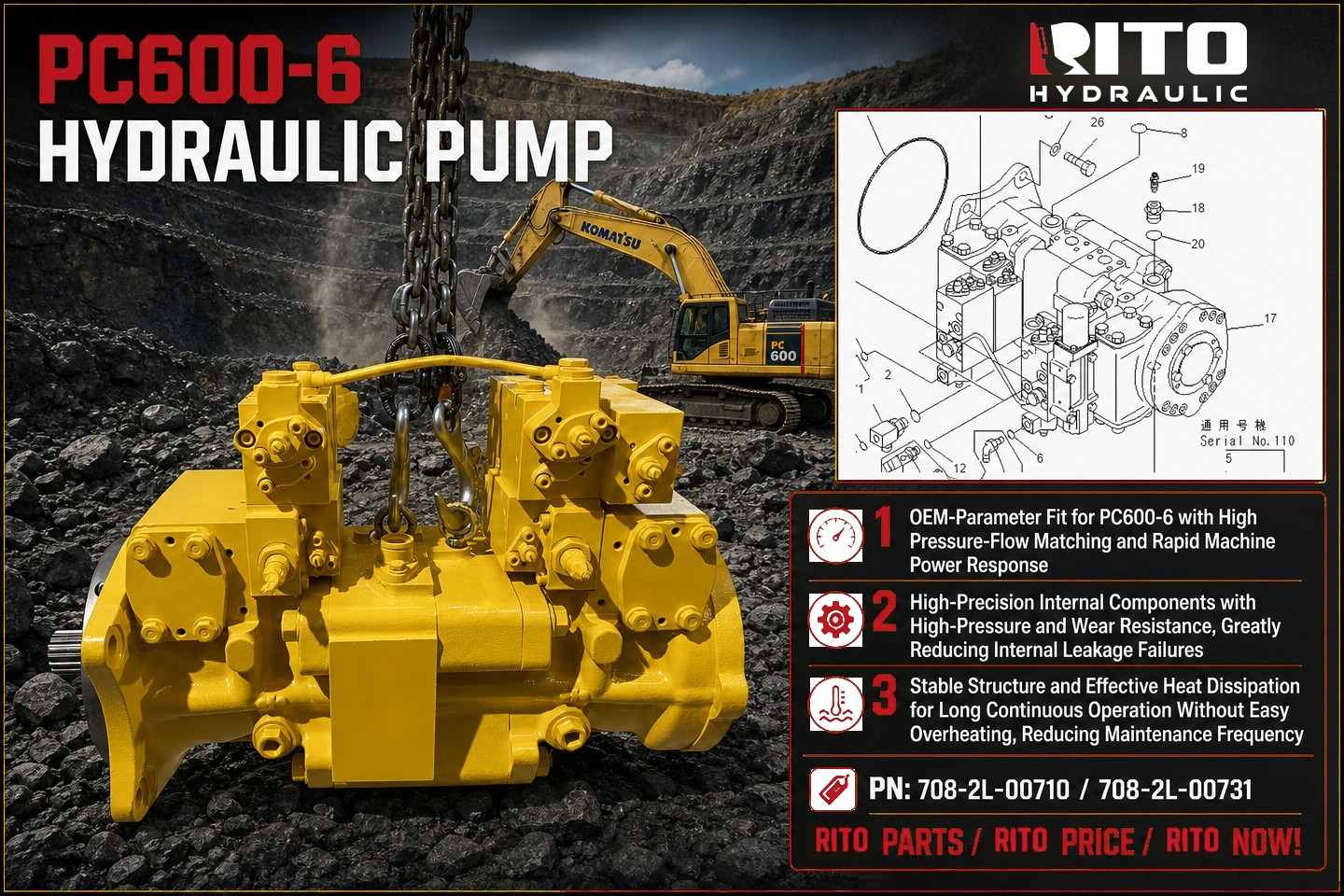
The PC600-6 main pump assembly is ordered under the Komatsu 708-2L series, and this unit is supplied as 708-2L-00710 or 708-2L-00731. You will also meet 708-2L-00721 and 708-2L-00770 in the same listings, and the assembly is commonly quoted across the PC600-6, PC650-6, PC600-7, PC650-7, PC600-8, PC650-8 and PC700-8 machines.
Two cautions, and neither is small:
- A number that appears for several models is not automatically right for yours. Serial ranges and build revisions change what was fitted, so the plate on your own pump remains the authority.
- The numbers within a series are not alternatives in the way they look. Before swapping one 708-2L number for another, confirm it is a genuine supersession for your machine rather than a different build. The naming logic is broken down in our guide to the 708-2G series part numbers.
8. FAQ
Q1: What is case drain flow on a hydraulic pump?
It is the low-pressure leakage oil that escapes past internal clearances, collects in the pump housing and returns to the tank through the case drain line. Because it exists only because of internal leakage, measuring its flow rate gives you a direct reading of how much oil the pump is losing internally.
Q2: Why is case drain flow better than waiting for the machine to feel weak?
Because the pump compensates. As clearances open, the pump strokes further to hold output, so the operator does not notice at first. Case drain flow rises during that period, which means it flags the wear while you can still plan the repair instead of reacting to a failure.
Q3: How do I measure case drain flow?
Either fit an inline flow meter into the case drain line, or disconnect the line and collect the oil in a container for a measured time and convert that to a flow rate. Both work; the inline meter is faster for repeat testing.
Q4: What conditions do I need to control?
Oil at operating temperature, a defined and recorded operating point (engine speed and function), a known-good drain line, and one component isolated at a time. Change any of those between tests and the readings are not comparable.
Q5: What is an acceptable case drain flow?
Use your machine's own service specification wherever it exists. As a general industry rule of thumb, drain flow beyond roughly one tenth of the pump's theoretical output is considered excessive internal leakage — but that is a guide, not a substitute for the manufacturer's figure for your machine.
Q6: My flow reading is high — does that prove the pump is worn out?
Not on its own. Temperature, viscosity, speed and drain-line restriction all affect the reading, and some internal leakage never appears as case drain flow at all. A high reading supports a diagnosis; it should be combined with pressure and flow testing of the circuit.
Q7: Could the weakness be something other than the pump?
Yes. Relief settings, the control signal reaching the pump, and worn or leaking valve sections can all mimic pump wear. The case drain test is what separates internal pump leakage from those causes — which is exactly why it is worth doing before you order anything.
Q8: What hydraulic pump part number does a PC600-6 use?
The main pump assembly is supplied under the Komatsu 708-2L series as 708-2L-00710 or 708-2L-00731, with 708-2L-00721 and 708-2L-00770 also appearing in listings for this machine family. Confirm against your own pump's plate and machine serial.
Q9: Can I just keep topping up the oil instead of repairing?
No — and this is the expensive mistake. Internal leakage turns engine power into heat, so the machine loses production, raises fuel consumption and runs hotter, while the wear itself continues to accelerate. Topping up treats the symptom and shortens the pump's remaining life.
Q10: What should I send to get a quotation?
The machine model and serial number, the plate code from the old pump, your case drain flow reading with the conditions it was taken under, any pressure or flow test data, and a description of what the machine does wrong and when.
9. Get Your Pump Confirmed
Send us your machine model, serial number, the plate code from the old pump and your case drain flow reading — with a note of the conditions it was measured under — and our team will help you read it, confirm the correct assembly for your PC600-6, and quote lead time the same day. RITO HYDRAULIC supplies complete, individually tested main pumps, swing devices, travel motors and control valves for Komatsu, Hitachi, Caterpillar, Kobelco, Hyundai, Doosan, Kawasaki and SANY machines — with export packing and a 6–12 month warranty.
Contact our team or learn more about RITO HYDRAULIC.
- CAT 330GC Final Drive — Which Part Number Fits and What Should You Check Before You Buy?
- Why Do Customers Need the TM40 Travel Assembly? When It Is Used, What It Does, and What It Changes
- Komatsu PC300-8 / PC350-8 Hydraulic Pump: Which 708-2G Number Fits, and Why PC300-7 Numbers Keep Appearing
- Why Does a CAT 320C / 320D Hydraulic Pump Lose Power Under Heavy Load?
- Why Does Your CAT 312C Need the SBS80 Hydraulic Pump?