
SANY SY365 / SY485 / SY500 Control Valve: Reading the KMX32NA/P45208 Plate and Matching 60341178

Author
JERY WANG
Guangzhou Rito Hydraulic Co.,Ltd., located in Guangzhou, China, is a leading manufacturer and distributor of hydraulic pumps, final drives, swing motors, and main control valves for earthmoving machinery. We supply genuine, OEM, and high-quality aftermarket parts.
We are committed to continuously sharing our expertise regarding construction machinery and excavator hydraulic systems. Our goal is to help you gain a deeper understanding of equipment principles and applications—enabling you to work more efficiently—while also showcasing our professional knowledge and capabilities. We invite you to learn more about us.
Choose us, and you will enjoy the best service, the most favorable prices, and the most reliable supplier!
Marie R. Winters


Quick Answer
Key Takeaways
- KMX32NA is a Kawasaki/KPM main control valve family used on SANY large excavators — and on other brands' machines in the same class.
- The full type is KMX32NA/P45208: the suffix is the variant, and it is tied to a machine and a part number.
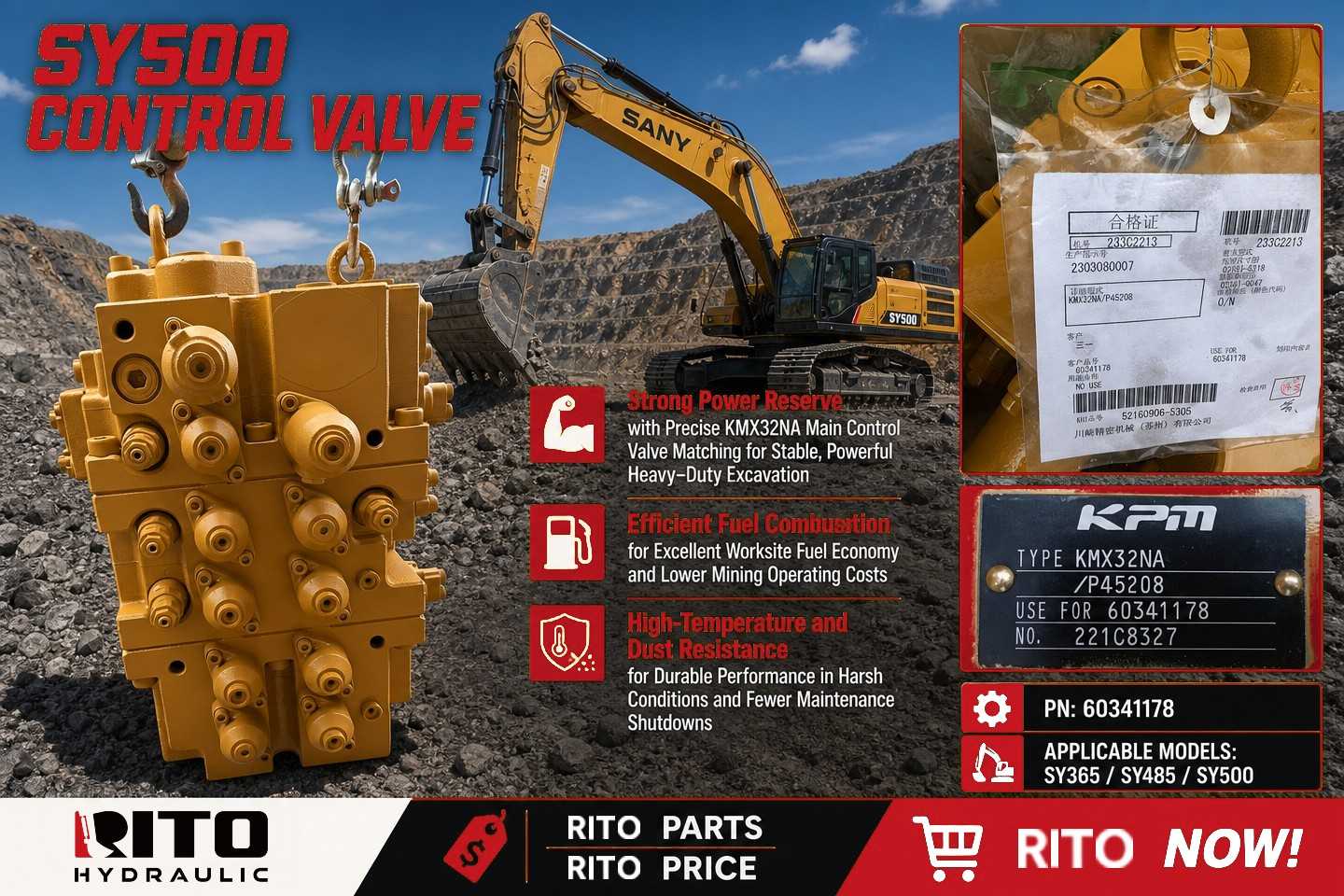
- This valve carries PN 60341178 and the product sheet lists it for SY365 / SY485 / SY500.
- Never order the family name alone. Family plus suffix plus part number is the order.
- The plate gives you four identifiers — learn to read all four before you quote anyone.
- On a mining machine, a tired control valve shows up as heat, fuel burn and slow functions — not only as a broken part.
Table of Contents
- 1. The Valve at a Glance
- 2. Read the Plate: Four Identities on One Valve
- 3. The Suffix Trap: A Family Is Not a Part
- 4. One Family, Several Machines
- 5. Why This Valve Decides Your Mining Cost
- 6. Slow, Weak or Drifting: Valve or Pump?
- 7. Confirm Before You Order
- 8. FAQ
- 9. Get Your Valve Confirmed
1. The Valve at a Glance
On a 36 to 50 tonne excavator, the main control valve is the component that decides where the pump's oil goes, in what order, and how much of it. It is the machine's traffic controller: every boom, arm, bucket, swing and travel movement passes through it, and it also sets priorities and pressure limits for the whole system.
On the SANY SY365, SY485 and SY500 that role is filled by a valve from the Kawasaki KMX32NA family, built by Kawasaki Precision Machinery and marked on the plate as TYPE KMX32NA/P45208.
| Item | Detail |
|---|---|
| Machine models | SANY SY365 / SY485 / SY500 |
| Component | Main control valve (main control valve assembly) |
| Valve family | Kawasaki / KPM KMX32NA |
| Full type on the plate | KMX32NA/P45208 |
| Part number | 60341178 (marked as USE FOR on the plate) |
| Supplied as | Complete assembly |
Complete control valve assemblies and the wider range sit under control valve assemblies if you want to see the family this belongs to.
2. Read the Plate: Four Identities on One Valve
Most wrong-valve purchases start with someone ordering from a photo of the outside. The plate is the answer, and on this valve it carries four separate identifiers — each doing a different job:
| On the plate | What it tells you | Why you need it |
|---|---|---|
| TYPE — KMX32NA/P45208 | The family and the variant | The part before the slash is the family; the part after it is the build |
| USE FOR — 60341178 | The machine-side part number this valve serves | This is what a supplier actually quotes against |
| NO. — 221C8327 | The unit's own serial / production number | Proves identity, and helps trace a build if the plate is the only evidence |
| Certificate — production order, customer, date | Production traceability: order number, customer name, build date | Tells you the valve is a production part, not a generic block |
Two habits make this reliable. First, photograph the plate straight-on and in focus — a blurry plate is the same as no plate. Second, photograph the whole valve as well, including the port face and the spool ends, so a supplier can cross-check the variant rather than trusting one number.
One more detail worth noticing on this valve: the manufacturer is Kawasaki Precision Machinery, and the certificate names the machine builder as the customer. In other words this is a cross-brand supply — a Kawasaki-designed valve fitted to a SANY machine. That is normal in this industry, and it explains why the same valve family turns up on more than one brand of excavator. The wider Kawasaki range is grouped under Kawasaki-series hydraulic parts.
3. The Suffix Trap: A Family Is Not a Part
Here is the mistake this article exists to prevent. A buyer searches "SY500 control valve", sees KMX32NA appear again and again, and orders it. The valve that arrives is from the right family and may still not be the right unit, because KMX32NA describes a family, while the suffix describes the build.
| How people order | What can go wrong |
|---|---|
| "The SY500 valve" | Within one machine family there can be more than one build; the model name does not pick the suffix |
| "KMX32NA" | Right family, unknown variant — the suffix after the slash is missing, and that is the deciding part |
| A photo that "looks the same" | Spool configurations, port layouts and settings differ inside while the casting looks identical |
You will see the same family quoted with several different suffixes in the market, each travelling with its own part number — for example, another variant of the same family is commonly listed against a different part number for the same machine class. That is not sellers being sloppy; it reflects a real product structure. It is also exactly why the suffix must come from your own plate.
The logic is the same one that catches buyers on other brands. When one family covers several builds, the variant code — not the family name — decides the order; our guide to the Kobelco SK200 to SK260 control valve variants works through the same problem with two competing part numbers.
4. One Family, Several Machines
The product sheet for this valve lists the SANY SY365, SY485 and SY500. That is a wide span of machine sizes running one valve family, and it has a practical consequence: a valve that physically fits one of these machines is not proof it belongs on yours.
| Listed on the product sheet | SY365 / SY485 / SY500 |
|---|---|
| Also commonly listed in the market | The same KMX32NA family is widely quoted for further models in this size band (for example SY375, SY395 and SY550) and for other brands' machines in the same class |
| What that means for you | The model list is a lead, not a confirmation — the plate and the machine serial are the confirmation |
So the sequence is always the same: machine model and serial first, then the plate on the old valve, then the photos. Anyone who quotes you from the model name alone is guessing, and on a component this size a wrong guess is expensive to ship back. Replacement assemblies are grouped under excavator hydraulic parts.
5. Why This Valve Decides Your Mining Cost
On a machine working in a quarry or a mine, the control valve is not only a "function" component — it is an operating cost component. Three characteristics of this valve explain why, and each one maps to a cost line you can see on site.
| Characteristic | In plain language | The cost it protects |
|---|---|---|
| Power reserve with precise valve matching | The valve is matched to the pump so the machine keeps its digging force under heavy, continuous load | Cycle time. A machine that stalls in the pile loses production every hour, not once a year |
| Efficient fuel combustion | A valve that does not waste flow lets the engine work in its efficient range instead of working harder for the same output | Fuel. On a 50 tonne machine, fuel is the largest daily cost after the operator |
| High-temperature and dust resistance | Sealing and clearances hold up in hot, dusty conditions instead of leaking or scoring early | Downtime and oil. Heat and dust are what turn a serviceable valve into a replacement |
Read that table in reverse and you have the early-warning list. A machine that slows down in the pile, drinks more fuel for the same work, or runs hotter than it used to is telling you the hydraulic side has lost efficiency — and the control valve is one of the two places to look for it, alongside the pump.
Dust deserves its own sentence, because it is the failure mode mining customers underestimate. Valve spools work on very fine clearances; grit that gets past the filtration does not need to be large to open up leakage paths. That is why oil condition, breather and filter discipline protects this valve as much as it protects the pump.
6. Slow, Weak or Drifting: Valve or Pump?
Before anyone buys a valve, the fault should point at the valve. The single most useful discriminator is simple: how many functions are affected.
| What the operator reports | Where it usually points | Cheapest sensible first step |
|---|---|---|
| One or two functions weak or slow | The valve section for those functions | Test pressure function by function before ordering anything |
| Every function weak and slow | Pump output, suction, relief setting or control signal | Pressure and flow test; check oil condition and suction side first |
| A function drifts or creeps when held | Internal leakage in that valve section or its cylinder | Isolate section versus cylinder before condemning either |
| Machine runs hot, oil darkens | Internal leakage somewhere in the circuit, cooler or relief | Find the source of the heat; do not simply add oil |
| A new pump behaved no better | The original fault was never the pump | Re-test properly; inspect the valve and flush the system |
Two rules follow from that table. First, all-function weakness is a pump-side question, while selective weakness is a valve-side question — a valve that serves every function rarely fails in a way that spares all of them. Second, a control valve that is replaced into a contaminated system will fail again, so flushing, filters and fresh oil are part of the valve job, not an optional extra.
If you want the underlying logic — how a load-sensing valve decides flow and how that differs from a conventional valve — it is set out in our guide to the control valve on the Komatsu PC300-8 and what CLSS means. The principle carries across brands; only the settings change.
7. Confirm Before You Order
Five minutes with the machine beats a wrong assembly on a pallet:
- 1. Record the machine model and serial number. The serial, not the model name, is what fixes the build.
- 2. Read the full TYPE on the old valve — family and suffix, not just the family (KMX32NA/P45208 on this unit).
- 3. Record the USE FOR part number and the unit's NO. Those two travel with the valve and confirm it against the machine.
- 4. Photograph the plate and the valve. Plate straight-on and sharp; valve from two or three angles including the ports.
- 5. Say what the machine actually does wrong, and which functions are affected. It changes both the diagnosis and the order.
Sent together, these five items turn the purchase into a single round. Sent as "one SY500 control valve", they turn it into a guess with a freight bill attached.
8. FAQ
Q1: What control valve does the SANY SY500 use?
The SY365, SY485 and SY500 use a Kawasaki/KPM main control valve of the KMX32NA family. The unit shown here is marked TYPE KMX32NA/P45208 with USE FOR 60341178. Confirm the exact variant from the plate on your own machine.
Q2: What does KMX32NA/P45208 mean?
KMX32NA is the valve family; the suffix after the slash (P45208) identifies the build. The suffix is what ties the valve to a machine and to a part number, so the full type — not just the family name — is what you should quote.
Q3: Can I order just by "KMX32NA"?
It is not safe. The family covers more than one build, and the same family appears in the market with several different suffixes and part numbers. Quote the family, the suffix and the USE FOR number together.
Q4: Which part number goes with this valve?
The plate on this unit shows USE FOR 60341178. Always read your own plate rather than assuming, because the applicable number depends on the machine and its build.
Q5: Will the same valve fit SY365, SY485 and SY500?
The product sheet for this valve lists all three, and the family is commonly quoted across this size band. That does not make any valve in the family interchangeable — confirm with your machine serial and the plate.
Q6: What is the NO. on the plate for?
It is the unit's own serial or production number (221C8327 on this valve). It proves the identity of the specific unit and helps trace the build if something needs to be verified later.
Q7: Is a Kawasaki valve on a SANY machine unusual?
No. Cross-brand supply is normal in construction machinery: OEMs fit components from major hydraulic manufacturers, and this valve is a Kawasaki Precision Machinery product supplied into SANY machines. It also explains why the same family appears on other brands.
Q8: How do I know whether the fault is the valve or the pump?
Count the affected functions. Weakness in one or two functions points to the valve section; weakness across every function points to the pump, suction side or relief. A pressure and flow test separates them before you spend.
Q9: Why does dust matter so much to this valve?
Valve spools rely on very fine clearances. Small particles that pass the filtration are enough to open leakage paths and cause scoring, so oil condition, breather and filter discipline protect the valve as much as the pump.
Q10: What should I send to get a quotation?
The machine model and serial number, the full TYPE from the old valve, the USE FOR part number and unit NO., two or three photos of the valve including the ports, and a description of which functions are affected.
9. Get Your Valve Confirmed
Send us your machine model, serial number and the full TYPE from the old valve (family and suffix), together with the USE FOR number and a few clear photos — and our team will confirm the correct assembly for your SY365, SY485 or SY500, flag any variant difference, and quote lead time the same day. RITO HYDRAULIC supplies complete, individually tested control valves, main pumps, travel motors and swing motors for SANY, Kawasaki, Komatsu, Hitachi, Caterpillar, Kobelco, Hyundai and Doosan machines — with export packing and a 6–12 month warranty.
Contact our team or learn more about RITO HYDRAULIC.
- CAT 330GC Final Drive — Which Part Number Fits and What Should You Check Before You Buy?
- Why Do Customers Need the TM40 Travel Assembly? When It Is Used, What It Does, and What It Changes
- Komatsu PC300-8 / PC350-8 Hydraulic Pump: Which 708-2G Number Fits, and Why PC300-7 Numbers Keep Appearing
- Why Does a CAT 320C / 320D Hydraulic Pump Lose Power Under Heavy Load?
- Why Does Your CAT 312C Need the SBS80 Hydraulic Pump?