
How Does the Hydraulic Pump Work on a Caterpillar 336F Excavator?


Author
JERY WANG
Guangzhou Rito Hydraulic Co.,Ltd., located in Guangzhou, China, is a leading manufacturer and distributor of hydraulic pumps, final drives, swing motors, and main control valves for earthmoving machinery. We supply genuine, OEM, and high-quality aftermarket parts.
We are committed to continuously sharing our expertise regarding construction machinery and excavator hydraulic systems. Our goal is to help you gain a deeper understanding of equipment principles and applications—enabling you to work more efficiently—while also showcasing our professional knowledge and capabilities. We invite you to learn more about us.
Choose us, and you will enjoy the best service, the most favorable prices, and the most reliable supplier!
Marie R. Winters


Quick Answer
Key Takeaways
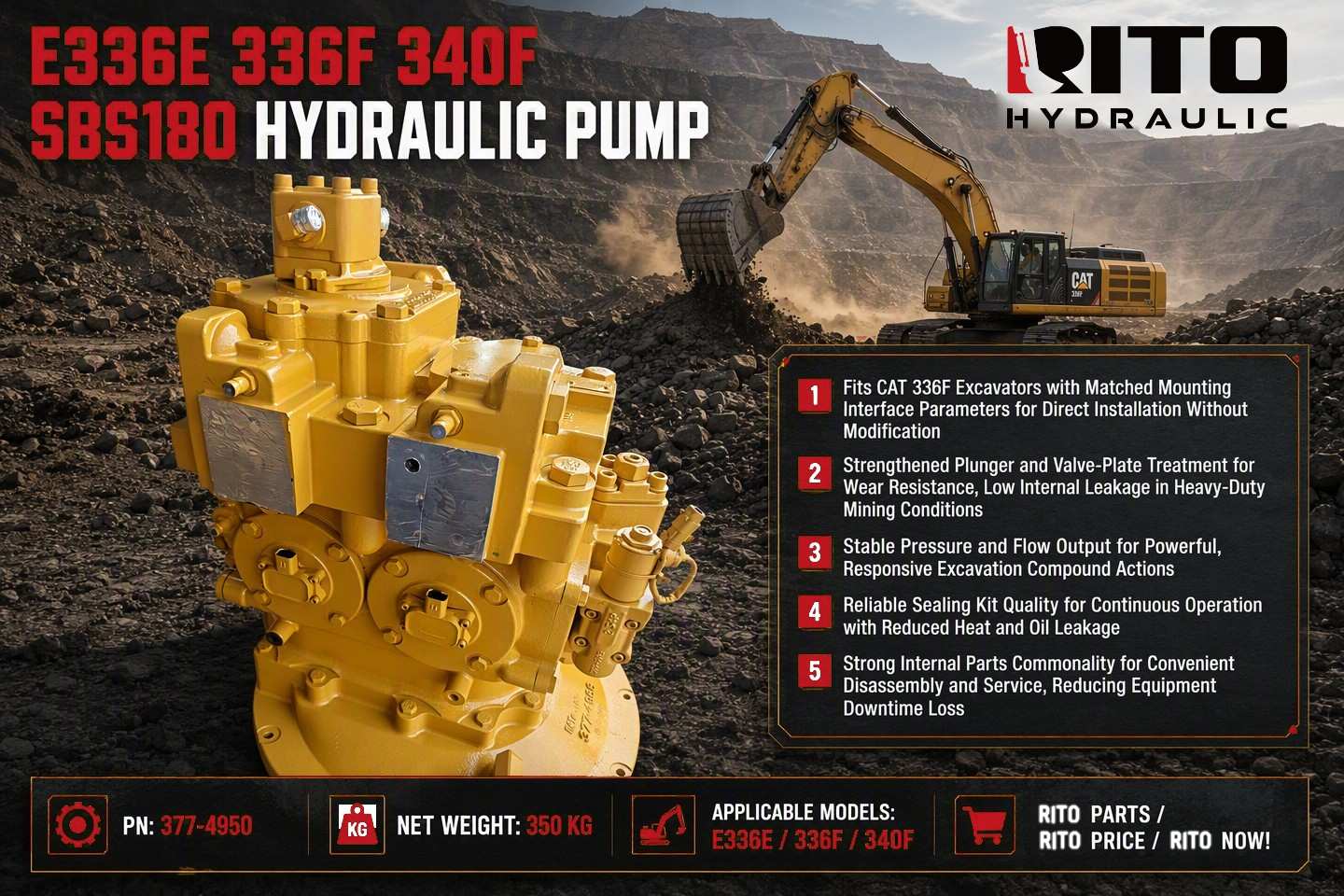
- The 336F main pump is a variable-displacement axial-piston pump; Cat lists 377-4950 as a 2P Series Hydraulic Pump, known in the trade as SBS180.
- "Variable displacement" means the pump changes its own output instead of delivering a fixed flow — that is what saves fuel and stops the oil overheating.
- The pump does not decide alone: load pressure and the machine's electronic control both influence how far it strokes.
- Its real test is compound actions — boom, arm, bucket and swing working together, each getting flow in proportion.
- A pre-shaped mounting interface (drive, flange, ports) is what makes replacement a bolt-on job rather than a fabrication job.
- Internal parts commonality is what makes these pumps serviceable and remanufacturable — Cat's own Reman alternative is 30R-0952.
Table of Contents
- 1. Where the Pump Sits in a 336F
- 2. The Core Idea: a Pump That Changes Its Own Output
- 3. How the Pump Decides How Much to Deliver
- 4. Delivering Compound Actions
- 5. Why the Mounting Interface Decides Whether It Fits
- 6. Internal Parts Commonality — and What It Saves
- 7. What a Healthy Pump Feels Like — and What Failure Feels Like
- 8. FAQ
- 9. Get Your Pump Confirmed
1. Where the Pump Sits in a 336F
In simple terms, the machine works like this: the engine turns the pump, the pump pushes oil, and the oil does the work. Between the two sits the main control valve, which decides where that oil goes — boom, arm, bucket, swing or travel — and in what proportion.
As Cat itself puts it, a hydraulic pump "generates hydraulic flow and pressure by converting mechanical power into hydraulic energy." That one sentence is the whole job description. Engine torque goes in one end; pressurised oil comes out the other; everything the operator feels at the levers is downstream of that conversion.
On the 336F that unit is Cat part 377-4950, catalogued by Cat as a "2P Series Hydraulic Pump" and known across the parts trade as the SBS180. The same pump is used across the 336F / 336E / 340F family — Cat's own fitment list runs from the 336F L, 336F LN and 336F XE through the 336E H, 336E LH and 336E LNH to the 340F, 340F L UHD and 340F L LRE, plus the 336F mobile hydraulic power unit.
One detail worth knowing before you shop: the SBS designation is a size class, not a unique part. The smaller 329D carries an SBS140 pump — the same family, a smaller displacement — which is why our guide to power loss on the 329D and its SBS140 pump reads across to this machine even though the numbers differ. The wider Caterpillar-series hydraulic parts range shows where the SBS180 sits in the line-up.
2. The Core Idea: a Pump That Changes Its Own Output
Here is the single concept that makes everything else make sense. Inside the pump, pistons run in a rotating cylinder block and are pushed in and out by a swashplate — an angled plate. The angle of that plate sets how far each piston travels, and the piston travel sets how much oil the pump pushes per revolution.
Change the angle and you change the output. That is what "variable displacement" means, and it is the difference between this pump and a simple fixed pump:
| Type | What it does | Consequence on the machine |
|---|---|---|
| Fixed displacement | Delivers the same flow every revolution, whether or not anyone needs it | Unused flow is pushed over a relief valve — straight into heat, noise and wasted fuel |
| Variable displacement | Changes its own output to match what the machine is asking for | Little wasted flow, so less heat, lower fuel burn and smoother control |
Read that second row carefully, because it explains two things owners notice but rarely connect to the pump. A machine that drinks fuel and runs hot without doing more work is often a pump that has stopped varying properly and is simply pushing oil somewhere it should not go. And a machine whose functions feel abrupt or uncontrollable is often a pump that can still stroke, but no longer responds smoothly to the demand signal.
If you want the mechanism itself in more depth — how the pistons, valve plate and swashplate work together — that is covered in our explainer on how a variable-displacement piston pump works. The principle is the same on every machine; only the numbers change.
3. How the Pump Decides How Much to Deliver
A pump cannot see the operator's hand. It only receives signals — and on a modern excavator those signals come from two places.
| Signal source | What it carries | What the pump does with it |
|---|---|---|
| Hydraulic pressure | How hard the work is — the load on the boom, arm or bucket | Limits stroke so the machine works at the pressure it needs, not more |
| Electronic control | The operator's demand, engine condition and machine mode | Shapes how much flow is offered overall, so the engine is not overloaded or left idle |
On Cat's 300-series excavators the electronic side is not decorative — it is an active part of the pump's regulation, working through a proportional solenoid and a control pressure that trims pump output to keep the engine working efficiently. That is why an electrical fault on this class of machine can feel exactly like a hydraulic fault: a pump that never receives the right signal will never stroke correctly.
Two practical consequences follow, and they are worth carrying into any diagnosis:
- A fault "in the pump" may not be inside the pump. Before you condemn the assembly, confirm the machine is actually asking the pump for output — signal, wiring, sensor and control pressure first.
- Settings and calibration matter. A replacement pump fitted without checking the machine's control settings can behave badly even though it is mechanically perfect.
The wider system that carries these signals — and distributes the pump's output to each function — is described in our guide to control valve assemblies.
4. Delivering Compound Actions
Nobody digs with one function at a time. A single productive cycle on a 336F typically involves the boom, arm, bucket and swing working together — and every one of them is fed from the same pump output. This is what the machine's literature calls compound action, and it is the hardest demand placed on the pump.
Three things have to happen at once for compound work to feel strong and smooth:
| Requirement | Why it matters to the operator |
|---|---|
| Enough total flow | So that moving two levers does not halve the speed of both |
| Stable pressure under load | So digging force and holding power do not fade when the pile gets hard |
| Fast response | So the machine feels precise rather than laggy or jerky |
This is exactly where a worn pump announces itself. Piston and valve-plate surfaces wear, internal clearances open up, and oil that should be going to the actuators leaks back inside the pump instead. The symptoms are predictable: the machine gets slower in every function at once, it runs hotter, and the loss shows up first in the heaviest combined movements — precisely the ones this machine was bought to do. Surface treatment of the plunger and valve plate is what buys wear resistance in that duty, and it is one of the first things a low-cost rebuild skimps on.
Very important distinction, and it saves real money: if only one or two functions are weak, the pump is usually not the cause — a single function points at its own valve section or cylinder. Weakness that appears across all functions is what points at the pump.
5. Why the Mounting Interface Decides Whether It Fits
The pump is bolted to the engine side and driven from it, so "it fits" is not a matter of brand loyalty — it is a few machined dimensions agreeing with each other. When a supplier says a unit is built to matched mounting interface parameters, this is what they are promising:
| Check | Why it decides the installation |
|---|---|
| Drive spline or coupling | The pump must engage the engine-side drive exactly; this cannot be adapted on site |
| Mounting flange and bolt pattern | The unit bolts to the same mounting group as the original |
| Port positions and sizes | Suction, delivery and drain lines reconnect without re-plumbing |
| Regulator and control arrangement | The pump must accept the machine's control signals as the original did |
| Physical size and weight | Around 350 kg on this assembly — it has to go back into the same space, the same way |
Get all five right and the replacement is a straightforward lift-and-bolt job. Get one wrong and the machine is down while someone makes brackets, which is why the model list in a listing is only a starting point. The plate and the machine serial are what confirm fitment — and on a 350 kg part, that five-minute check is worth far more than it costs.
6. Internal Parts Commonality — and What It Saves
Here is the feature buyers underestimate until they need it. Because this pump family shares internal components across a wide spread of models, its internal parts are obtainable as individual pieces — pistons, bores, valve plates, bearings, regulators and seal kits — rather than existing only as a sealed whole.
That has three practical effects:
- A repair is possible, not just a replacement. If the damage is confined — a worn valve plate, a leaking regulator, tired seals — the unit can be brought back rather than scrapped.
- Remanufacturing is viable at industrial scale. Cat itself offers a Reman alternative for this exact part number (30R-0952), which only exists because the internals can be reworked and re-tested economically.
- Downtime gets shorter. Commonality means a wider pool of stock and faster parts availability across the 336E / 336F / 340F family.
Two cautions still apply, and they matter more on this part than on most. First, internal commonality between models does not mean the assemblies are interchangeable — the same internals can sit behind different mounting interfaces and control arrangements. Second, a rebuild is only as good as the parts and the testing behind it; commonality makes a good rebuild possible, it does not make every rebuild good. Ask for a per-unit test report and know whether you are buying new or remanufactured. Replacement assemblies and the wider spare range are grouped under excavator hydraulic parts.
7. What a Healthy Pump Feels Like — and What Failure Feels Like
Because the pump drives every function, its condition shows up as machine behaviour rather than as a single dramatic breakdown. This is the quickest way to judge it from the seat:
| What you observe | Healthy pump | Pump losing efficiency |
|---|---|---|
| Response to the levers | Immediate and progressive | Lag, then a surge; harder to feather |
| Every function at once | Consistent speeds across boom, arm, bucket, swing and travel | Everything is slower together — the classic pump signature |
| Under hard load | Holds pressure; digging force stays | Fades in the pile, recovers when the load eases |
| Oil temperature | Stable in normal working range | Keeps climbing; oil darkens earlier |
| Fuel use for the same job | Predictable shift to shift | Creeps up — the pump is doing more work on itself |
Before spending anything, separate the pump from everything around it:
- All functions weak → look at the pump side, along with suction, relief settings and the control signal reaching the pump.
- One or two functions weak → look at that valve section or cylinder, not the pump.
- Heat with no loss of speed → look at the cooler, relief or a leak before condemning the pump.
- A new pump that changed nothing → the original diagnosis was wrong. Re-test rather than replacing something else on a guess.
Two maintenance habits protect a pump of this class more than anything else. The first is cleanliness: piston pumps run on very fine clearances, and the filters listed alongside this part number exist for a reason — grit that passes them opens up internal leakage and scores surfaces that cannot be restored by flushing. The second is not running to the limit cold: heavy work on thick, cold oil before the machine warms through is one of the fastest ways to shorten a pump's life. Our breakdown of classic faults on the 320GC pump shows how the same habits play out on the smaller machine.
8. FAQ
Q1: What hydraulic pump does a Caterpillar 336F use?
It uses a variable-displacement axial-piston main pump. Cat catalogues the assembly as 377-4950, a "2P Series Hydraulic Pump"; in the parts trade it is known as the SBS180. Always confirm the number on your own machine before ordering.
Q2: What does SBS180 mean?
SBS180 is the trade designation for this pump class. Think of it as a size class rather than a unique part number — the same SBS family is used on smaller machines as the SBS140, so the SBS name identifies the family while the part number identifies the exact unit.
Q3: Which machines does 377-4950 fit?
Cat's own fitment list covers the 336F L, 336F LN, 336F L XE, 336F LN XE, 336F XE and 336F, the 336E H, 336E LH and 336E LNH, the 340F, 340F L UHD and 340F L LRE, plus the 336F mobile hydraulic power unit. Variants within one model family can differ, so confirm by serial.
Q4: How does the pump vary how much oil it delivers?
By changing the angle of its internal swashplate, which changes how far each piston travels per revolution. A steeper angle means more oil per revolution; a shallower angle means less. The pump adjusts that angle continuously while the machine works.
Q5: Does the pump decide the flow on its own?
No. It responds to signals: hydraulic pressure tells it how hard the work is, and the machine's electronic control tells it how much output the operator and engine condition call for. Because of that, an electrical or control-side fault can feel exactly like a hydraulic one.
Q6: Why is my 336F slow in every function?
Weakness across all functions together is the classic signature of a pump that is losing volumetric efficiency — oil is leaking internally instead of reaching the actuators. Check suction, relief settings and the control signal as well, then have the pump tested before ordering.
Q7: Why does the machine run hotter and use more fuel?
When the pump stops varying efficiently, flow that should be doing useful work is pushed over relief or leaks internally. That input energy becomes heat instead of movement, which is why higher fuel use and higher oil temperature often appear together.
Q8: Are 377-4968, 451-9302 or 369-9643 the same pump?
Those numbers are commonly listed alongside 377-4950 for the 336E / 336F / 340F family, and some of them are alternative or superseded references. Treat them as leads to verify against your plate and serial — a shared cell in a listing is not a manufacturer's statement of equivalence.
Q9: Can this pump be repaired rather than replaced?
Often yes, because the internal parts are obtainable individually across this pump family. Cat's own remanufactured alternative for 377-4950 is 30R-0952, which shows the unit is designed to be reworked. Whether a repair makes sense depends on how far the damage has spread.
Q10: What should I send to get a quotation?
The machine model and serial number, the plate code from the old pump, a description of what the machine does wrong and when, plus two or three clear photos of the pump including the plate, flange and ports. Any pressure or flow test readings you have will shorten the conversation considerably.
9. Get Your Pump Confirmed
Send us your machine model, serial number, the plate code from the old pump and a few clear photos — plus a note of how the machine behaves — and our team will confirm the correct assembly for your 336F, tell you whether a repair or a replacement is the sensible route, and quote lead time the same day. RITO HYDRAULIC supplies complete, individually tested main pumps, swing devices, travel motors and control valves for Caterpillar, Komatsu, Hitachi, Kobelco, Hyundai, Doosan and SANY machines — with export packing and a 6–12 month warranty.
Contact our team or learn more about RITO HYDRAULIC.
- CAT 330GC Final Drive — Which Part Number Fits and What Should You Check Before You Buy?
- Why Do Customers Need the TM40 Travel Assembly? When It Is Used, What It Does, and What It Changes
- Komatsu PC300-8 / PC350-8 Hydraulic Pump: Which 708-2G Number Fits, and Why PC300-7 Numbers Keep Appearing
- Why Does a CAT 320C / 320D Hydraulic Pump Lose Power Under Heavy Load?
- Why Does Your CAT 312C Need the SBS80 Hydraulic Pump?