
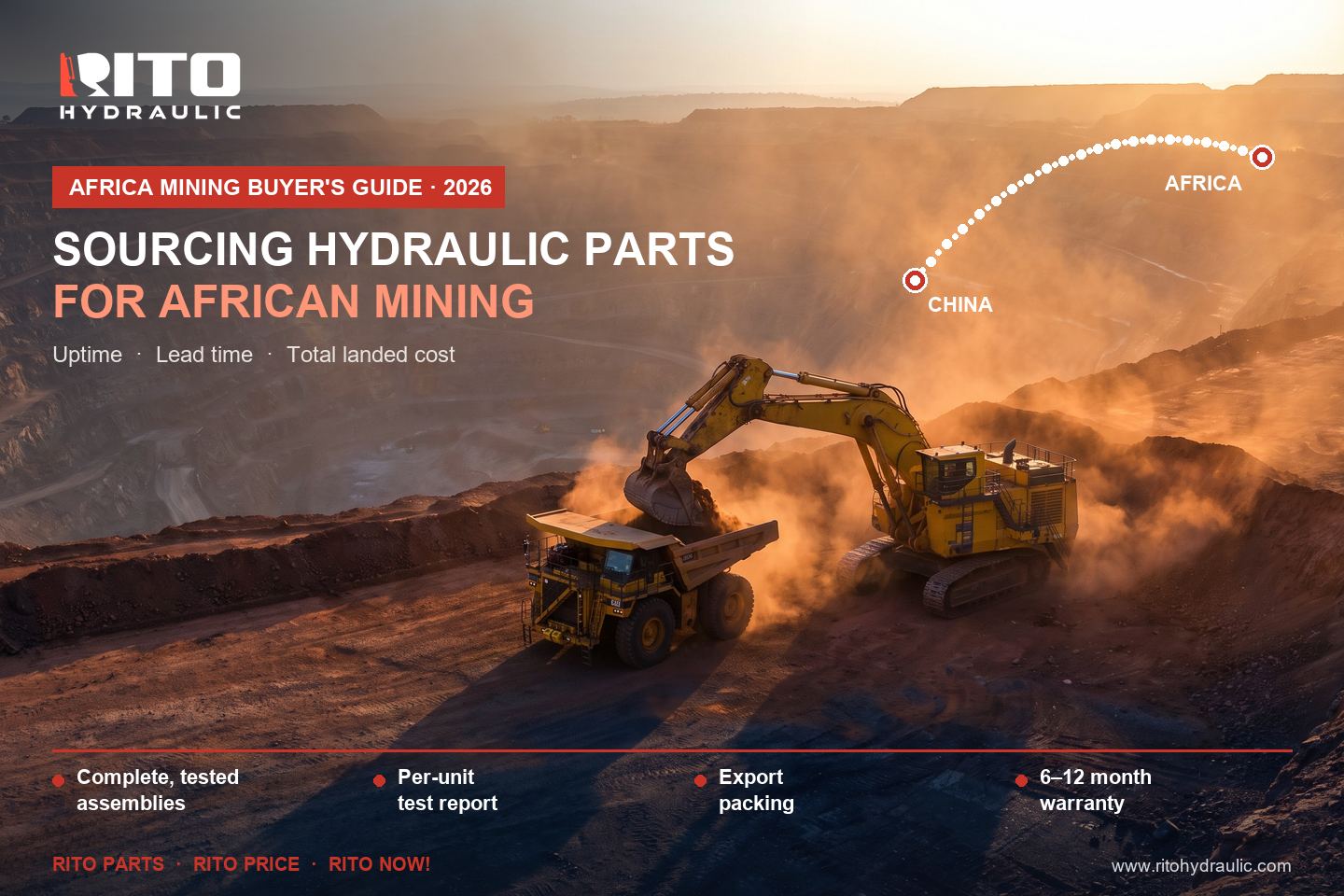
Sourcing Excavator Hydraulic Parts for African Mining: A 2026 Buyer's Guide

Author
JERY WANG
Guangzhou Rito Hydraulic Co.,Ltd., located in Guangzhou, China, is a leading manufacturer and distributor of hydraulic pumps, final drives, swing motors, and main control valves for earthmoving machinery. We supply genuine, OEM, and high-quality aftermarket parts.
We are committed to continuously sharing our expertise regarding construction machinery and excavator hydraulic systems. Our goal is to help you gain a deeper understanding of equipment principles and applications—enabling you to work more efficiently—while also showcasing our professional knowledge and capabilities. We invite you to learn more about us.
Choose us, and you will enjoy the best service, the most favorable prices, and the most reliable supplier!
Marie R. Winters


Quick Answer
Key Takeaways
- In African mining, downtime > unit price — buy for uptime, not for the cheapest quote.
- Buy complete, individually tested assemblies (pump, swing motor, travel motor, control valve), not loose parts of unknown history.
- Sea freight is the economical route; air freight is the emergency route — plan so you rarely need it.
- Plan around lead time: order to your maintenance schedule, and keep a spare of the highest-wear item on site.
- Insist on export packing (rust protection + moisture barrier + crate) for long sea transit.
- Confirm the supplier can provide a per-unit test report and a 6–12 month warranty before you order.
Table of Contents
- 1. Why African Mining Is Different
- 2. The Parts That Matter Most
- 3. Sourcing Options Compared
- 4. How to Vet a Supplier
- 5. Shipping & Logistics to Africa
- 6. Customs, Duty & Documents
- 7. Packing for Long Sea Transit
- 8. Your Ordering Checklist
- 9. FAQ
- 10. Get a Quote for Your Fleet
1. Why African Mining Is Different
An excavator working a mine in Africa faces a combination that shortens component life and punishes poor planning:
- Dust. Quarry and pit dust is relentless, and contamination is the number-one killer of hydraulic pumps.
- Heat. High ambient temperatures push oil past its comfort zone, accelerating wear and oil degradation.
- Long shifts. Mining machines often run near-continuously — so components reach their service limits faster.
- Distance from support. A dealer or port may be days away, which turns a small delay into a long stoppage.
- Lead time. Sea freight from Asia is economical but slow; air freight is fast but expensive.
The result is that the usual "buy the cheapest part" logic fails. In a pit, the cost of a stopped machine dwarfs the price difference between a cheap part and a reliable one. Sourcing decisions here are uptime decisions.
2. The Parts That Matter Most
Focus your sourcing and your spare-parts budget on the highest-wear, highest-consequence components:
| Priority | Component | Why it matters |
|---|---|---|
| 1 | Main hydraulic pump | Stops the whole machine; longest lead time |
| 2 | Travel motors | Disables movement; hard to source locally |
| 3 | Swing motor / drive | Disables the working cycle |
| 4 | Control valve | High value; one function or many |
| 5 | Filters, seals, hoses | Cheap to hold, always needed |
Browse the full range of excavator hydraulic parts to plan a single consolidated order.
3. Sourcing Options Compared
| Option | Best for | Trade-off |
|---|---|---|
| Local dealer (OEM) | New machines under warranty | Highest price; local stock may be limited |
| Regional importer | Fast delivery within the region | Mark-up; availability varies by part |
| Direct from verified factory (China) | Best landed cost + full range in one order | Plan for sea-freight lead time |
For most fleets the practical model is a hybrid: buy critical assemblies directly from a verified factory for cost and range, and keep a small local buffer for emergencies.
4. How to Vet a Supplier
- 1. Ask for a per-unit test report (flow, pressure, leakage) — not just a catalogue photo.
- 2. Confirm the warranty (6–12 months) and how a claim is handled across borders.
- 3. Ask whether units are new complete assemblies or rebuilt — and get it in writing.
- 4. Check export packing standards (rust protection, moisture barrier, crating).
- 5. Test their response speed before you need it — same-day quoting is a good sign.
5. Shipping & Logistics to Africa
Two routes, two purposes:
- Sea freight (LCL / FCL). The economical choice for planned orders. Slow, but the right way to move heavy assemblies like pumps and motors. Consolidate several items into one shipment to share the cost.
- Air freight. Reserve it for emergencies — it is fast but many times the cost of sea freight. A single air-freighted assembly can cost more than the price difference between a cheap pump and a verified one.
Practical rules: order to your maintenance schedule, not to the day of failure; and keep a spare of the highest-wear item on site so you are never forced into emergency freight.
6. Customs, Duty & Documents
Long-distance sourcing adds paperwork. Make sure your supplier can provide:
- Commercial invoice and packing list.
- Bill of lading / airway bill.
- Certificate of origin where your customs regime requires it.
- Consistent HS classification of the parts (hydraulic pumps, motors and valves).
Duty and clearance rules vary by country and change over time — always confirm current requirements with your local freight forwarder or customs broker before shipping, and factor duty, clearance and inland transport into your total landed cost.
7. Packing for Long Sea Transit
A long sea voyage is harsh on precision parts. Insist on:
- Rust protection on all machined surfaces.
- Moisture barrier and desiccant inside the packaging.
- Rigid crating with the unit secured so it cannot shift.
- Ports plugged against dust and moisture in transit.
8. Your Ordering Checklist
- 1. List your machine models and the part numbers from the pump/motor plates.
- 2. Decide which items to stock vs order on demand.
- 3. Request a quote for the whole list in one message (FOB or CIF).
- 4. Confirm test report, warranty and packing.
- 5. Confirm HS codes and required documents with your broker.
- 6. Ship by sea; keep air for genuine emergencies.
9. FAQ
Q1: Is it cheaper to buy excavator hydraulic parts directly from China?
Usually yes for landed cost and range, if you plan around sea-freight lead time. Factor in freight, duty, clearance and inland transport to compare fairly.
Q2: How long does sea freight to Africa take?
It varies widely by port and route — typically weeks, not days. Always get a current transit estimate from your forwarder and order to your maintenance schedule rather than to failure.
Q3: Should I keep spare hydraulic pumps on site?
For production-critical machines, yes — at least a spare of the highest-wear item. A spare turns a multi-week sourcing event into a same-day repair.
Q4: What should I check before ordering from an overseas supplier?
That they supply complete, individually tested assemblies, offer a test report and 6–12 month warranty, and use proper export packing. Ask for these in writing.
Q5: Which brands can you supply for African fleets?
RITO HYDRAULIC supplies parts for Caterpillar, Komatsu, Hitachi, Hyundai, Kobelco, Doosan and Kawasaki / Rexroth-series machines — including the pumps, motors and valves most used in mining fleets.
Q6: Why is dust so damaging to hydraulic parts?
Contamination is the top cause of premature hydraulic pump failure. Dust enters through breathers, seals and damaged hoses and abrades precision surfaces. Clean oil and correct filtration are the cheapest protection.
Q7: How do I avoid expensive air freight?
Plan ahead: order against your maintenance schedule by sea, and keep a critical spare in stock so a failure never becomes an emergency.
Q8: What documents do I need for import?
Typically a commercial invoice, packing list and bill of lading, plus a certificate of origin and correct HS codes where required. Confirm specifics with a local customs broker.
Q9: Can parts be consolidated into one shipment?
Yes — and they should be. Combining a pump, motors and consumables into one sea shipment shares the freight cost and simplifies clearance.
Q10: How can I be sure a pump or motor is good before it ships?
Ask for the per-unit test report covering flow, pressure and leakage. A verified supplier bench-tests each unit and provides the data before shipment.
10. Get a Quote for Your Fleet
Send us your machine models and the part numbers from your pump and motor plates, and our team will confirm fit, provide test-report samples and quote FOB/CIF pricing with lead time the same day. RITO HYDRAULIC supplies complete, individually tested main pumps, swing motors, travel motors and control valves for mining fleets across Africa and beyond — with export packing and a 6–12 month warranty.
Contact our team or learn more about RITO HYDRAULIC.
- CAT 330GC Final Drive — Which Part Number Fits and What Should You Check Before You Buy?
- Why Do Customers Need the TM40 Travel Assembly? When It Is Used, What It Does, and What It Changes
- Komatsu PC300-8 / PC350-8 Hydraulic Pump: Which 708-2G Number Fits, and Why PC300-7 Numbers Keep Appearing
- Why Does a CAT 320C / 320D Hydraulic Pump Lose Power Under Heavy Load?
- Why Does Your CAT 312C Need the SBS80 Hydraulic Pump?