
How an Excavator Hydraulic System Works: Pump, Valve, Cylinder & Motor Explained (2026)


Author
JERY WANG
Guangzhou Rito Hydraulic Co.,Ltd., located in Guangzhou, China, is a leading manufacturer and distributor of hydraulic pumps, final drives, swing motors, and main control valves for earthmoving machinery. We supply genuine, OEM, and high-quality aftermarket parts.
We are committed to continuously sharing our expertise regarding construction machinery and excavator hydraulic systems. Our goal is to help you gain a deeper understanding of equipment principles and applications—enabling you to work more efficiently—while also showcasing our professional knowledge and capabilities. We invite you to learn more about us.
Choose us, and you will enjoy the best service, the most favorable prices, and the most reliable supplier!
Marie R. Winters


Quick Answer
Key Takeaways
- The system is a closed loop: pump → valve → cylinder or motor → tank → pump.
- The pump creates flow, not pressure — pressure rises only when the oil meets resistance (a load).
- The control valve is the brain — it sends oil to the function the operator selects.
- Cylinders give linear force; motors give rotation (one for swing, two for travel).
- The tank and filters are the circulation system — clean oil is why the parts last.
- Because everything shares one circuit, a problem in one place shows up as a symptom somewhere else.
Table of Contents
- 1. The Big Picture: A Closed Loop
- 2. The Main Pump: The Heart
- 3. The Control Valve: The Brain
- 4. Cylinders: Linear Muscle
- 5. Motors: Swing and Travel
- 6. Tank, Filters and Oil: The Circulation
- 7. Why the Parts Depend on Each Other
- 8. What This Means When Buying Parts
- 9. FAQ
- 10. Parts That Keep the Loop Running
1. The Big Picture: A Closed Loop
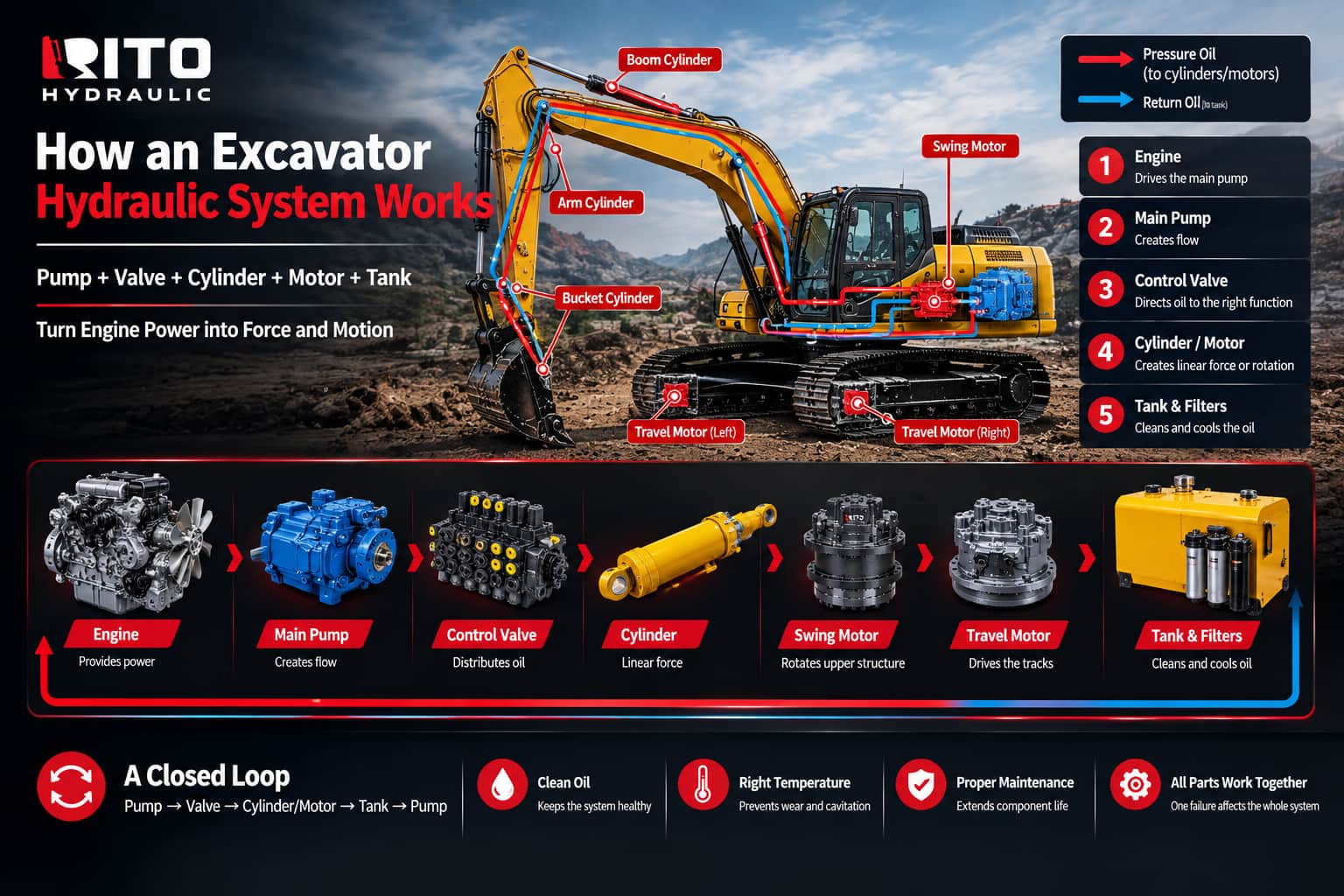
Every excavator hydraulic system is a loop. Follow the oil once around it and the whole machine makes sense:
Engine → Main Pump → Control Valve → Cylinder / Motor → Tank → (back to Pump)
The engine spins the pump. The pump pushes oil to the control valve. The valve sends it to whichever function the operator moves. The cylinder or motor turns that flow into force or rotation. The oil then returns to the tank, passes the filters, and starts again.
Two facts follow from this design:
- Everything shares one oil supply. The same oil that drives a cylinder also cools and lubricates the pump.
- Everything shares one failure mode. Contaminated or starved oil affects the whole loop at once.
2. The Main Pump: The Heart
The main pump is the most important — and most expensive — part of the system. Its job is to create flow, not pressure. Pressure appears only when that flow meets resistance, which is exactly what happens when the bucket hits ground.
Most modern excavators use a variable-displacement axial piston pump, often as a tandem (two pumps on one shaft). Because the displacement is variable, the pump can deliver only the flow the machine needs at any moment — which is what makes precise control and fuel efficiency possible.
Inside, pistons slide against a cylinder barrel and a valve plate spins against the end cover — machined clearances measured in microns. This is why clean, cool oil is the pump's whole world.
3. The Control Valve: The Brain
The control valve is the decision-maker. It takes the single flow from the pump and distributes it, on demand, to the boom, arm, bucket, swing and travel circuits. Move one lever and the valve sends oil there.
It also does three quieter jobs:
- Priority control — decides which function gets flow when several are used together.
- Pressure limiting — relief valves cap pressure to protect the pump and components.
- Load sensing — tells the pump how much flow the work actually needs.
When the valve leaks or sticks, the symptom often looks like a "weak pump" — one of the most common mis-diagnoses on site.
4. Cylinders: Linear Muscle
Cylinders do the straight-line work — raising the boom, curling the arm, closing the bucket. Pressurised oil pushes a piston inside a barrel; the rod attached to it moves the machine's linkage.
Two details matter for buyers:
- Bore and stroke determine force and reach — and they must match the machine.
- Seals and rods wear first. A scored rod or leaking seal bleeds pressure and quietly reduces productivity.
5. Motors: Swing and Travel
Where a cylinder pushes in a straight line, a hydraulic motor spins. An excavator has two kinds:
- Swing motor — one unit, under the cab, rotating the upper structure through 360°. It works through a swing drive with a brake and gearbox (see our swing motor range).
- Travel motors — two units, one inside each track (final drive), moving and steering the machine.
Motors and cylinders are the "outputs" of the loop: they are where the pressurised oil finally becomes the work you can see.
6. Tank, Filters and Oil: The Circulation
The tank stores the oil, lets heat escape and lets contamination settle. The filters — suction strainer, return filter and pilot filter — protect different points of the loop.
This is the part owners most often neglect, and it is the part that decides how long everything else lasts. Oil does four jobs at once: it transmits power, lubricates, cools and carries contamination away. Degrade the oil and every other component ages faster.
7. Why the Parts Depend on Each Other
Because the system is one loop, faults travel. Typical examples:
| Root cause | What the operator feels |
|---|---|
| Worn pump (internal leakage) | All functions slow and weak; oil runs hot |
| Leaking control valve | One function weak; drift when held |
| Clogged suction strainer | Pump whine, cavitation; everything loses power |
| Contaminated oil | Gradual decline; metal in the filters |
| Worn travel motor | Machine pulls to one side; weak on slopes |
The lesson: always diagnose the whole loop before replacing a part. A new pump fitted to a contaminated circuit is a second failure waiting to happen.
8. What This Means When Buying Parts
- 1. Know where the fault is: pump, valve, cylinder or motor — and confirm it.
- 2. Buy complete, tested assemblies for the critical parts (pump, motors, valve).
- 3. Match the control variant — load-sensing and pressure settings must suit your machine.
- 4. Flush and filter when you replace a major component.
- 5. Recheck between the pump and valve: many "pump" faults are valve faults.
Browse the full range of excavator hydraulic parts to plan a complete repair in one order.
9. FAQ
Q1: How does an excavator hydraulic system work?
The engine drives a pump that pushes oil to a control valve; the valve sends it to cylinders (linear motion) and motors (rotation); the oil returns to the tank through filters and circulates again.
Q2: What is the most important part of the hydraulic system?
The main pump is the most critical and most expensive, but the control valve and oil quality matter just as much — a good pump cannot work in a contaminated or mis-controlled system.
Q3: Does the pump create pressure?
No. The pump creates flow; pressure only appears when that flow meets resistance (a load). This is why testing under load is essential.
Q4: What is the difference between a cylinder and a motor?
A cylinder converts hydraulic pressure into straight-line force (boom, arm, bucket). A motor converts it into rotation (swing and travel).
Q5: How many hydraulic motors does an excavator have?
Three in total: one swing motor (rotates the house) and two travel motors (one per track).
Q6: Why do all functions slow down at once?
Because they share one pump and one oil supply. All-function weakness usually points to the pump, the main relief or a suction/filtration problem — not to a single cylinder.
Q7: Why is oil quality so important?
Oil transmits power, lubricates, cools and carries contamination. Contaminated or overheated oil accelerates wear across the whole loop — it is the number-one cause of premature pump failure.
Q8: What are the main filters?
Suction strainer (pump inlet), return filter (return line to tank) and pilot filter (pilot circuit). Each protects a different part of the loop.
Q9: If one function is weak, is it always that circuit's fault?
Usually yes — a single weak function points to that circuit's valve spool, cylinder seal or motor. All-function weakness points upstream to the pump.
Q10: Do I need to flush the system when replacing a pump?
Always. Flush the system and replace the return filter and suction strainer — debris from the failed pump will damage the new one otherwise.
10. Parts That Keep the Loop Running
RITO HYDRAULIC supplies complete, individually tested components for every point of the loop — main pumps, travel motors, swing motors and control valves — for Komatsu, Hitachi, Caterpillar, Hyundai, Kobelco, Doosan and Kawasaki / Rexroth-series machines, with per-unit test reports, export packing and a 6–12 month warranty.
Send us your machine model and the part number from the component plate, and we will confirm fit, stock and lead time the same day. Contact our team or learn more about RITO HYDRAULIC.
- CAT 330GC Final Drive — Which Part Number Fits and What Should You Check Before You Buy?
- Why Do Customers Need the TM40 Travel Assembly? When It Is Used, What It Does, and What It Changes
- Komatsu PC300-8 / PC350-8 Hydraulic Pump: Which 708-2G Number Fits, and Why PC300-7 Numbers Keep Appearing
- Why Does a CAT 320C / 320D Hydraulic Pump Lose Power Under Heavy Load?
- Why Does Your CAT 312C Need the SBS80 Hydraulic Pump?