
Komatsu PC210-7K Hydraulic Pump (708-2L-00202): Symptoms, Diagnosis & Replacement Guide for Dash-7 Excavators (2026)


Author
JERY WANG
Guangzhou Rito Hydraulic Co.,Ltd., located in Guangzhou, China, is a leading manufacturer and distributor of hydraulic pumps, final drives, swing motors, and main control valves for earthmoving machinery. We supply genuine, OEM, and high-quality aftermarket parts.
We are committed to continuously sharing our expertise regarding construction machinery and excavator hydraulic systems. Our goal is to help you gain a deeper understanding of equipment principles and applications—enabling you to work more efficiently—while also showcasing our professional knowledge and capabilities. We invite you to learn more about us.
Choose us, and you will enjoy the best service, the most favorable prices, and the most reliable supplier!
Marie R. Winters


Quick Answer
Key Takeaways
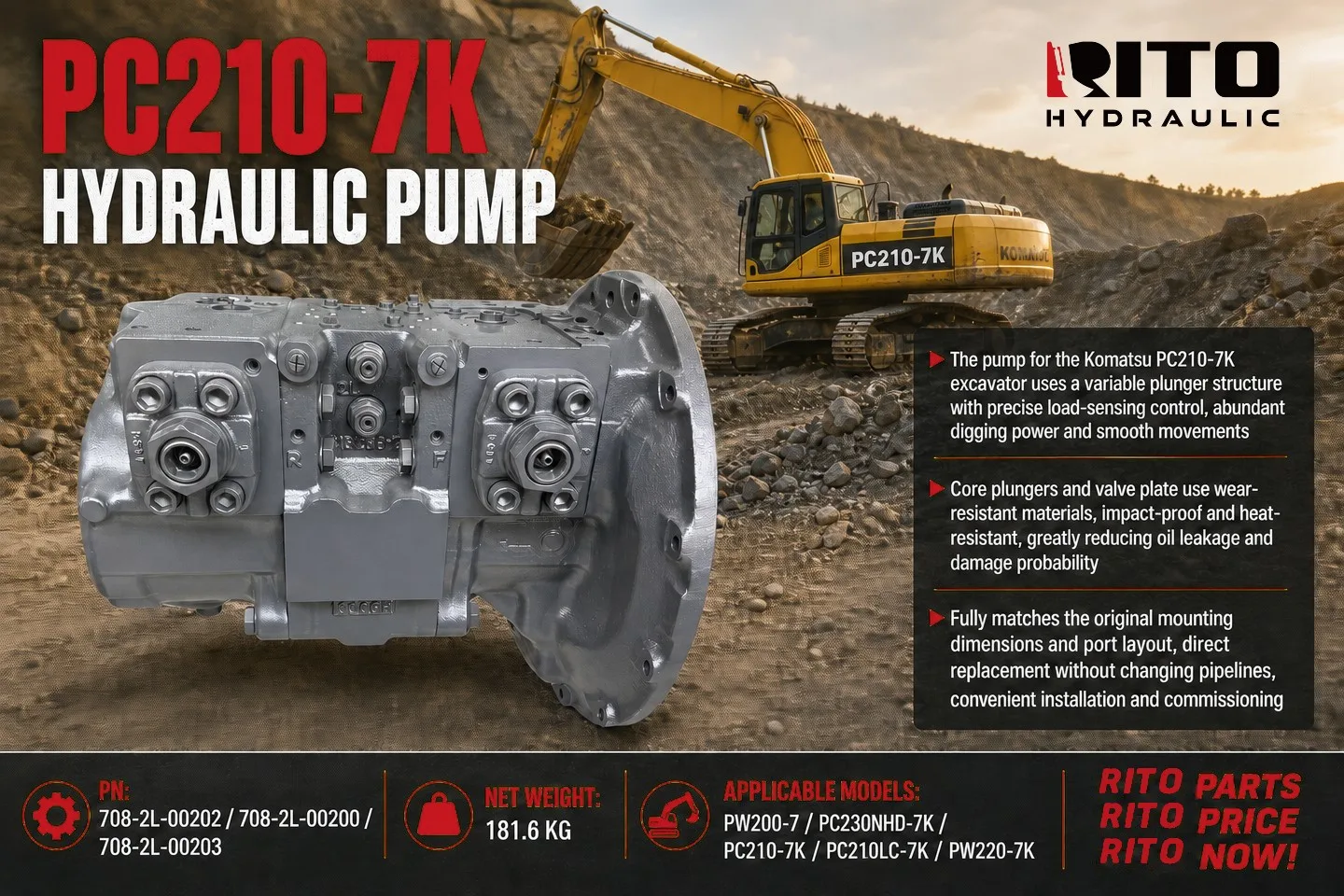
- The PC210-7K main pump is referenced as 708-2L-00202, with 708-2L-00200 and 708-2L-00203 as companion numbers.
- It also fits PC210LC-7K, PC230NHD-7K, PW200-7 and PW220-7K — a shared 20-ton-class pump family.
- Weak digging is not automatically a pump fault. Relief valves, control valves and cylinders can produce identical symptoms.
- Run the differential diagnosis in this guide before you order a 181.6 kg pump.
- It is a variable plunger, load-sensing pump — designed for precise, on-demand flow and smooth movement.
- Original mounting dimensions and port layout allow direct replacement without changing pipelines.
Table of Contents
- 1. The Dash-7 20-Ton Workhorse
- 2. PC210-7K Pump Specifications
- 3. Is It Really the Pump? Differential Diagnosis
- 4. Six Signs of a Failing PC210-7K Pump
- 5. Variable Plunger Load-Sensing in the Field
- 6. The Dash-7 Reality: Keeping a 20-Ton Machine Running
- 7. Rebuild vs Replace: A Decision Framework
- 8. What to Send for an Accurate Quote
- 9. FAQ
- 10. Get Your PC210-7K Pump Quote
1. The Dash-7 20-Ton Workhorse
The Komatsu PC210-7K is one of the most common 20-ton machines still earning a living on job sites worldwide. It is simple, strong and repairable — which is exactly why owners keep them running. But when productivity drops, the main pump is usually the first suspect, and replacing it is a serious decision: the assembly weighs around 181.6 kg and the machine is out of service while you wait.
Before you spend on a pump, it pays to be sure. This guide is written for the fleet owner, dealer and repair shop who needs to move from "the machine feels weak" to a confirmed diagnosis — and then to the right replacement. If you are comparing Komatsu excavator parts, start here.
2. PC210-7K Pump Specifications
| Parameter | Specification |
|---|---|
| Primary application | Komatsu PC210-7K (20-ton class) |
| Other models | PC210LC-7K, PC230NHD-7K, PW200-7, PW220-7K |
| Reference part number | 708-2L-00202 |
| Companion numbers | 708-2L-00200 / 708-2L-00203 |
| Type | Variable plunger, load-sensing main pump |
| Net weight | 181.6 kg |
| Mounting | Original dimensions & port layout — direct replacement |
Confirm against the plate on your original pump and your machine serial number — part numbers can vary with production batch.
3. Is It Really the Pump? Differential Diagnosis
This is the step most owners skip — and it is why perfectly good pumps are sometimes replaced. Weak, slow or hot operation can come from several places in the circuit. Work through the table before condemning the pump:
| What you see | Pump? | Check this first |
|---|---|---|
| All functions weak and slow | Possible | Main relief pressure; system pressure test |
| One function weak, others normal | Unlikely | That circuit's spool in the control valve; cylinder seals |
| Fast functions, no power under load | Possible | Load-sensing / regulator setting; relief leakage |
| Oil overheats with normal speed | Possible | Cooler, oil level, then case-drain flow |
| Pump whines, machine still works | Possible | Suction strainer, air ingress, oil viscosity |
A simple pressure and flow test at the pump outlet tells you most of the story. If pressure holds and flow meets specification, the pump is often fine — and the fault lies downstream.
4. Six Signs of a Failing PC210-7K Pump
When the diagnosis does point to the pump, these are the signals that confirm it:
- 1. Slow cycle times across all functions, worsening over weeks.
- 2. Weak digging — the machine cannot hold pressure under load.
- 3. High oil temperature and a hot case-drain line (internal leakage makes heat).
- 4. Whining or knocking from the pump, especially under load.
- 5. Metal particles in the return filter — the most urgent warning.
- 6. Unstable pressure that drifts instead of holding steady.
5. Variable Plunger Load-Sensing in the Field
The PC210-7K pump uses a variable plunger structure with load-sensing control. In plain terms, it senses the pressure the work function needs and adjusts flow to match — giving abundant digging power and smooth, precise movement instead of a fixed, wasteful output.
Its core plungers and valve plate are built from wear-resistant material and designed to be impact-proof and heat-resistant, which greatly reduces oil leakage and the probability of damage. That matters on a machine that spends its life in rock and dust: the pump is only as good as the surfaces that seal it.
6. The Dash-7 Reality: Keeping a 20-Ton Machine Running
Dash-7 machines are now well out of warranty, yet they remain highly productive — which creates a specific parts challenge. Three practical points for owners:
- Numbers are stable, stock is not. The pump family (708-2L-00202 / 00200 / 00203) is well established, but availability varies — confirm before the machine goes down.
- Age shifts the risk. On a high-hour machine, a failed pump often signals a system that has run with contaminated or overheated oil. Clean the circuit before fitting a new unit.
- Downtime dominates the maths. On any production machine, the cost of being stopped usually exceeds the price difference between a cheap pump and a verified one.
Related 20-ton-class components are worth checking at the same time — a worn Komatsu PC200 swing motor or a leaking swing drive unit will cost you twice if it fails after the machine is back at work.
7. Rebuild vs Replace: A Decision Framework
| Situation | Better route |
|---|---|
| Housing and shaft confirmed sound; clean workshop available | Rebuild may be viable |
| Production machine, needs to work next week | Verified complete assembly |
| Metal debris found in the system | Replace + full system flush |
| Machine being prepared for resale | Verified assembly (protects the sale) |
Optionally, review the wider excavator hydraulic parts range to plan the whole repair in one order.
8. What to Send for an Accurate Quote
- 1. Machine model (PC210-7K / PC210LC-7K) and serial number.
- 2. The part number from the pump's ID plate (reference: 708-2L-00202).
- 3. Photos of the pump — side view, mounting flange and ID plate.
- 4. The test result / symptom (pressure, flow, temperature, noise).
- 5. Shipping requirement — sea or air, destination and lead time.
Our full range also covers Kawasaki-series pumps, swing motors, travel motors and control valves. Learn more about RITO HYDRAULIC.
9. FAQ
Q1: What is the part number of the PC210-7K hydraulic pump?
The reference number is 708-2L-00202, with 708-2L-00200 and 708-2L-00203 as companion numbers. Confirm against your pump's ID plate and machine serial number.
Q2: What other machines use this pump?
It serves the PC210-7K along with PC210LC-7K, PC230NHD-7K, PW200-7 and PW220-7K — a shared 20-ton-class pump family.
Q3: How much does the pump weigh?
Approximately 181.6 kg — plan for lifting equipment during removal and installation.
Q4: How do I know if the pump or the valve is at fault?
Run a pressure and flow test at the pump. If all functions are weak, suspect the pump or main relief; if only one function is weak, the fault is usually in that circuit's control valve spool or cylinder seal.
Q5: What type of pump is it?
A variable plunger, load-sensing main pump. It adjusts flow to demand for precise control and strong digging power.
Q6: Can it be installed without changing pipelines?
Yes. The pump matches the original mounting dimensions and port layout, so it is a direct replacement without pipeline changes.
Q7: Should I flush the system when replacing the pump?
Always. Flush the system and replace the return filter and suction strainer — debris from a failed pump will damage the new one.
Q8: My machine is a high-hour Dash-7 — is a rebuild worth it?
Only if the housing and shaft are confirmed sound and a clean workshop is available. On a production machine, a verified complete assembly is usually the lower total-cost option once downtime is counted.
Q9: Why does my PC210-7K run hot?
Common causes are a clogged oil cooler, low oil level, wrong oil grade, or internal pump leakage converting flow to heat. Investigate any sustained temperature above 80°C.
Q10: How can I be sure the pump is good before it ships?
Ask for the per-unit test report. A verified supplier bench-tests the pump for flow, pressure and leakage and provides the data before shipment.
10. Get Your PC210-7K Pump Quote
Send us your machine model, serial number and the part number from your pump plate — plus a couple of photos — and our team will confirm the correct number, provide a test-report sample and quote lead time the same day. RITO HYDRAULIC supplies complete, individually tested pumps, swing motors, travel motors and control valves for Komatsu, Caterpillar, Hitachi, Hyundai, Kobelco, Doosan and Kawasaki / Rexroth-series machines, with export packing and a 6–12 month warranty.
Contact our team for a same-day quotation.
- CAT 330GC Final Drive — Which Part Number Fits and What Should You Check Before You Buy?
- Why Do Customers Need the TM40 Travel Assembly? When It Is Used, What It Does, and What It Changes
- Komatsu PC300-8 / PC350-8 Hydraulic Pump: Which 708-2G Number Fits, and Why PC300-7 Numbers Keep Appearing
- Why Does a CAT 320C / 320D Hydraulic Pump Lose Power Under Heavy Load?
- Why Does Your CAT 312C Need the SBS80 Hydraulic Pump?