

Should You Keep a Spare Hydraulic Pump in Stock? A Fleet Owner's Decision Guide (2026)


Author
JERY WANG
Guangzhou Rito Hydraulic Co.,Ltd., located in Guangzhou, China, is a leading manufacturer and distributor of hydraulic pumps, final drives, swing motors, and main control valves for earthmoving machinery. We supply genuine, OEM, and high-quality aftermarket parts.
We are committed to continuously sharing our expertise regarding construction machinery and excavator hydraulic systems. Our goal is to help you gain a deeper understanding of equipment principles and applications—enabling you to work more efficiently—while also showcasing our professional knowledge and capabilities. We invite you to learn more about us.
Choose us, and you will enjoy the best service, the most favorable prices, and the most reliable supplier!
Marie R. Winters


Quick Answer
Key Takeaways
- The decision is not "is a spare expensive?" but "what does one week of downtime cost me?"
- If a stopped machine halts production or feeds other machines, a spare pump pays for itself on the first avoided failure.
- Priority order for stocking: main pump first, then swing or travel motor, then control valve, then filters and seals.
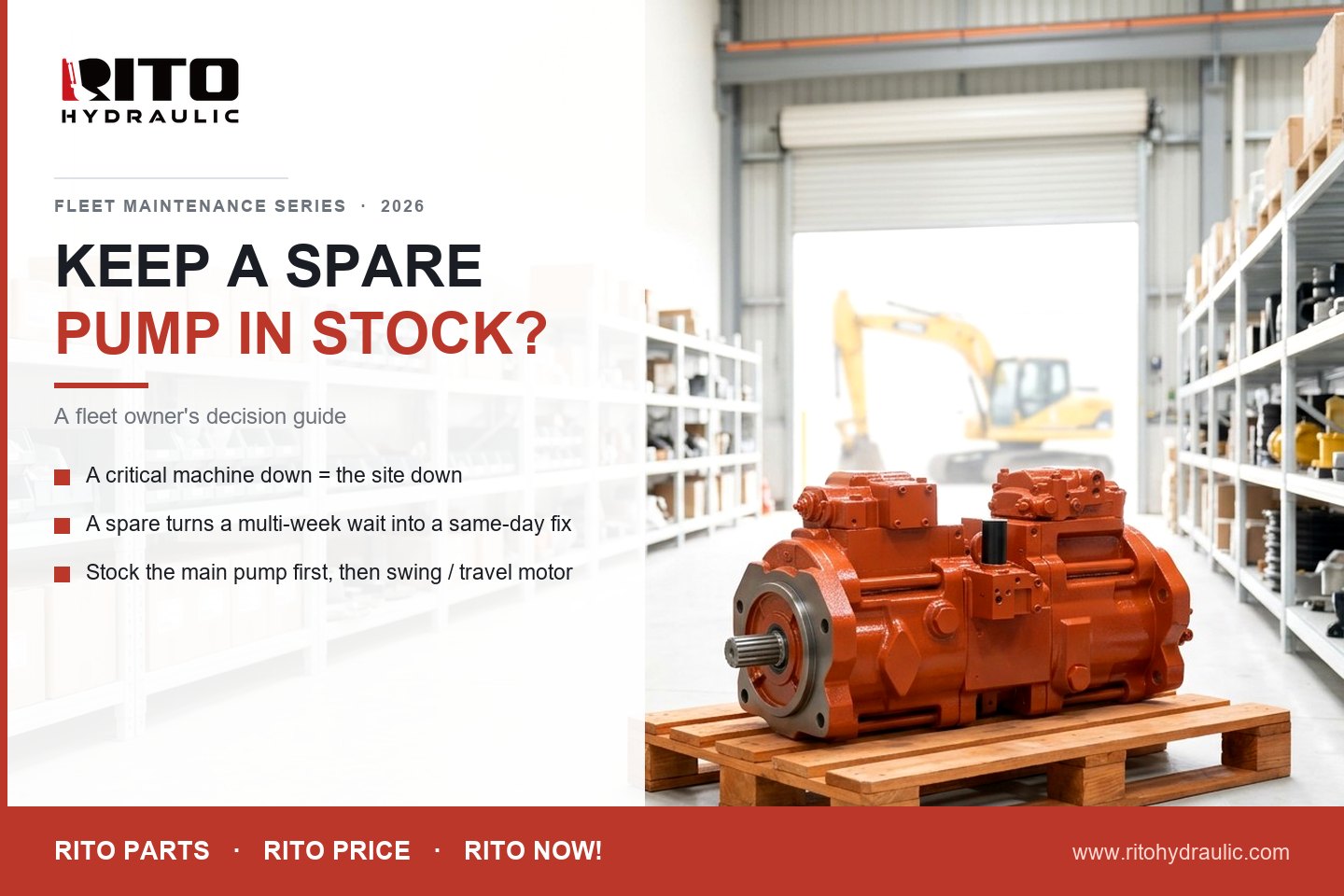
- Emergency sourcing of a 180 kg assembly by air freight costs far more than holding one on the shelf.
- A spare must be stored correctly — dry, sealed and protected from dust — or it will not be ready when you need it.
- For low-utilisation machines near good local support, renting or borrowing can beat buying.
Table of Contents
- 1. The 4 a.m. Failure
- 2. The True Cost of Waiting for a Pump
- 3. Which Machines Deserve a Spare?
- 4. What to Stock First: A Priority Order
- 5. Holding Cost vs Emergency Cost
- 6. How to Store a Spare So It's Ready
- 7. When Renting or Borrowing Beats Buying
- 8. A 60-Second Decision Framework
- 9. FAQ
- 10. Build Your Spare-Parts Plan
1. The 4 a.m. Failure
Hydraulic pumps do not fail at convenient times. They fail in the middle of a shift, on a machine that other machines depend on, with a deadline already tight. And in that moment, the only two questions that matter are: do we have a pump on the shelf, or do we start a multi-week sourcing process?
This is the quiet difference between fleets that keep working and fleets that lose weeks. Holding a spare is not hoarding — it is insurance against the one failure you cannot afford. This guide gives fleet owners a clear way to decide what to stock, and how to keep it ready. If you are building a plan around excavator hydraulic parts, start here.
2. The True Cost of Waiting for a Pump
Waiting for a pump is never just a parts delay. The impact multiplies through the operation:
| Scenario | Real impact |
|---|---|
| Machine is the production bottleneck | Every day stopped is a day of lost output for the whole site |
| Machine feeds haul trucks / loaders | Downtime spreads to machines and crew waiting on it |
| Pump sourced by air freight | Emergency freight costs many times the standard shipping rate |
| Contract / penalty deadlines | Late delivery can trigger penalties far bigger than the part |
| Reputation with the client | A missed deadline can cost the next contract, not just this one |
The lesson is simple: the spare's stored value is tiny compared with the value of the downtime it prevents.
3. Which Machines Deserve a Spare?
You cannot stock a pump for every machine — and you should not try. A machine earns a spare when it meets two or more of these conditions:
- High utilisation — it runs long shifts, day after day.
- Production-critical — if it stops, the site slows or stops.
- Remote location — far from dealers, ports or fast transport.
- Slow parts lead time — the model is older or the pump is less common.
- High replacement frequency — a known weak point on that model.
A machine that is lightly used and sits near a good local parts network rarely justifies a spare. A 20-hour-a-day quarry machine almost always does.
4. What to Stock First: A Priority Order
Budget is finite, so stock in the order that removes the most downtime risk per unit held:
| Priority | Component | Why |
|---|---|---|
| 1 | Main hydraulic pump | Stops the whole machine; longest lead time |
| 2 | Swing motor / travel motor | Disables a core function; also long lead time |
| 3 | Control valve assembly | Loss of one or more functions; high value |
| 4 | Filters, seals, hoses | Cheap to hold, always needed |
Start at the top and work down. One well-chosen pump in stock is worth more than a shelf of low-value items that delays the repair you cannot make.
5. Holding Cost vs Emergency Cost
Holding a spare has a cost: capital tied up, storage space, and the need to keep it protected. But set it against the alternative:
- Emergency air freight for a heavy assembly can cost many times standard sea freight — often more than the difference between buying now and buying later.
- Downtime is the largest cost of all, and it is usually measured per day, not per part.
- A spare bought in advance costs approximately the same as one bought later — the only difference is when you need it and how fast it must arrive.
For a critical machine, the maths usually favours holding one spare. For a fleet of identical machines, a shared spare pool can cover several units at once.
6. How to Store a Spare So It's Ready
A spare that has been sitting badly is not a spare. Protect it:
- Keep it dry and sealed. Moisture corrodes the internals even when the pump is not running.
- Plug all ports. Cap the inlet, outlet and case-drain to stop dust and insects entering.
- Store on a pallet, off the floor — never directly on concrete in a damp area.
- Protect the drive shaft. Keep the shipping cover on; impact on the spline can ruin it.
- Rotate stock. If you replace a pump in service, move the spare into service and re-order — a spare that never rotates can sit for years.
- Record it. Note the part number, date of purchase and test report alongside the unit.
7. When Renting or Borrowing Beats Buying
Buying is not always the answer. Consider alternatives when:
- The machine is low-utilisation or nearing the end of its life.
- You are close to a trusted supplier with short lead times.
- The failure is one-off and unlikely to recur on that machine.
- Your fleet has several identical machines — a single shared spare may be enough.
In these cases, a good supplier relationship — fast quotes, confirmed stock and quick shipping — can substitute for holding stock yourself.
8. A 60-Second Decision Framework
- 1. Is the machine production-critical? No → likely no spare.
- 2. Could a week of downtime exceed the cost of the spare? No → likely no spare.
- 3. Is the lead time long or the location remote? Yes → strong case for a spare.
- 4. Do several machines share the same pump? Yes → hold one shared spare.
- 5. If two or more answers point to "yes", buy the spare — and store it properly.
9. FAQ
Q1: Should I keep a spare hydraulic pump in stock?
If the machine is production-critical, runs long shifts, or is far from support, yes. A spare converts a multi-week emergency sourcing event into a same-day repair. For low-utilisation machines near good local support, it is usually unnecessary.
Q2: Which spare should I stock first?
Start with the main hydraulic pump — it stops the whole machine and has the longest lead time. Then a swing or travel motor, then a control valve, then filters and seals.
Q3: How long can a spare pump be stored?
Indefinitely if stored correctly — dry, sealed, ports plugged, off the floor and protected from impact. Poor storage, not time, is what ruins a spare.
Q4: Does a stored pump need maintenance?
Keep it sealed and dry, inspect the packaging periodically, and check that port plugs and the shaft cover are intact. Rotate stock when a unit goes into service.
Q5: Is it cheaper to buy a spare later or now?
The unit costs roughly the same either way — the difference is speed. Emergency air freight and downtime usually make "buy later" the more expensive path.
Q6: How many spares does a fleet need?
One per critical machine, or a shared pool for several identical machines. Base it on how many machines are down at once if a pump fails.
Q7: Should the spare be a new pump or a rebuild?
For a critical machine, a complete, individually tested assembly is the safer choice — it carries a warranty and known performance. Keep a rebuild only for low-risk, non-critical machines.
Q8: How do I make sure the spare is the right one?
Record the machine model, serial number and the part number from the pump plate when you order. Keep that record with the unit so a future fit is confirmed in minutes.
Q9: Can a spare be shipped with the rest of my parts order?
Yes — consolidating the spare with a normal parts order shares the freight and is far cheaper than a separate emergency shipment.
Q10: How do I know the spare is good when it arrives?
Ask for a per-unit test report covering flow, pressure and leakage, and inspect the packing on arrival. Store it correctly and it will be ready when you need it.
10. Build Your Spare-Parts Plan
Tell us which machines are critical to your operation and how long a failure could stop you. Our team will help you choose the right spare — pump, swing motor, travel motor or control valve — and confirm stock, test reports and shipping the same day. RITO HYDRAULIC supplies complete, individually tested components for Hitachi, Komatsu, Caterpillar, Hyundai, Kobelco, Doosan and Kawasaki / Rexroth-series machines, with export packing and a 6–12 month warranty.
Contact our team to build a plan — and learn more about RITO HYDRAULIC.
- CAT 330GC Final Drive — Which Part Number Fits and What Should You Check Before You Buy?
- Why Do Customers Need the TM40 Travel Assembly? When It Is Used, What It Does, and What It Changes
- Komatsu PC300-8 / PC350-8 Hydraulic Pump: Which 708-2G Number Fits, and Why PC300-7 Numbers Keep Appearing
- Why Does a CAT 320C / 320D Hydraulic Pump Lose Power Under Heavy Load?
- Why Does Your CAT 312C Need the SBS80 Hydraulic Pump?