
Gear Pump vs Piston Pump: How to Choose the Right Hydraulic Pump for Your Machine (2026)


Author
JERY WANG
Guangzhou Rito Hydraulic Co.,Ltd., located in Guangzhou, China, is a leading manufacturer and distributor of hydraulic pumps, final drives, swing motors, and main control valves for earthmoving machinery. We supply genuine, OEM, and high-quality aftermarket parts.
We are committed to continuously sharing our expertise regarding construction machinery and excavator hydraulic systems. Our goal is to help you gain a deeper understanding of equipment principles and applications—enabling you to work more efficiently—while also showcasing our professional knowledge and capabilities. We invite you to learn more about us.
Choose us, and you will enjoy the best service, the most favorable prices, and the most reliable supplier!
Marie R. Winters


Quick Answer
Key Takeaways
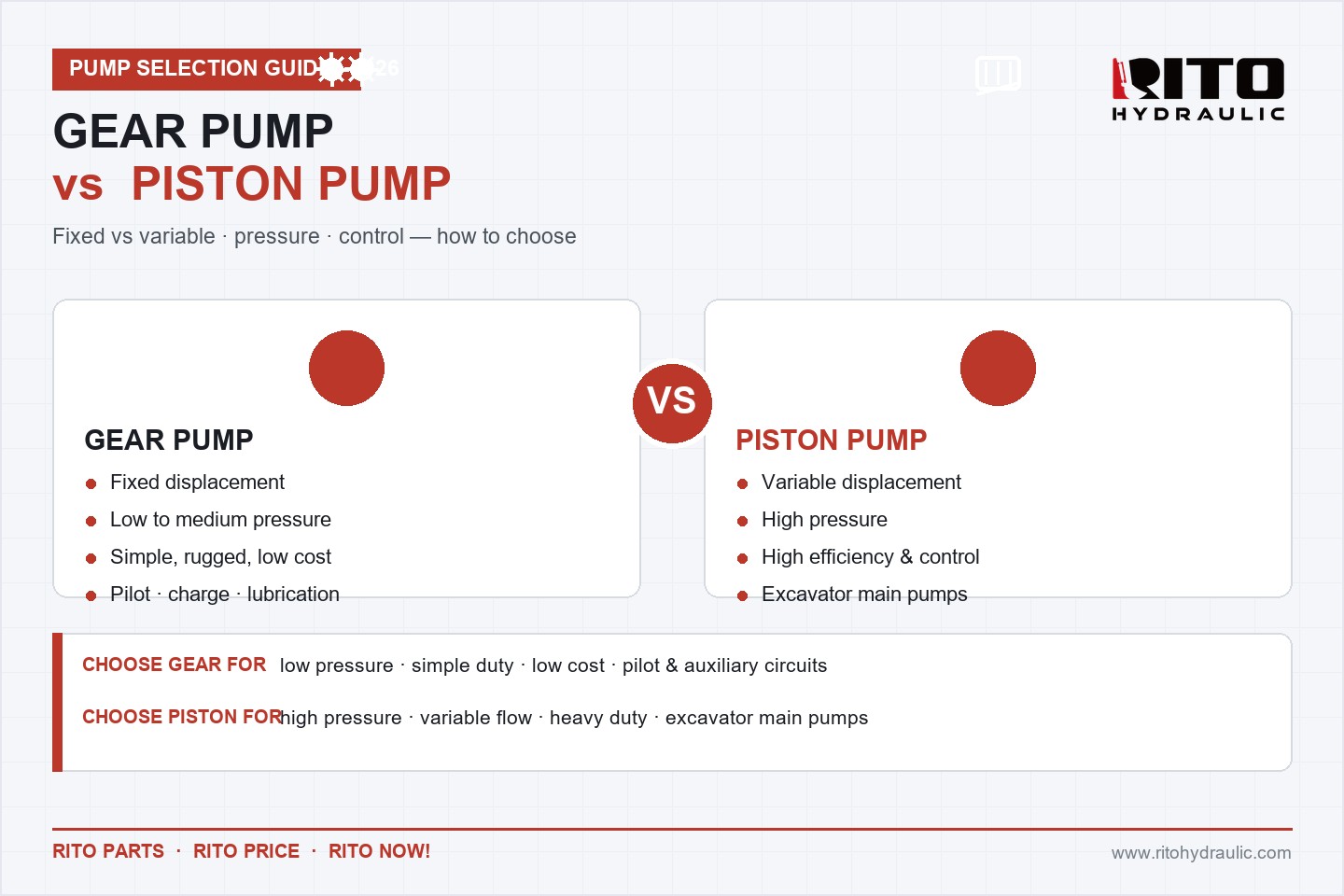
- Gear pump — fixed displacement, low-to-medium pressure, simple, rugged, low cost.
- Piston pump — variable displacement, high pressure, high efficiency, precise control.
- Gear pumps suit pilot, charge, lubrication and light-duty circuits; piston pumps suit main hydraulic circuits on heavy machines.
- The decision is driven by required pressure, flow control, duty cycle and sensitivity to contamination.
- They are usually not interchangeable — the whole circuit is designed around one type.
- Match the type, mounting, flow and pressure to the machine — not the other way round.
Table of Contents
- 1. Two Technologies, Two Jobs
- 2. How Each Pump Works
- 3. Head-to-Head Comparison
- 4. Where Gear Pumps Win
- 5. Where Piston Pumps Win
- 6. How to Tell Which Your Machine Uses
- 7. The 6 Factors That Decide
- 8. Buying Mistakes to Avoid
- 9. FAQ
- 10. Get the Right Pump
1. Two Technologies, Two Jobs
Hydraulic pumps fall into a few families, and two dominate mobile equipment: the gear pump and the axial piston pump. They are not competing versions of the same thing — they are built for different jobs.
- Gear pumps move a fixed volume of oil per revolution at modest pressure. They are simple, robust and inexpensive.
- Piston pumps use pistons against a swashplate and can change their displacement, so they deliver high pressure and variable flow on demand.
Understanding which job each is designed for is the whole decision. If you are comparing excavator hydraulic parts, this is the first question to settle.
2. How Each Pump Works
Gear pump. Two meshing gears rotate inside a housing. Oil is trapped between the gear teeth and the housing wall and carried from the inlet side to the outlet side. Because the volume trapped per revolution is fixed, the pump delivers a fixed flow for a given speed — and pressure rises only as the load resists that flow.
Axial piston pump. Pistons reciprocate inside a cylinder barrel against an angled swashplate. By changing the swashplate angle, the pump changes how much oil each stroke displaces — so its flow is variable. This is what allows an excavator to deliver only the flow the work needs, at high pressure, with good efficiency.
3. Head-to-Head Comparison
| Point | Gear Pump | Piston Pump |
|---|---|---|
| Displacement | Fixed | Variable |
| Pressure | Low to medium | High |
| Efficiency | Moderate | High |
| Cost | Low | Higher |
| Contamination tolerance | Higher | Lower (needs clean oil) |
| Typical use | Pilot, charge, lubrication, light machinery | Excavator & heavy equipment main circuits |
4. Where Gear Pumps Win
- Simple, low-pressure duty where precise flow control is not required.
- Pilot and charge circuits, lubrication and small auxiliary functions.
- Cost-sensitive machines — small excavators, loaders, attachments and utility equipment.
- Tolerant environments — gear pumps cope with less-than-perfect oil better than piston pumps.
- Ease of service — fewer precision parts, simpler design.
5. Where Piston Pumps Win
- High-pressure main circuits — excavators, cranes and mining equipment.
- Variable flow on demand — only the oil the work needs, for efficiency and precise control.
- Load-sensing and pressure control — the pump responds to what the machine is doing.
- Sustained heavy duty — designed to run long shifts under high load.
- Fuel efficiency — variable displacement avoids pumping (and heating) unused oil.
6. How to Tell Which Your Machine Uses
- 1. Check the nameplate on the pump and the machine manual.
- 2. Look at the shape: a simple two-piece body with two gear covers is usually a gear pump; a large body with a control regulator and multiple sections is usually a piston pump.
- 3. Check for a regulator or control valve block on the pump — a sign of a variable piston pump.
- 4. Note the system pressure: high-pressure machines almost always use piston pumps.
- 5. Photograph the nameplate and send it with the machine model — that settles it.
7. The 6 Factors That Decide
| Factor | Leans gear | Leans piston |
|---|---|---|
| Required pressure | Low | High |
| Flow control needed | Fixed flow is fine | Variable / on demand |
| Duty cycle | Light / intermittent | Continuous heavy duty |
| Oil cleanliness | Less critical | Critical |
| Budget | Tight | Invest for performance |
| Efficiency priority | Low | High |
Almost every excavator main pump decision lands on the piston side — and gear pumps appear as the pilot or auxiliary pump on the same machine.
8. Buying Mistakes to Avoid
- 1. Trying to fit a gear pump where a piston pump belongs (or vice versa) — the circuit is designed for one type.
- 2. Ignoring the control variant on a piston pump (load-sensing, pressure settings).
- 3. Buying by photo or model name without the nameplate number and machine serial.
- 4. Accepting a cheap unverified unit with no test report or warranty.
- 5. Not flushing the system when replacing a pump — debris kills the new one.
- 6. Forgetting that a piston pump needs clean oil — contamination is its biggest enemy.
9. FAQ
Q1: What is the main difference between a gear pump and a piston pump?
A gear pump has fixed displacement and works at low-to-medium pressure; a piston pump has variable displacement and delivers high pressure with flow on demand.
Q2: Which pump is better?
Neither is "better" — they suit different jobs. Gear pumps win on simplicity and cost; piston pumps win on pressure, efficiency and control. Match the pump to the application.
Q3: Why do excavators use piston pumps?
Because they need high pressure and variable flow for powerful, precise, efficient operation. A gear pump cannot deliver the same pressure or on-demand control in a main circuit.
Q4: Can I replace a piston pump with a gear pump?
Practically, no. The circuit, control system and pressure requirements are designed around one type. Substituting the wrong type will not perform correctly and can damage the system.
Q5: Where are gear pumps used on an excavator?
Typically for pilot circuits, charge pumps, lubrication and auxiliary functions — not as the machine's main work pump.
Q6: Are piston pumps more sensitive to contamination?
Yes. Their precision clearances are measured in microns, so clean oil and correct filtration are essential. Gear pumps are more tolerant but still need clean oil to last.
Q7: Which pump is cheaper?
Gear pumps are generally much cheaper to buy. Piston pumps cost more but deliver performance, efficiency and control that gear pumps cannot — so the "cheaper" pump is not the lower-cost choice if it cannot do the job.
Q8: How do I know which pump my machine has?
Check the pump nameplate and the machine manual, look for a control regulator (a sign of a piston pump), and confirm the system pressure. Send the nameplate photo for a definitive answer.
Q9: Do gear pumps produce variable flow?
No. A gear pump's flow is fixed for a given speed. Flow is varied by other means (such as valves), whereas a piston pump can vary its own displacement.
Q10: What should I send to get the right pump?
The machine model and serial number, the pump nameplate number, clear photos, the control variant (for piston pumps), and your shipping requirement.
10. Get the Right Pump
RITO HYDRAULIC supplies complete, individually tested axial piston pumps and the auxiliary gear pumps that support them, for Kawasaki, Komatsu, Hitachi, Caterpillar, Hyundai, Kobelco, Doosan and Rexroth-series machines — with per-unit test reports, export packing and a 6–12 month warranty.
Send us your machine model and the part number from the pump plate, and we will confirm the correct type, fit and lead time the same day. Contact our team or learn more about RITO HYDRAULIC.
- CAT 330GC Final Drive — Which Part Number Fits and What Should You Check Before You Buy?
- Why Do Customers Need the TM40 Travel Assembly? When It Is Used, What It Does, and What It Changes
- Komatsu PC300-8 / PC350-8 Hydraulic Pump: Which 708-2G Number Fits, and Why PC300-7 Numbers Keep Appearing
- Why Does a CAT 320C / 320D Hydraulic Pump Lose Power Under Heavy Load?
- Why Does Your CAT 312C Need the SBS80 Hydraulic Pump?