

Excavator Swing System Fault Diagnosis: Swing Motor or Swing Gearbox — A Field Guide (2026)


Author
JERY WANG
Guangzhou Rito Hydraulic Co.,Ltd., located in Guangzhou, China, is a leading manufacturer and distributor of hydraulic pumps, final drives, swing motors, and main control valves for earthmoving machinery. We supply genuine, OEM, and high-quality aftermarket parts.
We are committed to continuously sharing our expertise regarding construction machinery and excavator hydraulic systems. Our goal is to help you gain a deeper understanding of equipment principles and applications—enabling you to work more efficiently—while also showcasing our professional knowledge and capabilities. We invite you to learn more about us.
Choose us, and you will enjoy the best service, the most favorable prices, and the most reliable supplier!
Marie R. Winters


Quick Answer
Key Takeaways
- The swing system has three main components: the swing motor (hydraulic), the swing gearbox (reduction drive), and the swing control valve. Each fails differently.
- Slow swing with full power elsewhere usually means the swing motor is worn internally or the relief valve is weak — not the gearbox.
- Jerky, binding or noisy rotation — especially with metal sounds — points to the swing gearbox (worn gears or bearings).
- Superstructure creep on a slope, or a harsh start/stop feel, points to the gearbox parking brake.
- Swing on one side only, or after warm-up only, often means a control valve or seal issue rather than a mechanical fault.
- RITO HYDRAULIC supplies both swing motors and complete swing gearboxes — correct identification lets you order exactly the right assembly.
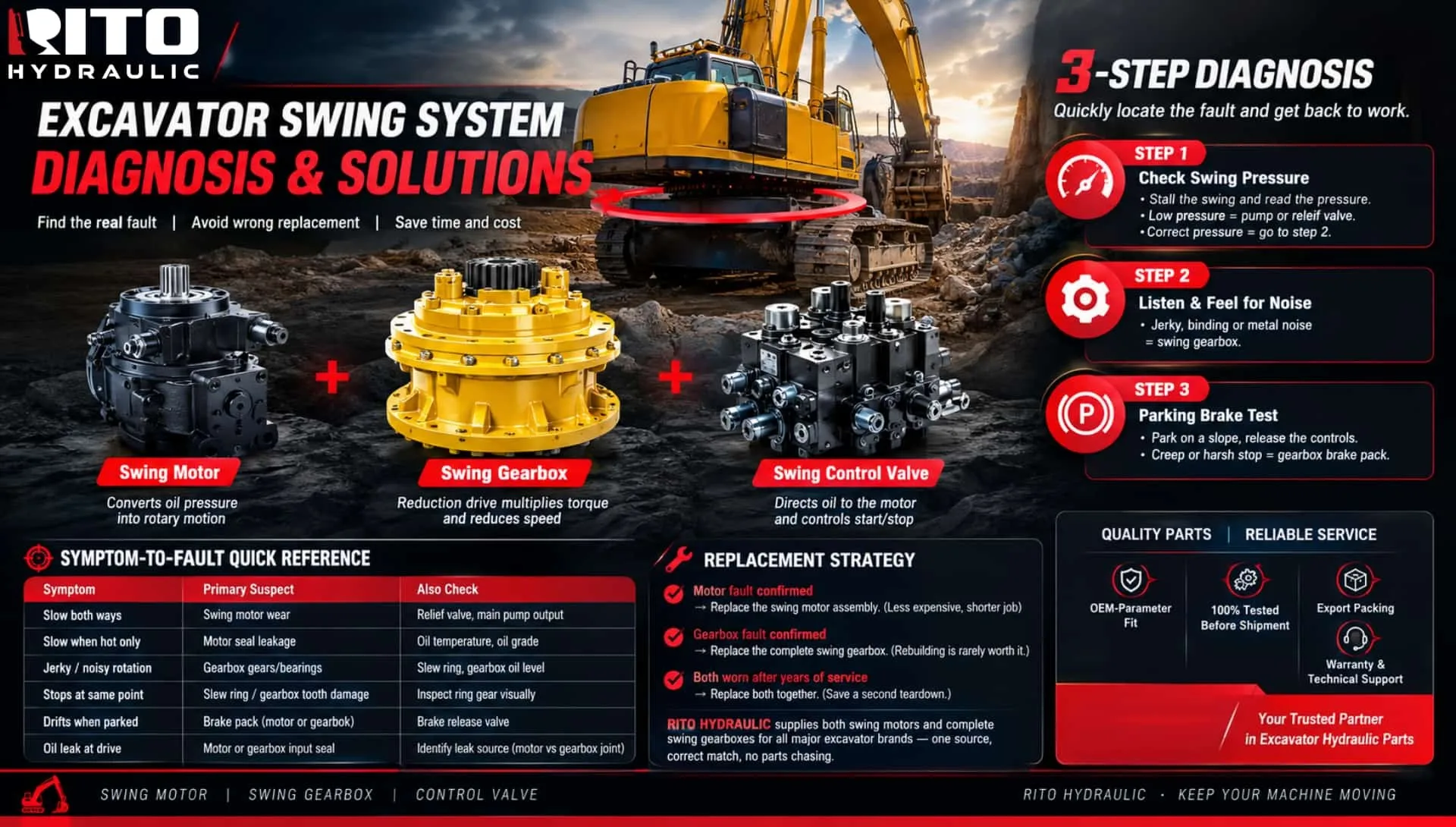
Table of Contents
- How the Swing System Works — Three Components, One Motion
- Diagnostic Step 1: Is It Hydraulic or Mechanical?
- Diagnostic Step 2: Swing Motor or Swing Gearbox?
- Diagnostic Step 3: The Parking Brake Test
- Symptom-to-Fault Quick Reference Table
- What a Worn Swing Motor Feels Like
- What a Worn Swing Gearbox Feels Like
- Replacement Strategy: Motor, Gearbox, or Both?
- FAQ
- Get Your Swing System Parts Quote
1. How the Swing System Works — Three Components, One Motion
The swiswing systemrns the excavator's upper structure. Three components work together:
- Swing motor — a hydraulic motor that converts oil pressure into rotary motion.
- Swing gearbox — a reduction drive that multiplies the motor's torque and reduces its speed to drive the slew ring.
- Swing control valve — directs oil to the motor and controls start/stop smoothness.
Because the symptoms of a failing motor and a failing gearbox overlap, owners frequently replace the wrong part. A swiswing motorap that does not fix a gearbox problem means two repairs and two sets of downtime. This guide gives you a practical field diagnosis before you spend.
2. Diagnostic Step 1: Is It Hydraulic or Mechanical?
Run this test first — it separates hydraulic faults (motor, valve, pump) from mechanical faults (gearbox, slew ring):
- Position the bucket to create a load against the swing — stall the swing fully.
- Read the swing pressure on a test gauge at the motor port.
- Compare it with the machine spec (typically 200–300 bar on most excavators).
If swing pressure is low (below spec): the fault is hydraulic — worn swing motor internals, a weak relief valve, or the main pump not delivering enough. If pressure holds to spec but the machine still won't turn smoothly: the fault is mechanical — the gearbox or slew ring.
3. Diagnostic Step 2: Swing Motor or Swing Gearbox?
Once you know the fault is in the drive unit, distinguish motor from gearbox:
| Observation | Likely Fault |
|---|---|
| Slow swing in both directions, full power elsewhere | Worn swing motor (internal leakage) or relief valve |
| Slow swing only after the machine warms up | Swing motor seal leakage (worse when hot) |
| Jerky, binding rotation with metal noise | Swing gearbox — worn gears or bearings |
| Rotation stops at the same point each time | Slew ring or gearbox tooth damage at that position |
| Swing works, but the upper structure drifts when parked | Gearbox parking brake or motor brake valve |
4. Diagnostic Step 3: The Parking Brake Test
The parking brake holds the superstructure when the machine is parked or working on a slope. A simple field test isolates it:
- Park the machine on a gentle slope with the swing brake engaged.
- Release the controls and observe whether the upper structure creeps.
- If it creeps, engage the swing and stop it mid-rotation — feel for a harsh grab or a delayed hold.
Creep or harsh engagement points to the gearbox brake pack (or the motor's brake-release valve). On excavators where the brake sits inside the swing motor, the motor is the suspect; on designs where the brake is in the gearbox, the gearbox is the suspect. Check your machine's construction before ordering parts.
5. Symptom-to-Fault Quick Reference Table
| Symptom | Primary Suspect | Also Check |
|---|---|---|
| Slow both ways | Swing motor wear | Relief valve, main pump output |
| Slow when hot only | Motor seal leakage | Oil temperature, oil grade |
| Jerky / noisy rotation | Gearbox gears/bearings | Slew ring, gearbox oil level |
| Stops at same point | Slew ring / gearbox tooth damage | Inspect the ring gear visually |
| Drifts when parked | Brake pack (motor or gearbox) | Brake release valve |
| Oil leak at drive | Motor or gearbox input seal | Identify leak source (motor vs gearbox joint) |
6. What a Worn Swing Motor Feels Like
A worn swing motor is a hydraulic problem: internal clearances open up, oil bypasses the pistons, and the motor produces less torque for the same pressure. Operators describe it as the swing "losing power" — slower under load, weaker when digging with the machine rotated to one side, and noticeably worse once the oil is hot. Pressure testing confirms it: swing pressure below spec with the pump healthy points straight at the motor.
7. What a Worn Swing Gearbox Feels Like
A worn swing gearbox is a mechanical problem: gear teeth chip, bearings develop play, and the reduction drive binds or knocks. Operators describe it as the swing "catching" or "jumping" — a vibration or metallic click through the cab, sometimes at the same point every rotation. Unlike motor wear, gearbox wear does not improve when the machine is cold, and it does not respond to pressure changes. If you hear metal, stop and inspect before the damage spreads to the slew ring.
8. Replacement Strategy: Motor, Gearbox, or Both?
Once you have identified the failed component, the replacement decision is straightforward:
- Motor fault confirmed — replace the swing motor assembly. It is the less expensive of the two and a shorter job.
- Gearbox fault confirmed — replace the complete swing gearbox. Rebuilding a gearbox in the field is rarely worth it; hidden bearing and gear damage surfaces weeks later.
- Both worn after years of service — replacing both together saves a second teardown. Many owners choose this when the machine is already in the shop.
When ordering, send the machine model, serial number, and the part number from the motor plate or gearbox housing. RITO HYDRAULIC supplies both swing motors and complete swing gearboxes for all major excavator brands — one source, correct match, no parts chasing.
9. FAQ
Q1: How do I know if my excavator swing problem is the motor or the gearbox?
Run the three-step test: stall the swing and read pressure (low pressure = hydraulic/motor fault; correct pressure = mechanical/gearbox fault), listen for metal noise (gearbox), and test the parking brake on a slope (brake pack). The symptom-to-fault table in this guide summarizes each case.
Q2: Why does my excavator swing slowly but everything else works fine?
Most often a worn swing motor losing internal pressure, or a weak swing relief valve. If it is worse when hot, suspect motor seal leakage. Pressure testing at the motor port confirms it.
Q3: My excavator swings and stops suddenly / jerks. What causes this?
Sudden stops and jerky rotation usually point to the swing gearbox (worn gears or bearings) or the slew ring — a mechanical issue. A harsh stop can also come from a faulty brake release valve engaging the brake mid-swing.
Q4: Can a swing motor be rebuilt instead of replaced?
Rebuilding is possible for motors with sound housings, but requires clean workshop conditions and precision parts. For production machines, a complete tested swing motor assembly is usually the faster, lower-risk choice.
Q5: How much does swing motor or gearbox replacement cost?
Costs vary by machine class and quality tier. A swing motor assembly typically costs less than a complete gearbox. Contact RITO HYDRAULIC with your machine model and part number for exact pricing.
Q6: Where can I buy a swing motor or swing gearbox for my excavator?
RITO HYDRAULIC supplies complete swing motor and swing gearbox assemblies for Caterpillar, Komatsu, Hitachi, Hyundai, Kobelco and other brands — individually tested, OEM-parameter fit, with export packing and warranty. Send your machine model and part number for a same-day quote.
10. Get Your Swing System Parts Quote
Correct diagnosis is half the repair. The other half is choosing the right replacement from a supplier you can verify. RITO HYDRAULIC supplies swing motors and complete swing gearboxes with OEM-parameter fit, per-unit testing and export documentation.
Send us your machine model, serial number and the part number from the motor plate or gearbox housing — we will confirm the correct match, stock and lead time the same day.
- CAT 330GC Final Drive — Which Part Number Fits and What Should You Check Before You Buy?
- Why Do Customers Need the TM40 Travel Assembly? When It Is Used, What It Does, and What It Changes
- Komatsu PC300-8 / PC350-8 Hydraulic Pump: Which 708-2G Number Fits, and Why PC300-7 Numbers Keep Appearing
- Why Does a CAT 320C / 320D Hydraulic Pump Lose Power Under Heavy Load?
- Why Does Your CAT 312C Need the SBS80 Hydraulic Pump?